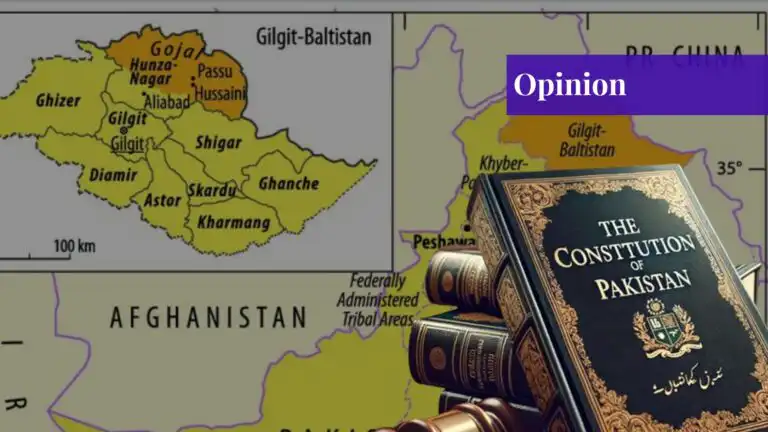
The current ongoing hullaballoo in the political landscape of Pakistan regarding the proposed 26th amendment entails meticulous handling as it will have irrevocable implications in the future if passed. Some notable proposals are the much-controversial judicial-related amendments like the Chief Justice tenure, the forming of the Federal Constitutional Court (FCC), and the appointment of judges to this very court. An increase in the Balochistan Assembly seats from 65 to 81 and other amendments of diminutive importance are also embedded in the proposals. A concern that arises is whether GB is being neglected yet again in the amended constitution, as is the way of history.
The amendments are more or less related to the judiciary and its judges. Still, the government is using this opportunity to amend many other articles and has, therefore, come up with more than 50 proposals to the constitution.
Although it is apparent from the façade that the government is in some haste in the amendment process, it was not visible before the 12 July ruling of the Supreme Court in favor of PTI regarding the reserved seat plea of the Sunni Ittehad Council (SIC). However, the application of the ruling is yet to come. Once the seat goes in favor of PTI, the structure of the assembly and its number game will surely be affected.
In such a posthaste situation, the government did not find time to entertain other major issues, namely addressing the issues of Balochistan and Gilgit-Baltistan (GB). Leaving Balochistan for some other day, we will discuss the much-talked-about constitutional status of the administered territory of GB.
The status of GB has been in abeyance since its annexation to the region. Successive governments have tried to assimilate the region into Pakistan in the past seven decades, but none could bring about a robust constitutional package—enough to get the region out of this limbo.
Unlike other princely states, Gilgit Baltistan was freed by its fighters in 1948, forcing the Dogra Army to leave the territory. Later on, the region voluntarily annexed itself to Pakistan and remained under the control of the federally administered tribal area. Till 1949, the area was ruled by bureaucracy, which enforced the stringent Frontier Crimes Regulations (FCR) to administer the region.
In 1949, the Federal Government and the Kashmir Government signed the notorious Karachi Agreement without involving the representatives of GB. This agreement gave the region to the Ministry of Kashmir Affairs and Gilgit Baltistan (KANA) in 1950. Since then, the region has been considered part of Kashmir and its fate has been inextricably linked to that of the disputed territory.
During the latter two decades of military regimes, no significant development was made except for the Chenab Formula being proposed in 1962 between India and Pakistan, which aimed to divide greater Kashmir using Chenab as the boundary. This formula was discussed for years but failed to bear fruition.
Then, to give representation to its people, the Northern Areas Advisory Council came into being in 1969. It was renamed in 1974 as the Northern Areas Council. In 1994, the Legal Framework Ordinance gave minimal legislative power to the local representatives. But all of these arrangements were ad-hoc in nature.
On 28 May 1999, the Supreme Court of Pakistan, in its landmark remark, declared the people of GB to be citizens of Pakistan for all practical purposes. It was only in 2009 that the then-government of PPP, at the federal level, introduced the Gilgit Baltistan Empowerment and Self-government Order, which gave the province a quasi-province-like structure. A 33-seated assembly was established, known as the GB Legislative Assembly, empowered to elect its chief minister. The region would have its own governor, election commission, and supreme appellate court, according to the order. Although this package tried to bring the region to parity with other provinces, it failed to placate the deeply rooted sense of deprivation.
To give the arduous constitutional journey a new turn, the much-sought-after CPEC project came to the show. China, being cognizant of the passage passing through GB, showed its reservation over the region’s status. To legalize it for China, in 2015, a committee headed by Sartaj Aziz was set up by the government. The committee submitted a 93-page constitutional report to the government. The report stipulated making GB a special province till there came a permanent resolution for the Kashmir issue. The report also suggested giving GB seats in the Senate and National Assembly after amending Articles 51 and 59 of the Constitution. In this report, it was also mentioned that all the legislative subjects be transferred to the province to bring it to par with other provinces. Gilgit Baltistan was to be given representation in NEC, NFC, and IRSA under this report. Although these recommendations could not be constitutionalized under the PMLN government, they led to the promulgation of the GB Order 2018. Later on, the Gilgit-Baltistan Supreme Appellate Court set aside the order and restored the earlier order of 2009.
However, in January 2019, the Supreme Court restored the order of 2018 by remarking that GB is an indispensable part of the Kashmir issue and will remain so till its resolution. This was in contrast to the decision in the Al-Jehad Trust Case of 1999 where the people of Gilgit Baltistan were citizens of Pakistan. This ruling by the seven judges headed by JCP Saqib Nisar was to appease India at the cost of the rights of GB. This notorious ruling has stalled constitutional progress.
All these historical anecdotes show the state’s relenting commitment to the matter. Successive governments have brought recommendations and packages, but have not been followed through with actions. In the last four years, no development has been made in this regard. This has led to the inculcation of a sense of deprivation in the hearts of the populace.
The current GB and federal governments have not bothered to look into the matter; otherwise, they would use the opportunity of the upcoming 26th amendment to constitutionalize the recommendations proposed by the Sartaj Aziz Committee in 2017. However, the government has remained focused on bringing changes to the judicature.
In short, it is foolhardy to wait till the resolution of the Kashmir issue, which seems impossible in the near future. Using this pretext to keep the people of GB deprived of their rights is ridiculous at a time when India is busy making IOK part and parcel of its state. Now, the onus is on the Government of Pakistan to deal with the matter. Sans giving constitutional status to GB, warding off the sense of deprivation from the hearts of the people of GB will remain a distant dream. It is high time the government paid heed to this matter seriously.
If you want to submit your articles, research papers, and book reviews, please check the Submissions page.
The views and opinions expressed in this article/paper are the author’s own and do not necessarily reflect the editorial position of Paradigm Shift.

He is from Skardu. He has recently graduated with a Bachelor's degree from the University of Punjab, majoring in Political Science.