
Introduction
Men and women, being the building blocks of society, play an equally important role in the thriving of human civilization. Keeping in view the equal importance of both, it is valid to claim that a balanced relationship between the two and gender parity in society is an essential component of social, political, and economic prosperity. The more a region respects the status of women, the more it is balanced and harmonious. The ground reality of the developing countries, however, presents a capsized picture where the social, political, and economic rights of the opposite gender are usually brushed aside. Being a developing country, Pakistan is unfortunately not an exception to this grim reality. In fact, the national and international indexes have put Pakistan in the lowest ebbs of gender-based rankings. For instance, the World Economic Forum’s Global Gender Gap Report 2025 ranks Pakistan 148th out of 148 countries in the world. This ranking is indeed alarming because it not only exposes the suppression of almost half of the country’s population, but it also reveals one of the key obstacles to the prosperity of the country. Hence, this injustice could be labelled as a social ailment.
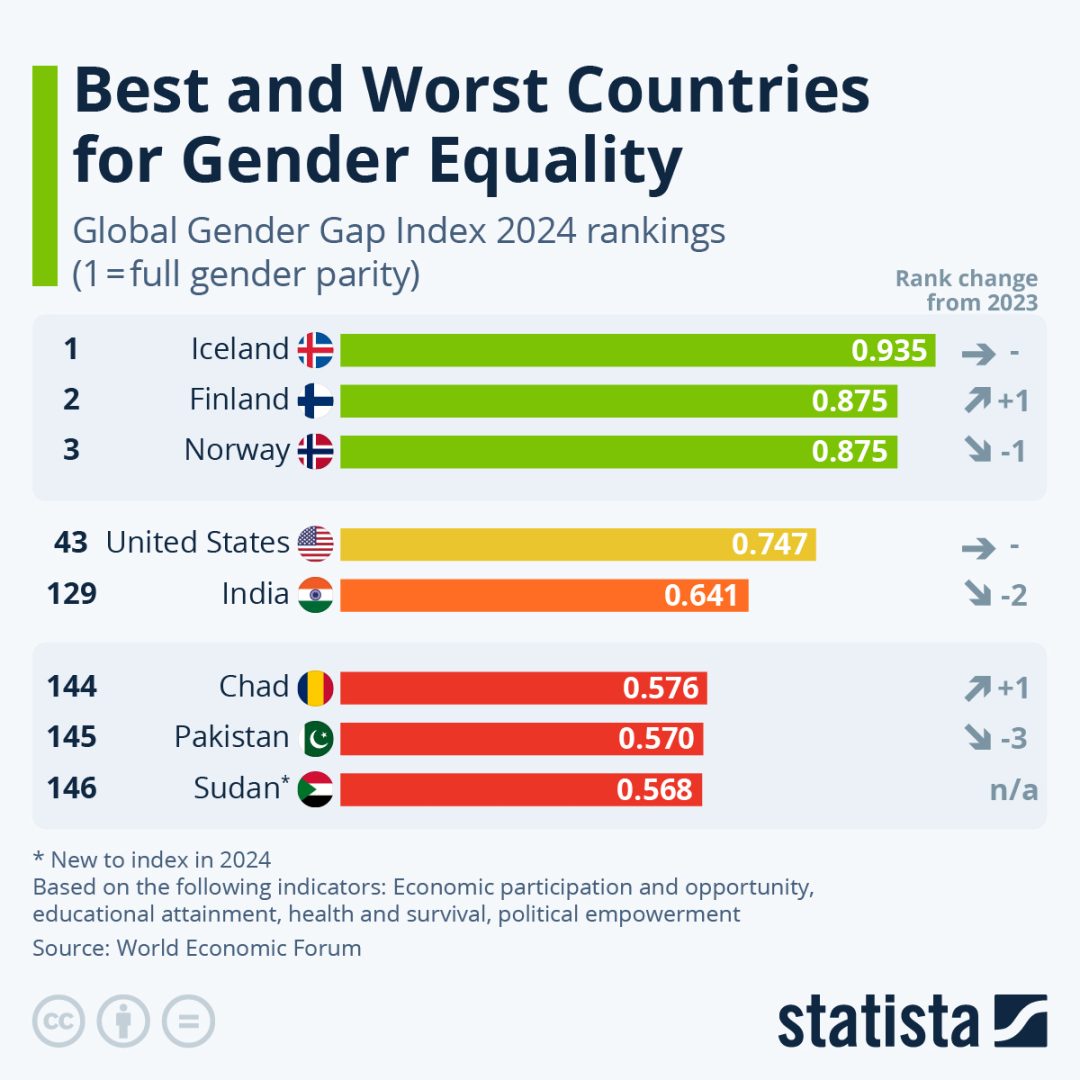
Best and Worst Countries for Gender Equality by Anna Fleck licensed by Statista under CC BY-ND
The causes of this ailment are diverse, with the patriarchal structures being the leading factor. In the same way, the prejudiced mentality, linguistic bias, irresponsible media representation, and lack of access to education add further layers of immunity to the social pathology. Consequently, the sickness manifests itself in the form of detrimental symptoms such as gender-based violence, economic stagnation, literacy deficit, political turmoil, and social chaos. Therefore, keeping in view the importance of women’s empowerment and the lethal impacts of gender disparity, it is crucial to pay solemn and sincere attention to the issue and formulate certain pragmatic policies in order to cure the malady. In this regard, linking the parameters of the National Finance Commission (NFC) Award with women’s empowerment is the need of the hour. Alongside, investing in women’s literacy through incentivised education, and encouraging women’s participation in the economic sector through flexible and women-friendly policies can substantially address the menace of gender inequality in the country. For this initiative, the implementation of the legal system, which has been codified in the 1973 constitution, is of utmost importance. Last but not least, the constructive utilization of media with respect to women’s empowerment can yield certain laudable outcomes, such as an enhancement in women’s participation and national awareness regarding the rights of women.
Causes of Gender Disparity
There are numerous factors responsible for gender disparity in the country. However, it would not be misleading to claim that the very root of the issue is the patriarchal social system, characterized by the dominance of male members in every sphere of society. Moving ahead, the patriarchal structures breed the subsequent factors responsible for gender discrimination, such as lack of access to education, restricted participation in the economic domains, prejudiced, misconstructed linguistic patterns, irresponsible media representation, and so on. These factors collectively reduce the role and competence of women to certain limited tasks, particularly domestic chores and reproduction.
Patriarchal Society: The Root Cause of Women’s Subjugation
Patriarchal society, which is characterized by the hegemony of male members over the social, political, and economic domains, is the leading cause of gender disparity. The men monopolizing the power corridors eventually cast aside the role of their female counterparts. Consequently, roles are divided based on gender, and a clear binarism is established between the two equally important building blocks of society. However, the binary is allocated unjust attributions in the form of stereotypical labels, and the importance of one is compromised by the over-importance of the other. Subsequently, the role of the male members is expanded to decision-making and power exercise, while the role of the females is limited to domestic chores and reproduction. Therefore, patriarchy, in all its forms, could be labelled as the very root of the injustice that substantially cherishes the subsequent causes of gender disparity. For example, the UN Women Pakistan’s 2023 report sums up that the Pakistani society is highly patriarchal and repressive, due to which the country is subjected to an incessant discrimination and violence against women.
Lack of Access to Education: A Catalysing Factor in Gender Discrimination
The deficit of literacy is another leading cause behind the gender gap. Despite Article 25 (A) of the 1973 constitution, the ratio of literacy in the country does not really present an encouraging picture. According to the UNICEF estimates, around 25.1 million Pakistani children are out of school, with the female children being more than half of the total assessments. Similarly, the Pakistan Bureau of Statistics’ (PBS) 2026 report reveals that the current literacy rate of Pakistan is around 63%, which in itself is not an encouraging figure, while the tragedy is further aggravated by the fact that there is a huge gap between male and female literacy in the country. As per the same report, the male literacy rate is 74% while the female literacy rate is just 55%. This gap is verily shocking because it clearly indicates that nearly half of the Pakistani women are illiterate. Now, this is concerning because the illiterate women, being unaware of their legal rights, cannot even resist the injustice done to them in any form. Consequently, child marriages are on the peak, particularly in the rural areas of the country.
Restricted Participation in the Economic Sector: A Triggering Element in Gender Disparity
Economic stability is believed to be the soul of individual and national prosperity as it directs the human capital of the country constructively, and ultimately leads to a laudable human development. Having said this, it is also imperative to mention the current economic profile of the country. Despite being a nuclear power, Pakistan is unfortunately the only country among the atomic states with less than half a trillion economy. The current GDP of Pakistan, as per the Economic Survey, is around $411 billion. It is, however, worth mentioning that out of the 49.28% female population of the country, only 22.8% women are engaged in the labour force. Regrettably, the International Labour Organization (ILO) 2025 reveals that this chunk receives comparatively 30% less wages per month than their male counterparts. Now, this disparity is again startling, because on the one hand, it discourages the participation of women in the economic field, and on the other hand, it further intensifies the financial dependency of women. As a result, an economically dependent woman cannot make independent decisions, whether that be about her personal life or social life.
Biased Linguistic Patterns: Dividing the Gender into Partial Binaries
Language, being the tool for social interaction and personal expression, plays a key role in shaping an individual’s and social behaviour. In patriarchal society, the language is often stereotypical and prejudiced, in which linguistic items for the male members are glamorized, whereas for female members, they are generally demonized. This practice has been in vogue for centuries. For instance, the icon of English literature, William Shakespeare, equates women with “frailty,” while the founder of modern political science, Niccolò Machiavelli, personifies “fortuna” with femininity, which could be captivated while being harsh, decisive, and aggressive.
The same patterns could be observed in almost every patriarchal language. For example, in the Urdu language, the woman’s identity i.e. bangles is analogized with weakness, as is often said, “main ne choorya nahe pehni” (i have not put on bangles), while in Pashto language, the women role is staunchly restricted to the four walls of the house, as it is usually said, “khazi la ya kor di ya gor di ”(for a woman, either home or grave). This is the reason that Pamela Fishman came up with the Linguistic Freedom theory, which posits that, due to the patriarchal society, women generally lack linguistic autonomy. Hence, language plays a key role in enshrining gender inequality with the help of numerous sexist linguistic items and structures.
Irresponsible Media Representation: A Triggering Component in Gender Inequality
It would not be an exaggeration to argue that the contemporary era is shaped by media, whether that be in the form of printed media or social media, but comparatively, the latter is a key influencing tool in the current times. Though the productive role of media in exposing gender-based discrimination cannot be denied, the implicit destructive role of media, particularly social media, also deserves a critical gaze. By delayering its negative face, it is evident that social media plays a notorious role in embedding women’s objectification. For instance, through advertisements such as Tapal Danedar tea or the Brite detergent, it is internalized that a woman is an integral member of the kitchen. Similarly, by promoting children’s products such as diapers, only through women, indirectly indicates that the sole purpose of a female is to look after the children. Moreover, the promotion of toxic Alpha male psyche through movies such as “Kabir Singh” and “Animal” is potentially disastrous for a sane and harmonious society. Such a representation through media deserves question marks because it either directly or indirectly shapes the mentality and behavior of the viewers in a biased manner.
Consequences of Gender Discrimination
Like a disease, gender discrimination manifests itself in the form of excruciating symptoms. Therefore, to label gender discrimination as one of the root causes of economic stagnation would not be merely a titanic claim. In the same way, gender discrimination paves a feasible way to gender-based violence, which, indeed, is one of the pressing issues of the motherland. Likewise, the ailment also leads to diplomatic doldrums and a literacy deficit. All in all, these symptoms haunt the country both in the short term and long-term consequences, and eventually exacerbate the miseries of the Pakistani citizens.
Economic Stagnation: A Direct Outcome of the Disease
As is obvious from the national and international calculations, the economic performance of the country is not up to the mark. Plenty of factors are indeed responsible for aggravating such derailment, but among them, gender disparity occupies the top hierarchy. Women make up almost half of the national population. However, with grave concern, only a negligible chunk of the total population is engaged in the economic sector. The International Labour Organization estimates that only 22.8% of the total female population is involved in the labour force. This is concerning because a large number of social members are not even performing in one of the very crucial sectors of the country. Again, the situation in the outskirts of the country is much more discouraging, where a female is allowed to labor in other houses but not in soft entrepreneurial ventures or even governmental services. This exclusion of women from the economic sector drastically perpetuates poverty, which, according to the Express Tribune, stands at 44.7% as of 2025. Hence, it would not be complex to draw a parallel between the economic fragility of the country and gender discrimination.
Gender Based Violence: An Immediate Impact of the Disparity
Defined by the United Nations, gender-based violence is any act of aggression against the opposite gender that results in physical or psychological harm. Further expanding the domain of GBV, the United Nations argues that the violence could either be in the form of direct aggression or structural violence. As per this definition, Pakistan presents an unwelcoming picture because both forms of violence are in constant practice in the country. According to the United Nations Population Fund (UNFP), 28% of women aged 15-49 have experienced physical violence, and 6% have experienced sexual violence. 34% of ever-married women have experienced spousal physical, sexual, or emotional violence in Pakistan. Similarly, the Human Rights Commission of Pakistan (HRCP) reported the cases of 405 femicides in 2024 alone, while the Smile Again Foundation claims that nearly 200 females face acid attacks per annum. This is indeed distressing because it not only depicts the pathetic conditions of women in the country, but also gives a solid justification to the external forces to capitalize on this unfortunate reality of Pakistan in their own favour.
Literacy Challenges: A By-product of Gender Discrimination
Nevertheless, Pakistan is endowed with around 63% youth of the total population under the age of 30, but instead of an asset, it remains a liability for the society because this huge chunk goes either illiterate or unskilled or even both. Further, the icing on the cake is that there is a substantial gap between male and female literacy. As has already been mentioned, the literacy of males stands at 70% while that of females is around 55% as per the Pakistan Bureau of Statistics (PBS) 2026. Undoubtedly, in the contemporary world, those societies can flourish that have the capabilities to cash in on the potential of their younger population, either in the form of skills or in the form of intellectual enlightenment. For instance, China, Japan, and Germany. However, in Pakistan, this opportunity unfortunately remains unexplored, in which the younger females are comparatively more sidelined. Thus, the result is obvious in the form of collective ignorance, petty crimes, hyper-impulsivity, and social, mental, political, and financial violence against women.
Diplomatic Doldrums: An Aftermath of the Disparity
A strong diplomatic engagement is an indicator of healthy relations in global politics. The health and strength of diplomacy is ensured by multiple factors such as economic stability, political maturity, gender parity, and human rights protection. The antonyms of all the aforementioned factors exist in the country, due to which the diplomatic leverage of Pakistan remains in the lower hierarchies as compared to the regional competitors. Among these factors, the scarcity of gender parity could be given a potential weightage, because in civilized states, this factor is given utmost importance. Those states where the role and responsibilities of women are restricted are looked down upon by the global community. Hence, there is a lack of this noble quality of gender equality; therefore, the diplomatic health of the country is also in limbo.
Cure of the Disease
With a sane mind, it could be claimed that gender discrimination in the world generally and the developing countries particularly is behaving like a deadly disease that has impaired the social, political, and economic potential of human civilization, and Pakistan is obviously not an exception. In fact, Pakistan is one of the key victims of the disorder, being constantly haunted by the infection in the form of femicides and other relevant heinous crimes. Therefore, a rational counter-approach needs to be in the form of a pragmatic treatment which comprises both preventive measures as well as a comprehensive therapy framework. Having said this, reshaping the parameters of the NFC Award, investing in national literacy, ensuring responsible utilization of media, and accumulating the models of the developed countries as per the national needs are of utmost importance.
Reshaping the Parameters of the NFC Award
The National Finance Commission, dealt under article 160 of the 1973 constitution, administers the distribution of the national divisible pool among the four provinces of Pakistan. As per Article 160 of the Constitution, 57.5% of net federal tax revenues are allocated to the provinces based on population ratio, revenue generation, backwardness, and inverse population density, while 42.5% is retained by the centre. In order to make the division productive and female-friendly, the state needs to add a parameter by earmarking a specific amount for women’s empowerment in the distribution. Through this way, the provinces will be encouraged to invest in women’s agency. Therefore, the disparity will be bridged to a remarkable extent.
Investing in National Literacy
As is frequently said, “education is the key to change” because it not only equips the younger generation for future challenges, but also reforms their individual and social psyche in a profound way. Once the women are equipped with education, they will be able to defend their social and legal rights. Therefore, it is imperative to uplift the educational standards of the country. In such upliftment, educational quality and equality, as has been ensured by Article 25(A) of the Constitution, need to be prioritized. This policy would be comparatively more productive for the rural areas where the early marriages of the female children are preferred, while their right to education is turned a deaf ear and a blind eye. To make this policy more outcome-oriented, the government needs to incentivize women’s education. Furthermore, the future generation, both male and female, equally need to be familiarized with digital literacy, which is going to shape the future. For this whole framework, however, the educational budget needs to be increased, which is currently just 0.8% of the total budget.
Ensuring a Responsible Use of Media
The media, without any doubt, is a leading tool in shaping and influencing the contemporary human society, which indeed is subject to both merits and demerits. Nevertheless, the constructive utilization of media can ensure significant and promising outcomes. For instance, Discover Pakistan is a social media platform that shares the stories of inspiring women on their social media outlets that boosts the confidence and motivation of the viewers. Therefore, such initiatives of social media need to be encouraged and expanded in order to yield maximum outcomes from the positive face of the opportunity. Similarly, through social media, the traditional notions and binaries, which assign certain stereotypical and misinformed notions to the identity of women, could be potentially countered. Last but not least, social media could be used as a feasible platform for raising national and international awareness regarding the rights of women.
Adopting the Examples of Other Countries
As argued by the modernization theory, gender parity and women’s empowerment could be ensured through economic stability and industrialization because with such transformation, the traditional gender roles are waived, and women are allowed to participate in the economic sector of the country, which subsequently expands their choices in other spheres as well. This model is in vogue in almost all the developed and, to some extent, the developing countries. For instance, the western countries, as well as some of the eastern countries like India and Bangladesh. Interestingly, the Indian government is now promoting the slogan of “Beti Parhao, Beti Bachao” (Educate the Daughter, Save the Daughter), which is verily a laudable step with respect to women’s empowerment. Similarly, Bangladesh uplifted the status of women by encouraging women’s entrepreneurship through feasible loans. In the same way, Community Policing, adopted by the developed countries, which is relatively a new model in criminology, needs to be incorporated in Pakistan to address gender-based violence, domestic violence, and other heinous crimes, such as femicide and acid attacks. In addition, the integration of digital tools in preventing gender-based crimes can also facilitate positive outcomes, as the Zainab Alert Response and Recovery Act (ZARRA) app has been implemented by Pakistan on the framework of the US Amber Alert- America’s Missing: Broadcast Emergency Response.
Implementing the Constitutional Rights of Women
The 1973 constitution of Pakistan has vividly codified the rights of women through multiple articles. For instance, Article 25 of the Constitution ensures equality of all citizens before the law and the prevention of discrimination based on sex. Article 25 (A) declares free and compulsory education as the fundamental right of all children of the country. Similarly, Article 32 ensures the participation of women in the local political system of the country. Likewise, article 34 claims equal participation of women in all spheres of national life, while article 35 guarantees the protection of marriage, mother, and child. These are some of the articles that proclaim the equality and special protection of women. If these articles are implemented sincerely, multiple issues could be resolved substantially.
Conclusion
To wrap up, gender disparity is one of the key ills that has disrupted the social, political, and economic fabric of Pakistan. Like an ailment, the evil has multi-fold risk factors, ranging from the patriarchal structure of the country and expanding to a substantial level of illiteracy, negligible performance in the economic sector, lower representation in the political system, stereotypical linguistic forms, and irresponsible media depiction. Consequently, the disease makes itself conspicuous in the form of social disruption, characterized by femicides, domestic clashes, and gender-based violence, and poor economic participation marked by the exclusion of a large number of individuals from the economic sector.
Similarly, this social evil also leads to poor educational status, a degraded international image, and weak diplomatic standing. However, as Mohsin Hamid puts it, “the pessimists may be right, but we have reasons for optimism too”; therefore, if society paid serious attention to the issue, it could be substantially addressed. In this regard, reshaping the parameters of the NFC Award, investing in national literacy, and ensuring responsible and constructive use of media can prove fruitful. Last but not least, implementing the legal obligations of the constitution in letter and spirit, and adopting the developmental models of other countries, can ensure a significant social balance and gender harmony in the country.
If you want to submit your articles and/or research papers, please visit the Submissions page.
To stay updated with the latest jobs, CSS news, internships, scholarships, and current affairs articles, join our Community Forum!
The views and opinions expressed in this article/paper are the author’s own and do not necessarily reflect the editorial position of Paradigm Shift.

Mr. Yaseen Khan, is the graduate of National University of Modern Languages (Peshawar) in English Literature and Linguistics. He is keenly interested in exploring and writing on social issues and global affairs.