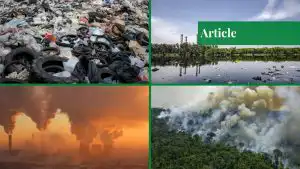
Pakistan’s struggle against pollution is closely linked to its political landscape, where challenges in governance, industrial lobbying, and institutional fragmentation significantly influence ecological outcomes. This paper explores how political dynamics shape the adoption of emerging chemical innovations such as nanotechnology for heavy metals removal, green chemistry in textiles, and bioremediation techniques in agriculture to reduce pollutant levels. By critically analyzing case studies ranging from Lahore’s smog crisis to Kasur’s tanneries, the present study highlights how electoral agendas, federal-provincial tensions, and corruption can obstruct or facilitate progress. Recommendations underscore the need for institutional reforms, stronger anti-corruption measures, and mobilizing political will to align chemical advancements with Pakistan’s environmental and socio-economic goals.
Introduction
Environmental degradation in Pakistan is a scientific and political challenge. The air quality index ranks Pakistan among the world’s worst countries facing a pollution crisis, and the condition is getting more bitter because of weak governance, industrial lobbying, and fragmentation in federal-provincial environmental policies. A gardener from Lahore named Safdar Masiha commented, “The air feels thick, and it is exhausting just to breathe.” Several local start-ups, such as Greener Pakistan, have also contributed to reducing air pollution by developing low-cost and environment-friendly vanadium-based catalysts for brick kilns and succeeded in cutting carbon monoxide emissions by almost 65%. However, its adoption is slow due to insufficient subsidies and higher upfront costs.

You will find more infographics at Statista
Almost 60% of the population of Pakistan is exposed to unclean drinking water. Industrial effluents rich in heavy metals, such as vanadium, from tanneries in Kasur, agricultural runoff filled with insecticides, especially in Sindh, and emissions from vehicles in Pakistan’s big cities exacerbate ecosystem degradation.
“Green chemistry is not just a mere catchphrase: it is the key to the survival of mankind.”
Nobel Laureate in Chemistry, Ryoji Noyori.
The implications of Green Chemistry solve several local challenges. For instance, the elimination of chromium discharge and a 40% reduction in water usage at Faisalabad Textile Mills by using microbial cellulases in enzyme-based dyeing techniques (Chatha, 2017). However, the enforcement remains weak despite the National Environmental Quality Standards.

You will find more infographics at Statista
Similarly, a pilot project was started in Lahore to tackle water contamination using nanotechnology. For this, magnetic nanoparticles and nanotubes were developed, which adsorbed 98% of arsenic at a very low cost from groundwater. Meanwhile, scaling challenges faced by this nanotechnology pollution-free project include limited funding and public distrust that hinder its deployment (Dawn, 2022).
The toxicity of soil is common in Punjab, and its leading cause is the overuse of pesticides. 70% of national pesticides are used in Cotton farms in Punjab. In order to restore agricultural lands, bioremediation is employed where a fungus, Aspergillus niger, was used to degrade the most harmful endosulfan residues in field trials by 90%. This technique has been employed in Multan, where absorption of cancer-causing heavy metals, cadmium and lead, is brought about by sunflower-based phytoremediation (Ali, 2013).
This article explores how the intersection of political structures and power dynamics with chemical innovations is shaping the implementation and efficacy of these innovations in mitigating pollutants. To reduce the levels of pollutants in Pakistan, chemical innovations are being tailored with a strong emphasis on cost-effective, flexible strategies for an economically weak nation.
The Political Economy of Environmental Degradation
The pollution crisis in Pakistan cannot be separated from the broader political and economic systems that shape environmental decisions. The industrial sector is considered an engine of economic growth, and it exerts considerable pressure on policymaking processes, thus influencing the design and enforcement of environmental regulations. In some cases, governments struggle to balance economic development with ecological conservation, leading to unstable policy frameworks or weak implementation of environmental laws.
This dynamic often enables industries to continue their harmful practices without significant repercussions. Consequently, pollution transcends not merely as an environmental issue but also as a reflection of deeper structural flaws within governance and economic objectives. Some of the most prominent governance issues that need special attention to tackle the problem of the pollution crisis through the implementation of chemical innovations are as follows:
Federal-Provincial Tensions
Longstanding tensions in Federal-provincial relations, rooted in power imbalances and resource allocation, significantly exacerbate environmental degradation by hindering cohesive policy implementation, equitable resource distribution, and intergovernmental coordination. The inconsistency in the enforcement of the National Environmental Quality Standards (NEQS) can be attributed to Pakistan’s 18th Amendment, which devolved environmental oversight to provinces. The 18th Constitutional Amendment devolved the power of industrial policymaking to provinces, but federal oversight remains in sectors like energy and taxation. This duality is one of the reasons for many conflicts.
Chemical companies must wait longer to get a response from federal energy regulating agencies like NEPRA and the National Tariff Commission on disputes regarding tariff protections for local manufacturers. For instance, Pakistan’s Environmental Protection Agency (EPA) struggles to regulate effluents from the textile industry in Faisalabad owing to the political pressure that aims to protect the export industry worth 20 billion dollars (PCMA, 2022).
Industrial Lobbying
Industrial lobbying in Pakistan significantly hinders chemical innovation by distorting regulatory frameworks, prioritizing short-term corporate interests over long-term research and development (R&D), and perpetuating systemic inefficiencies. The strong agricultural lobby in Sindh has severely affected pesticide regulations, leading to greater economic risks to cotton farmers. This regulatory blockage delays the adoption of the most effective mycoremediation solutions for pesticide-laden soils.
In 2017, lobbying by a PML-N parliamentarian resulted in a 5% reduction in customs duties on phthalic anhydride imports used in the plastics industry. This undercut local manufacturer Nimir Chemicals, the only manufacturer in the industry working locally (Tribune, 2017), and caused significant financial losses.
In the same context, it was recently reported that despite Supreme Court orders regarding the relocation of polluting tanneries in Kasur, the political will of local leaders has stalled compliance, and chromium contamination in groundwater continues to perpetuate (Dawn, 2021).
Policy Paralysis in the Age of Green Chemistry
Despite significant advances in laboratory innovation and educational reform, translating green chemistry principles into effective policy often stalls due to policy paralysis, where legislative and regulatory progress is hampered by political polarization, bureaucratic inertia, and competing stakeholder interests. This adaptability to prioritize economic or political motives over genuine greener sustainability can dilute original goodwill for environmental health.
It was presented in the NAB report that while enzyme-based dyeing reduces water use by 40%, its adoption is limited by Punjab’s reluctance to enforce NEQS, cautious of industrial backlash as elections approach (NAB, 2023).
Tax incentives are also being used as political tools against chemical manufacturers. The federal government’s 2023 tax breaks for industries adopting solvent-free processes were diluted after lobbying by chemical manufacturers reliant on traditional, polluting methods (Ministry of Finance, 2023).
Public Trust and Political Agendas in Nanotechnology Investment
Nanotechnology research is gaining more momentum these days and providing benefits in fields of agriculture, environment, health, and industry, with government-aided projects such as the National Center for Nanoscience and Nanotechnology (NCNN), which aims to manufacture good-quality nanomaterials locally. Funding opportunities from bodies like the Pakistan Science Foundation further support innovation and commercialization in nanotechnology, strongly emphasizing import substitution and economic development.
However, politics’ involvement in funding is causing hurdles in implementing these innovations. A 2022 pilot using iron oxide nanoparticles for arsenic removal in Lahore faced funding cuts after a cabinet reshuffle diverted resources to populist infrastructure projects (Safdar, 2024).
Misinformation in media campaigns also aggravates the issue. For instance, Opposition politicians in Khyber Pakhtunkhwa labeled nanotechnology a “Western experiment.” These types of statements prevent the community from accepting these new innovations. The negative outcomes of the interrelationship between technology and Pakistan’s political culture have become more evident in recent years (Zain, 2024).
Bioremediation and Electoral Cycles
In Pakistan, bioremediation initiatives face challenges linked to electoral cycles, as shifting political priorities and funding decisions often interrupt long-term environmental projects. While bioremediation technologies demonstrate high efficacy, their scalability relies on consistent policy support and sustained investment, which often fluctuates with changes in administration, as was evident in a project granted to the University of Punjab, Lahore. Under the Pakistan–USA collaboration program, USAID awarded $2,37,460, but the project continued even after the grant ended, and its summaries are pending (National Academies of Sciences, 2025).
The Ministry of Climate Change advocates bioremediation as an economical solution for soil and water pollution. However, implementation faces a delay due to competing electoral agendas that favor short-term infrastructure programs or welfare initiatives over ecological sustainability.
National programs, such as the Pakistan Green Taxonomy and the National Agriculture Biotech Policy, aim to standardize eco-friendly practices. However, their progress relies on a bipartisan commitment, which often remains vulnerable to political transitions. At the same time, the short-term nature of agricultural policies is badly affecting the implementation of several chemical innovations. Mycoremediation trials in Punjab’s cotton belt were deprioritized before the 2023 elections, as incumbents focused on subsidizing chemical fertilizers to secure votes in rural areas (Election Commission Report, 2023).
Populism Chokes Air Quality Reforms
In Pakistan, air quality management has become a battleground between populist impulses and scientifically grounded policy reforms. The approval of the National Clean Air Policy (NCAP) in March 2023 and the Punjab Clean Air Plan (PbCAP) in April signaled important acknowledgment of the country’s air pollution crisis. However, both policies favor short-term public appeasement over comprehensive, long-term solutions.
Populist pressures have led to relaxed air quality standards, such as proposing to increase PM2.5 limits to 75 μg/m³ for 24 hours, which is far above the guidelines provided by the WHO. This reflects a willingness to compromise on environmental targets for political expediency rather than implementing tough emission controls that might face public or industrial pushback (CREA report, 2023).

You will find more infographics at Statista
Similarly, the Lahore High Court’s 2021 directive requiring emission controls for industries faced pushback from ruling-party-aligned business elites, highlighting the judiciary’s limited enforcement power (LHC Order No. 45/2021).
Corruption and Institutional Overlaps
The diversion of funds intended for environmental programs into private hands through corruption involving embezzlement and bribery undermines the implementation and enforcement of environmental regulations. The lack of accountability due to corruption allows the exploitation of ecological resources.
Bureaucratic Rent-Seeking is a widespread practice in Pakistan. Audits revealed that 30% of the Clean Drinking Water Initiative funds were mismanaged by local officials, which has significantly impacted nanoparticle-based filtration projects (NAB Report, 2023).
The efforts of various environmental institutions are often duplicated. For instance, the overlapping mandates between the federal Climate Change Ministry and provincial Environmental Protection Agencies (EPAs) have delayed approvals for green chemistry projects, such as Engro’s zero-liquid discharge system (UNDP, 2022).
Recommendations
Since the implications of chemical innovations are significant in helping to reduce environmental degradation due to climate change and industrial progress, some strategies should be employed to overcome hindrances and maximize their benefits. The Government of Pakistan is trying hard to improve the situation. Recently, on April 22, 2025, the Pakistan Innovation and Technology Expo was organized by the Punjab Higher Education Commission (PHEC) in Lahore, highlighting the government’s efforts to improve research standards in Pakistan. Several universities have presented their work in the fields of science and technology, and promising models for solving issues such as smog and those arising from climate change have been accepted by PHEC. Rana Sikandar Hayat, the government spokesperson, announced that funding of 10 crores will be allocated to universities to scale up their tech innovation models and make them applicable in the country.
However, some recommendations are needed to improve the implications of Green Chemistry further. First, we need to strengthen political and institutional reforms. Reforms that broaden public involvement and enhance democratic freedom can positively increase the performance of institutions. To enhance environmental regulations, political transparency, accountability, and government capacity need to be monitored.
Secondly, the role of special interest groups in these matters should be limited. Greenwashing and political capture can be reduced by introducing a robust set of rules on government bodies’ access to Lobbyists.
Thirdly, political parties can play a significant role in mediating the public’s environmental preferences. They should be encouraged to compete on climate action platforms and hold the government accountable.
Fourthly, promoting environmental democracy and protecting press freedom are crucial to raising public awareness and supporting open government initiatives, which help develop trust among state institutions.
Lastly, integrating environmentally sustainable practices in electoral processes, such as election campaigns, can prove fruitful in fostering a greener political culture.
Conclusion
The potential of Chemistry for Pakistan’s environmental recovery is transformative. Breakthroughs are promised by emerging fields such as carbohydrate-based ionic liquids, electrocatalytic carbon dioxide conversions, and AI-driven processes that channelize catalytic efficiency. Still, success relies on the effective employment of these innovations through equitable policy enforcement and enhanced international collaboration. Structural reforms and political will are critical to resolving Pakistan’s pollution crisis.
Pakistan can harness innovations like bioremediation and nanotechnology to build a greener, more sustainable future by addressing institutional fragmentation, short-termism in electoral processes, and corruption issues. The green future demands collaboration among scientists, policymakers, and civil society to manage the fraught relationship between chemistry and political dynamics effectively.
If you want to submit your articles and/or research papers, please visit the Submissions page.
To stay updated with the latest jobs, CSS news, internships, scholarships, and current affairs articles, join our Community Forum!
The views and opinions expressed in this article/paper are the author’s own and do not necessarily reflect the editorial position of Paradigm Shift.

Qandeel Fatima is a Lecturer of Chemistry at the University of Mianwali. Alongside her dedication to teaching and research, she remains deeply engaged with Pakistan's socio-political landscape and global dynamics, believing that scientific thinking must inform public policy for meaningful national progress. As a committed aspirant of CSS and PMS, she aims to combine her scientific knowledge with public service.