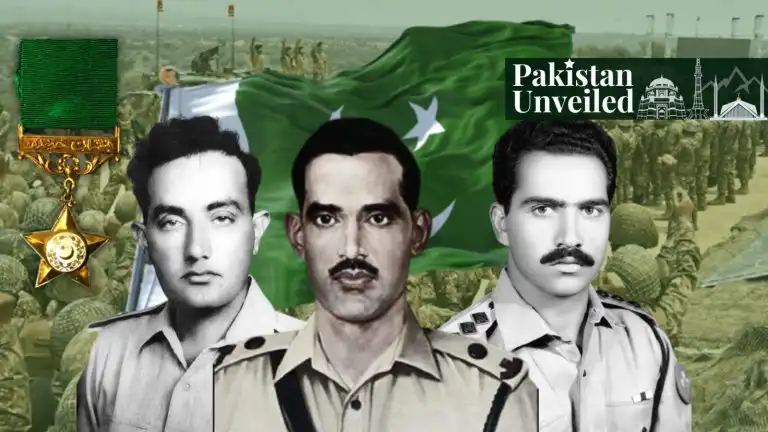
Pakistan’s Nishan-e-Haider has been awarded eleven times since independence in 1947. Eleven. Across eight decades, two generations of wars, and hundreds of thousands of soldiers who served and fell, the nation’s highest military honour has gone to eleven men. Three of them came from the same district.
Not from military posts, nor from a town with a tradition of breeding military commanders. Not from a large city, but from Gujrat, a town located where the Chenab River meets the northern border of Punjab in Pakistan. To most people throughout Pakistan, Gujrat is synonymous with producing fans and furniture; however, the area also has a substantial diaspora. The streets within the town will contain names that almost no one outside of Gujrat has ever looked at, and there are three sample villages within Gujrat (Ladian, Dinga and Kunjah) that quietly proseveralber of soldiers who died defending places they shouldn’t have; at the same time, they survived in circumstances that they shouldn’t have survived in.
Major Raja Aziz Bhatti, Major Muhammad Akram, and Major Shabbir Sharif, three men, three wars, one district. The story of what each of them did and what it cost them.
The Award That Is Never Given Lightly
The-Nishan-i-Haider, Emblem of the Lion, is the highest military honour Pakistan gives. Nothing else, military or civil, comes above it. The name comes from Hazrat Ali, the fourth Caliph of Islam, remembered in Islamic tradition as its greatest warrior. In that sense, it sits alongside the British Victoria Cross or the American Medal of Honor, though Pakistan has handed it out far more sparingly, eleven times, against the VC’s 1,358 and the Medal of Honor’s 3,515.
There is one aspect of the award that sets it apart from almost any comparable honour in the world: it has only ever been awarded posthumously. Every single recipient paid for it with his life. The medal itself is forged from captured enemy equipment, 88 percent copper, 10 percent gold, and 2 percent zinc, and the recipient’s name, rank, regiment, and date of award are inscribed on the back. It is handed to a family. Never to the soldier himself.
Pakistan’s military has a simple, stark position on why this is so. When the Chief of Army Staff was once asked why the award was never given to a living recipient, his reported answer was that if it were awarded to a living person, that person might one day act dishonourably and disgrace the award. The Nishan-e-Haider’s integrity, in this view, depends on the certainty that the recipient’s record is closed. The only way to guarantee that is death. Three of those eleven closed records belong to men from Gujrat.
Major Raja Aziz Bhatti Shaheed: The Guardian of Lahore
Major Raja Aziz Bhatti was born in Hong Kong in 1928. His father was stationed there at the time, though the family itself was from Ladian, a small village in the Kharian tehsil of Gujrat district. He was back in the subcontinent before Partition happened, and eventually found his way into the Pakistan Army in 1950, commissioned into the 17th Punjab Regiment. He was, by all accounts, one of the more outstanding officers of his generation: the first person to complete the PMA long course and receive both the Norman Medal and the Sword of Honour, as documented by the District Gujrat government.
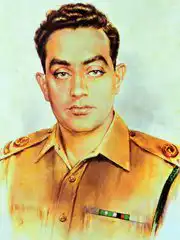
In September 1965, India launched a major armoured offensive in the Lahore sector. The objective was to cut the GT Road and isolate the city. Major Bhatti’s company was positioned at Burki, on the outskirts of Lahore, directly in the path of the Indian advance. What followed was six days and five nights of continuous combat with his company, heavily outnumbered, absorbing attack after attack from Indian armour and infantry while holding the BRB Canal line.
Bhatti maintained his position over the course of the six days; he continually moved around to different areas of his troops, reorganising his troops between attacks, controlling where the artillery was firing, and observing the enemy on every move, and that’s how he was martyred. On September 10, 1965, Bhatti rose up from his position so he could observe the Indian positions he would need to see, so he would know to call in artillery fire to the right locations. Bhatti’s sergeant allegedly told him to take cover, but he did not do that. He was hit by a round from a tank in his chest and died at the age of 37. He is buried not in a military cemetery, but in the courtyard of his family home in Ladian, Gujrat, the village he left as a boy and returned to only upon his death.
Burki did not lose contact with Lahore, and the Indian offensive at Burki was also stopped. In 1966, the Government of Pakistan awarded the Nishan-e-Haider, the highest military award, to Bhatti, and an annual honor guard is mounted at his grave on Defense Day. The road to his village in Gujrat and the roundabout and housing association in Lahore have been named in his honor. He has been regarded as one of the most decorated military officers in Pakistan’s history due to his commitment to helping others and ultimately sacrificing himself to do so, rather than his status as a military officer in the years following 1965; therefore, Bhatti now holds the title of most celebrated military officer in Pakistani history.
Major Muhammad Akram Shaheed: The Hero of Hilli
Major Muhammad Akram was born on 4 April 1983 in Dinga, a town where military service wasn’t unusual, and his family was no exception. His father had done his years in the British Indian Army, retiring as a Havildar. Akram followed the same path, graduating from the Pakistan Military Academy in 1963 and getting his commission in the 4th Frontier Force Regiment. The 1965 war put him in the Lahore sector as a Captain, where he led several operations through some of the hardest fighting of that conflict. He was made a Major before 1971, and when that war came, he was on the eastern front with a company under his command.
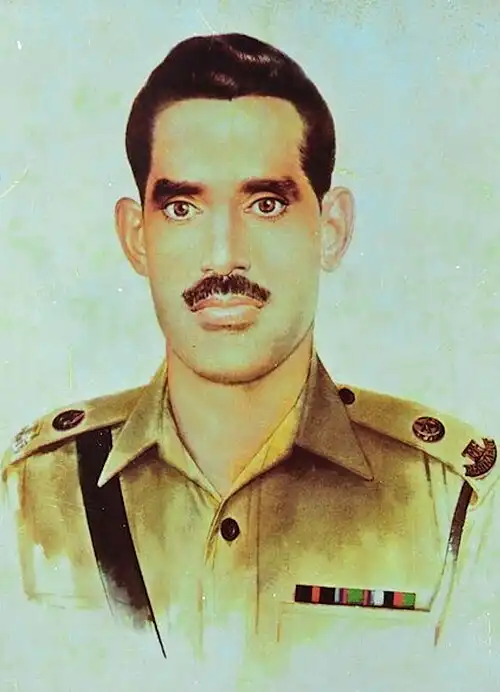
The Battle of Hilli, fought in the Dinajpur district of what was then East Pakistan, is not as widely remembered in Pakistan as the western front battles of 1971. It should be. Akram’s company, positioned at the Hilli forward area, came under continuous and coordinated Indian attack air strikes, artillery, and armour, wave after wave, for a fortnight. The Indian force was vastly superior in both numbers and firepower. For fourteen days and nights, Akram and his men held out.
On the night of 5-6 December 1971, Akram led an anti-tank party forward, crawling toward the enemy position under fire and personally directed the destruction of three Indian tanks. During that action, he was struck by machine-gun fire in the chest and killed. He was 33 years old. The Indian forces could not capture Hilli while Akram’s unit held it, and even after his death, the position was not given up until his regiment received orders to withdraw.
Indian Commander-in-Chief General Jagjit Singh Arora later acknowledged the fierce resistance his forces had encountered at Hilli, an unusual recognition from an opposing commander, and a measure of what Akram and his men had actually done. Akram is buried in the village of Boaldar in the Dinajpur district of Bangladesh, far from Dinga, far from Gujrat, far from the family that waited for him. His martyrdom anniversary is observed every 5 December. Pakistan Army’s top leadership attends. The village in Gujrat where he was born holds its own ceremonies.
There is a memorial to him in Jhelum city as well, because his family roots were also there. But Dinga claims him. Gujrat claims him. The boy from a small city who held Hilli for fourteen days.
Major Shabbir Sharif Shaheed
Major Shabbir Sharif was born on 28 April 1943 in Kunjah, a small town in Gujrat district. His family had a military background. He did his O Levels at St. Anthony’s High School in Lahore, then went to Government College, where the call from the Pakistan Military Academy at Kakul came before he’d finished. He left for Kakul, commissioned on 19 April 1964 into the 6th Frontier Force Regiment, and walked out with the Sword of Honour.
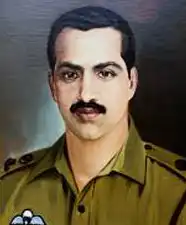
The 1965 war was personal for him in a way it wasn’t for most; his uncle, Major Raja Aziz Bhatti, was killed in that same conflict. Shabbir Sharif was a subaltern then, and whatever he did in those weeks earned him the Sitara-e-Jurat. Six years on, he was a Major with 6 FF Regiment, his company positioned near the Sulemanki headworks on the western front, and he was already probably the most decorated field officer of his rank in the army. That war is where he won the Nishan-e-Haider.
On 3 December 1971, his commanding officer ordered him to take the high ground overlooking Gurmukh Khera and Beriwala in the Sulemanki sector. Defending it was a company of the Indian Assam Regiment with a squadron of tanks behind them. What Sharif did over the next three days and nights is genuinely hard to write down without it reading like fiction. He took his men through a minefield, through heavy obstacles, knocked out four enemy tanks, killed forty-three soldiers, and kept two full enemy battalions from breaking through a force that outnumbered and outgunned his company by a distance that should have made the outcome obvious.
On the afternoon of 6 December 1971, a gunner on an anti-tank gun went down wounded mid-assault. Sharif stepped in and took over the gun himself. A direct hit killed him. He was 28. He carried two decorations, the Sitara-e-Jurat he won in 1965, and the Nishan-e-Haider from this war. Between them, no soldier in Pakistani history has collected what Shabbir Sharif Shaheed collected.
What Gujrat Gave, and What Was Taken
It is worth sitting with the geography for a moment. Ladian, Dinga, and Kunjah are not far from each other. All three sit within Gujrat district, a stretch of Punjab that is roughly 120 kilometres north of Lahore on the GT Road. The district is known, in economic terms, for manufacturing electric fans, furniture, and surgical instruments. Its diaspora is substantial: over 300,000 people from Gujrat live abroad and send back more than three billion rupees a year in remittances. Sir Syed Ahmad Khan, who knew this region, called it Khitta-e-Yunan, the Greece of the subcontinent, for the quality of its people.
None of that fully explains why three of the eleven Nishan-e-Haider recipients came from here. Punjab has a long military tradition, and the regiments that recruited from this belt, the Punjab Regiment and the Frontier Force, drew heavily from the same communities for generations. The families involved had military fathers and military uncles. Bhatti’s family had a military background. Akram’s father was a Havildar. Shabbir’s family produced both a martyr and an army chief. The culture of military service ran deep, and in that culture, the highest form of service was the one that did not come home.
What Gujrat gave in those two wars was three young men, none older than 37, one as young as 28, who died holding positions under conditions that most soldiers would not have survived, let alone continued to fight in. What was taken from Gujrat was three families that received medals instead of their sons. Graves that families visit instead of kitchens that brothers come home to. The district commemorates them. Schools are named for them. The Punjab Government maintains its records. Every 6th September, guards of honour appear at Bhatti’s grave in Ladian. Every 5 December, the army observes Akram’s anniversary. Shabbir Sharif’s name appears on the buildings of a district that has not been forgotten.
What Three Names From One District Tell Us
The Nishan-e-Haider is not just a military award. It is a record of the moments when Pakistan found itself at the edge of what it could defend, and someone stepped forward anyway. Of the eleven men on that list, three were from the same stretch of land along the Chenab. That is not a coincidence born of statistics. It is the result of families, communities, and a culture that produced soldiers who understood, in the most concrete possible way, what it meant to hold a line.
Major Raja Aziz Bhatti stood up to watch the enemy when his sergeant told him to take cover, because he needed to see clearly to protect Lahore. Major Muhammad Akram crawled forward in the dark with an anti-tank party in the middle of a fortnight-long siege because three more Indian tanks needed to be stopped. Major Shabbir Sharif picked up a dead gunner’s anti-tank weapon in the middle of an assault and kept firing because there was nobody else to do it.
They were not superhuman. They were men from small towns in Gujrat who had trained for war, understood what war required, and did not step back when the moment came. The country gave them its highest honour. Their families received medals and graves. Gujrat kept their names.
Pakistan has been asking, in various ways and for various decades, what kind of country it wants to be. The answer to that question is long, complicated, and contested. But somewhere in it, without much controversy, is the recognition that three men from Ladian, Dinga, and Kunjah set a standard that has not been matched not because no soldier has been brave since 1971, but because this particular combination of circumstance, leadership, and sacrifice only happens when everything aligns at once. It happened three times in Gujrat. The district earned its title.
If you want to submit your articles and/or research papers, please visit the Submissions page.
To stay updated with the latest jobs, CSS news, internships, scholarships, and current affairs articles, join our Community Forum!
The views and opinions expressed in this article/paper are the author’s own and do not necessarily reflect the editorial position of Paradigm Shift.

Kainat Farooq is a passionate International Relations student with a strong interest in diplomacy, policy, and global affairs. She is dedicated to contributing thoughtful analysis and research on international issues.