Introduction
When the economy of a nation collapses, terrorist groups become the most active bidders for human life. During its peak, ISIS deliberately targeted the vulnerable (unemployed and uneducated) sector in broken communities by providing stable incomes, marriage allowances, and other incentives for a better life. The void of regular jobs in the community was filled with the survival tactic of insurgency. One cannot nip the evil of ideology through military means if that ideology is helping the desperate people meet their ends. A terrorist attack does not set forth with the detonation of a bomb. It begins much earlier in the communities overshadowed by inequality and hopelessness. While the concept of terrorism is overwhelmed with the concept of security and military responses, its roots run much deeper in the socioeconomic context.
Socioeconomic Causes of Terrorism
Every extremist movement is rooted in the complex web of socio-economic grievances that acts as a base for the individuals targeted for radicalisation and extremism. Although religious affiliation and political association influence terrorism, socio-economic deprivation acts as a breeding ground for these narratives. Focusing on the elimination of terrorist groups without addressing the root causes will keep this cycle of violence unbroken.
Terrorism remains one of the most widely discussed issues of the 21st century. The Global Terrorism Index states that most of the terrorist-related deaths occur in the conflict-stricken and economically weakened states, with the Sahel region emerging as the world’s most terrorism-affected region. These figures speak volumes about the fact that terrorism is fuelled through hollow institutions and dwindling economic opportunities. Thabo Mbeki (former president of South Africa) highlighted this issue by saying:
“The fundamental source of conflict in the world today is the socioeconomic deprivation of billions of people across the globe, coexisting with islands of enormous wealth and prosperity within and among countries.”
Poverty as a Leading Cause
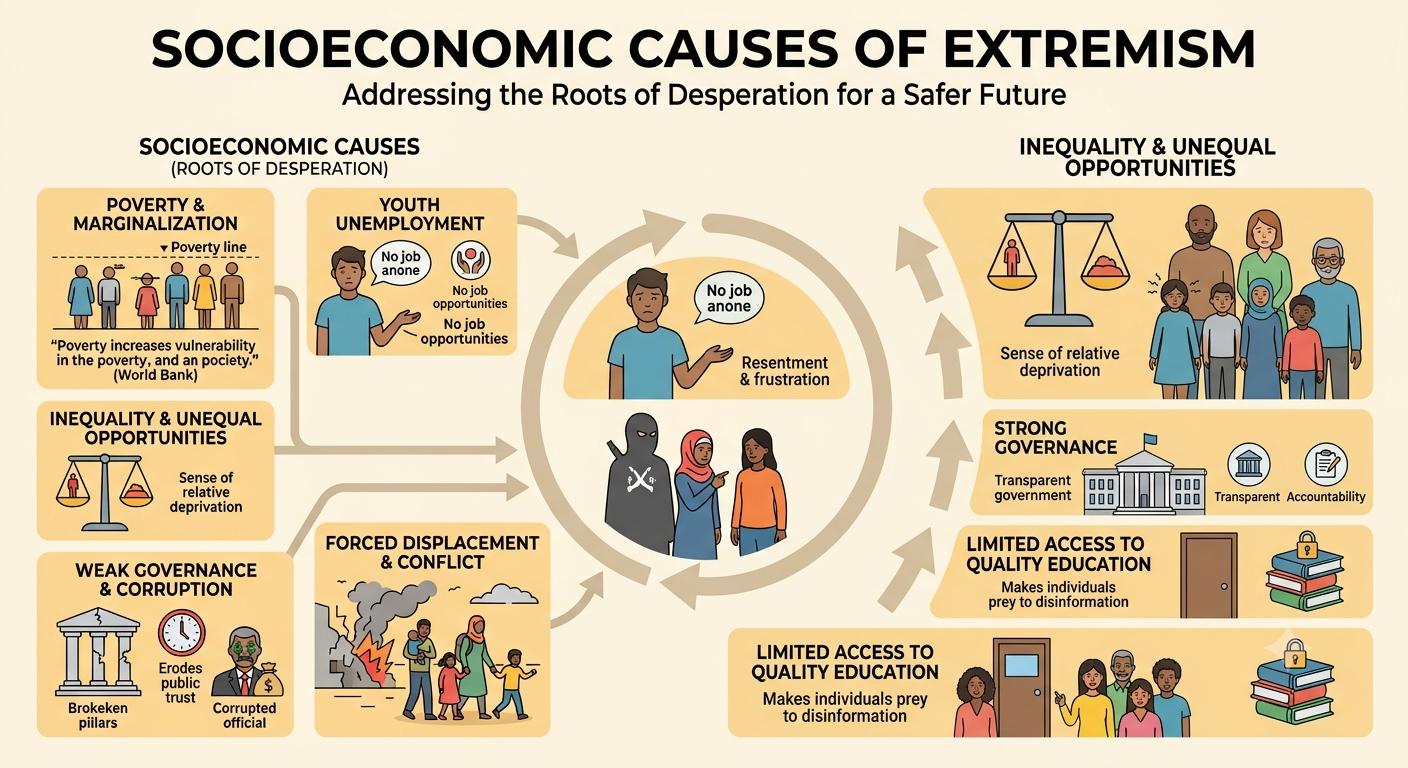
One cannot say that poverty is the ultimate cause; however, it increases vulnerability through deprivation and marginalisation. Statistics issued by the World Bank reveal that nearly 700 million people are below the poverty line, with a huge number of young people striving for better jobs and opportunities. Extremist organisations target these weaknesses and exploit the hopeless individuals by providing them with financial incentives and social inclusion. Persistent poverty not only takes away the source of income from individuals but also their dignity and hope. Communities suffering from poor infrastructure, inadequate health facilities, and unemployment become the base for extremist recruitment. For a youth trapped in a vicious cycle of inequality and injustice, terrorist organisations appear to offer what society has failed to provide: opportunities, purpose and recognition.
“Poverty does not make poor people into terrorists and murderers. Yet poverty, weak institutions, and corruption can make weak states vulnerable to terrorist networks…”
George W. Bush
Economic Marginalisation and Unemployment
The unfavourable conditions of poverty are further exacerbated by economic marginalisation and youth unemployment. Economic marginalisation provides a conducive environment for the extremists’ narratives to thrive and become more appealing. When legitimate pathways to success are crushed, the illegitimate pathways become more persuasive and attractive.
Youth unemployment is a situation of lost potential for a society, and this lost potential becomes a security threat for a country. Youth constitutes the base of a nation’s strength and responsibilities. If their energy is channelled in the proper direction, it can bring a sea of change in different sectors of a nation. On the contrary, millions of youth being uneducated and unemployed will pave the way for resentment and frustration.
According to UNESCO, hundreds of millions of people still lack access to quality education. Without promising opportunities, many begin to lose faith in the institutions and decide to rebel, becoming an easy target for extremist groups that provide financial stability along with purpose and status. Extremist organisations often recruit the unemployed youth because they are well aware of the vulnerabilities of youth searching for ultimate survival and hope. Addressing youth unemployment is therefore not merely an economic necessity; it is a long-term investment in national and global security.
Quality education acts as a strong shield against radicalisation and extremism. Quality education promotes tolerance, civic responsibility, critical thinking and healthy decision-making. On the other hand, limited access to education and poor literacy rates make individuals fall prey to disinformation and extremist propaganda.
Unequal Access to Opportunities
Beyond poverty and unemployment, injustice tends to arise from unequal access to opportunities. Resentment deepens when the communities sense themselves as marginalised. The belief of relative deprivation that a particular community enjoys opportunities and others are unfairly denied can fuel anger and hopelessness. Unequal provision of opportunities and bias create a sense of restlessness among the deprived communities. They tend to get attracted to illegal means which offer a promising future and hope for a better future. The extremist organisations mainly target the unemployed youth, frustrated with the unfair system.
Weak Governance and Forced Displacement
Weak governance adds to the situation through corruption, ineffective institutions, and delayed justice, as it is said that justice delayed is justice denied. This erodes public trust, leading to the joining of terrorist-related activities. In such a fragile environment, extremist groups exploit the situation by presenting themselves as alternatives to the state authority.
Armed conflicts and forced displacements create an environment in which terrorism can flourish. Families displaced by violence often lack access to quality education, employment, and healthcare facilities. Children raised amid conflicts may experience trauma and insecurity, making them a viable option to extremist organisations for recruitment. Without sufficient peacebuilding and peace transformation efforts, conflict-ridden regions remain trapped in a vicious cycle of violence. Terrorism is a multidimensional phenomenon shaped by ideologies, political grievances, foreign interventions and extremist propaganda. It is the socio-economic deprivation factor that provides a thriving ground for all other dimensions.
Development as a Solution and Way Forward
Where development takes root, terrorism loses its ground. An effective counterterrorism strategy extends beyond military operations. Authorities should prioritise inclusive growth by creating venues of equal opportunities. Working on the expansion of quality education can enhance future productivity. Equally important is the strengthening of governance through transparency and accountability. Consider society as a tall building. If the bottom floors are made of rotten wood like failing schools, unfair laws, and missing jobs, the whole building will crack and collapse. Terrorism is simply the smoke rising from the cracks in our foundation. The development should be viewed through the lens of winning peace, not just wars.
Conclusion
Fighting terrorism is not merely an armed fight. It involves striving and efforts for equality, fair provision of opportunities and prevailing justice. Kofi Annan consistently urged the international community to look beyond the immediate violence and address the root issues of desperation by saying:
“We must develop a strategy to contain and prevent terrorism by addressing conditions that allow the evil to take root and spread.”
Military operations can contribute to temporary relief, but they cannot contribute to the elimination of the conditions acting as a fertile, nurturing soil for extremist activities. Sustainable peace requires more than just strengthening border security. It requires a society where optimism and equality flourish, where justice and impartiality are ensured in every sector. In other words, the fight against terrorism is a fight for dignity, opportunity and human development.
If you want to submit your articles and/or research papers, please visit the Submissions page.
To stay updated with the latest jobs, CSS news, internships, scholarships, and current affairs articles, join our Community Forum!
The views and opinions expressed in this article/paper are the author’s own and do not necessarily reflect the editorial position of Paradigm Shift.

Eman Waseem is an undergraduate student of international relations with a strong passion for research and analytical writing. Her academic interests include terrorism studies, security, and gender studies, and she enjoys exploring contemporary global issues through evidence-based research.