Following the arrest of a Syrian ex-military officer on July 15, 2026, in Latakia, Colonel Ahmed Habib Ali’s questions regarding the enforcement mechanism of the International Chemical Weapons Ban came to the forefront. More than three decades after the convention came into force, why does the international community struggle to enforce one of the world’s largest prohibitions?
The former military officer was accused of manufacturing sarin gas bombs within Unit 417, which was a famous weapons site near Damascus under the presidential era of ousted president Bashar Al-Assad. The former Syrian government used chemical weapons during the civil war in 2013, followed by 2017 and 2018.
The Syrian government for Human Rights records a total of 1,514 individuals killed by the chemical weapons that the Syrian government used from 2012 to the end of the conflict. This development came to happen as the Chemical Weapons Watchdog restored Syria’s rights in the Organization for the Prohibition of Chemical Weapons (OPCW) as the new leadership made progress in addressing the chemical weapons issue.
However, this was not the first time that chemicals were used as weapons; rather, the origins can be traced back to the 17th century when France and the Holy Roman Empire concluded the first international ban agreement, the Strasbourg Agreement of 1675, which prohibited the use of poisoned bullets in warfare.
Organization for the Prohibition of Chemical Weapons
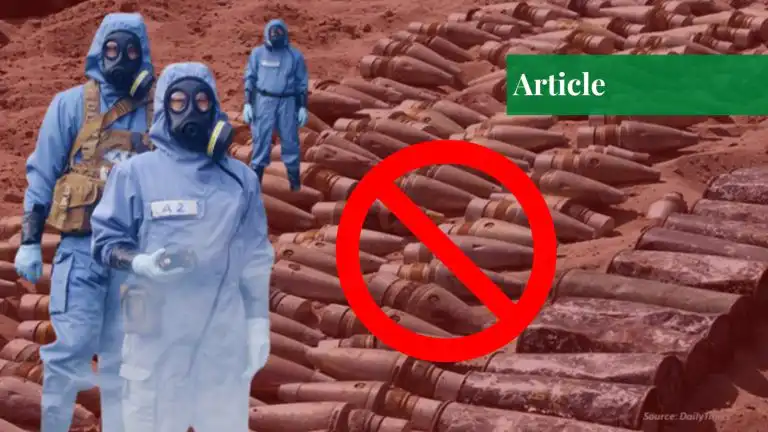
The use of chemical weapons became prominent during the world wars and later in the Middle Eastern crisis, such as when used by Egypt on Yemen and in the Iran-Iraq war in 1980. These circumstances led to the creation of the Organization for the Prohibition of Chemical Weapons (OPCW) on April 29, 1997.
The organization comprises 193 member states and represents nearly 98% of the total world population. OPCW claims to have destroyed 100% of the declared chemical weapons stockpile and even got the Nobel Prize in 2013 for its efforts to dismantle chemical weapons. The arrest of the former Syrian officer has revived a new question: despite the near-universal prohibition of chemical weapons, there remains a persistent enforcement challenge regarding the ban as allegations surrounding the controversial weapons continue to surface in recent conflicts. Moreover, the Syrian case is not unique. The greater challenge lies in the uneven application of international norms across different conflicts and regions.
Israel and the Enforcement Gap
On the morning of 17th January 2009, two brothers, aged five and seven, were asleep in the classroom on the second floor in the UNRWA school in Beit Lahia, where they had sought refuge a few days earlier due to fighting. At around 6am, an artillery shell hit the school, killing both brothers while injuring 14 others, including the mother of these brothers, whose leg later had to be amputated. Amnesty International officials visited the site two days later and found the remains of white phosphorus.
More than a decade later, humanitarian concerns regarding controversial weapons in armed conflict have not disappeared. Human Rights Watch researcher Ramzi Kaiss concluded that during recent Hezbollah-Israel hostilities, Israel has used white phosphorus, which will have dire consequences for civilians. Although white phosphorus is not classified as a chemical weapon under the convention, its repeated use in populated areas reignited concerns about the effectiveness of international humanitarian law.
Moreover, the legal distinction between chemical weapons and incendiary weapons does not rule out the possible humanitarian consequences of white phosphorus when used in populated areas. Such stories as this demonstrate why the true test of the global weapon ban lies not in its existence but rather in its enforcement. While Israel has signed the Convention but has never ratified it and has adhered to the policy of neither confirming it nor denying it.
As Israel is not a party to the convention of the OPCW, it is not required to declare or destroy its chemical stockpiles or even subject to routine inspection and verification that applies to party states. This exposes a fundamental weakness in the global chemical weapons regime, as the convention established powerful norms regarding non-proliferation, but their effectiveness depends on universal participation and the political will of the states. Without both, the allegations regarding continuous use of chemical weapons continue to emerge in contemporary conflicts, raising questions about the future of the Global Chemical Weapons Regime.
The Road Ahead for the OPCW
The arrest of the former Syrian officer serves as a reminder that accountability for the chemical weapons may reach the individual perpetrator, but it also exposes the deeper limitations. The Chemical Weapon Regime has been able to establish powerful norms, yet its enforcement remains uneven.
The OPCW has demonstrated exceptional capability in verifying, investigating allegations, and overseeing the destruction of the declared stockpile. But once verification ends, enforcement becomes more of a political issue than a legal question. This is what has become the greatest obstacle for all international organizations. These organizations do not exist above states; their authority, resources, and effectiveness depend on the governments of states.
So, when states’ interests coincide with international rules, multilateral organizations function effectively, but when the interests diverge, geopolitical interests outweigh international obligations. Even alliances and economic and political sanctions as a punishment when accountability is applied uniformly, which cannot be seen in the Israel case, as it receives unwavering and unprecedented support from the US, especially since the 2023 Gaza war.
The future of OPCW should therefore not be viewed solely through the lens of inspections and verification technologies. Its future relies on the international system as it evolves beyond selective enforcement. However, we cannot rule out the fact that OPCW has been successful in stigmatizing chemical weapons and even reducing the stockpile, but without impartial and consistent enforcement, even the strongest legal framework becomes vulnerable.
If you want to submit your articles and/or research papers, please visit the Submissions page.
To stay updated with the latest jobs, CSS news, internships, scholarships, and current affairs articles, join our Community Forum!
The views and opinions expressed in this article/paper are the author’s own and do not necessarily reflect the editorial position of Paradigm Shift.