
Introduction
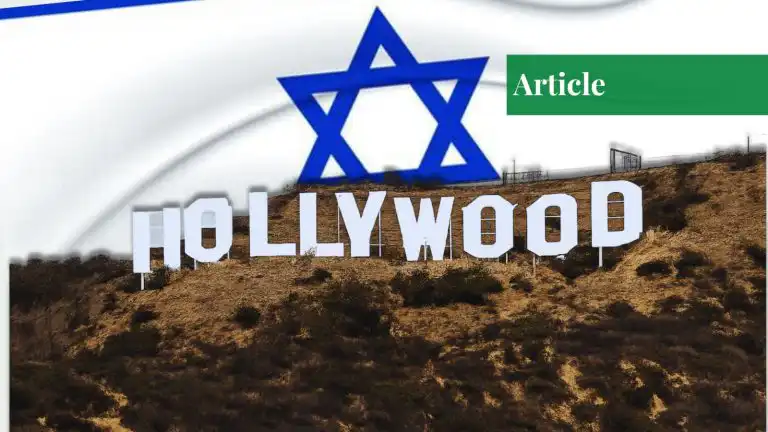
Hollywood has historically been used as a tool for pro-Israel propaganda, both directly and indirectly, thanks to its Jewish studio ownership, lobbying networks, and selective media representations. To examine how institutional mechanisms within Hollywood consistently advance Israeli narratives while marginalizing those pertaining to Palestinians, this study draws on media studies literature and propaganda theory. This study demonstrates how Hollywood functions as a soft power tool that can influence international public opinion in favor of Israel and change US foreign policy support through ownership structures, organizational pressure, and deliberate content creation.
The following inquiries are investigated in this study:
- What effects does the Israel lobby have on the creation and dissemination of Hollywood content?
- How has Jewish studio ownership influenced pro-Israel narratives in the past and present?
- In what ways are Israelis and Palestinians portrayed in popular movies and television shows?
- What effects do these patterns of representation have on public opinion around the world and American foreign policy in the Middle East?
Historical Context
Jews Founded Hollywood
The economic endeavors of European Jewish exiles who fled persecution back home in the late 19th and early 20th centuries gave rise to Hollywood. The Warner Brothers, Louis B. Mayer, Samuel Goldwyn, and Harry Cohn would go on to establish the main Hollywood studios that would dominate American filmmaking for many years. Despite being pioneers in business and enterprise, these people had sensibility derived from their marginalization and antisemitism experiences.
A strong identification with Jewish causes was undoubtedly generated by the immigrant experience, and this association later extended to the Zionist endeavor of building a Jewish homeland in Palestine. According to Shaw and Goodman, “Hollywood personalities organized massive fundraising and promotional activities for pre-state Zionist organizations and, after 1948, for the State of Israel.” This led to the formation of a network of cultural practices and institutions that continue to influence Hollywood’s response to Middle East concerns.
Early Cultural Productions That Supported Zionism
Based on a Leon Uris novel, Otto Preminger’s 1960 film “Exodus” marked a turning point in Hollywood’s pro-Israel propaganda. Arabs were characterized as archaic and antagonistic, whereas Jewish settlers in Palestine were heroic and archaic enemies of independence movements. The foundation for later Hollywood depictions of the Israeli-Palestinian conflict was established by its tremendous commercial success and ensuing cultural influence.
It was widely praised and perceived as a pro-Israel initiative funded by significant Jewish promotional efforts. A cursory examination of the film’s popularity indicated that Hollywood was becoming a propaganda tool for influencing public opinion through emotionally charged popular narratives that had the power to transform their political reality into moral stereotypes that supported Israeli opinions.
Israeli Victimhood and Holocaust Film
Steven Spielberg, whose Holocaust-themed picture Schindler’s List was released in 1993, is arguably the most successful. Thus, the primary moral foundation in Holocaust films is the pro-Israel narratives that are established by presenting the suffering of Jews. Despite not being for Israel, the film’s emotional moments and widespread cultural appeal foster empathetic attitudes toward Jewish concerns, such as Israeli nationalism as an idealized country in connection with shelter for persecuted Jews.
To make sure it adhered to accepted narratives about Jewish suffering and redemption, the movie, nevertheless, underwent a rigorous consultation process with Jewish organizations and Holocaust survivors. Its widespread popularity and widespread recognition make it yet another potent cultural relic that uses popular perception to represent historical experiences in comprehending modern-day Jewry and the actions of the Israeli government.
Hollywood’s Alignment with the Strategic Partnership between the United States and Israel
The Cold War-era “special relationship” between the US and Israel provided further motivation for Hollywood to create such pro-Israel fare. As Israel became closer to the United States in the Middle East, arguments in favor of Israeli narratives were less likely to provoke negative government censure or regulatory action and more consistent with some wider goals in US strategic politics.
Such congruence ultimately resulted in a mutually reinforcing arrangement: Hollywood’s pro-Israel productions would further the objectives of US foreign policy, while the latter’s endorsement of this relationship would provide justification for Hollywood’s representational decisions.
Propaganda Theory and Media Influence
“Manufacturing Consent” by Edward Herman and Noam Chomsky provides the theoretical framework for comprehending how media organizations function as propaganda machines for influential groups. Their filter-related propaganda model outlines five filters – ownership arrangements, advertising dependencies, sourcing methods, flak mechanisms, and ideological frameworks – that shape media content. The ownership filter provides more insight into the systematic support of Israeli narratives over Palestinian ones.
This type of ownership screening is especially important. Media firms’ ownership structures and financial interests have an impact on their content policies. Editorial and production decisions are more likely to be influenced by owners’ personal, financial, or ideological ties to causes. There has historically been a significant concentration of Jewish ownership and leadership in Hollywood, which has led to institutional biases toward Jewish and Israeli issues.
Hollywood and Cultural Politics Owned by Jews
Jewish immigrants played a significant role in the construction of Hollywood’s major studios, as noted by Neal Gabler’s scholarly research in “An Empire of Their Own” and later studies by Shaw and Goodman. These emigrant businesspeople founded the American film industry, fled persecution in Europe, and remained close to Jewish communities and, eventually, the State of Israel. This historical pattern created an institutional culture and an institutional net that still affect the decision-making in contemporary Hollywood.
According to recent research by Perlman, Jewish leadership remains concentrated in Hollywood’s top echelons, which has ramifications for decisions about distribution and production. The institutional systems that support Israeli viewpoints while marginalizing Palestinian narratives are made possible by this continuity of influence.
Media Influence and Israel Lobby
In Israel’s Lobby and Its Impact on the Media, Stephen Walt and John Mearsheimer have both controversially written extensively detailed studies on the Israel lobby. These academics expose the ways in which organizations promote Israel at the expense of other causes. The processes that have been identified, funding incentives, reputational penalties, and organizational pressure, would also apply to entertainment media, even though their study focuses mostly on loss to news media and political discourse.
The American Israel Public Affairs Committee (AIPAC), the Committee for Accuracy in Middle East Reporting in America (CAMERA), and the Anti-Defamation League (ADL) have all been known to use pro-Israel framings and steer clear of anything that could be interpreted as damaging to Israel’s image in all media, including marketing campaigns, distribution choices, and Hollywood productions.
Representation and Film Studies
Therefore, the analytical frameworks developed by Terri Ginsberg’s study of the Palestine solidarity film and Ella Shohat’s seminal work on Israeli cinema could be used to examine the performative historical production of political narrative in cinema. According to their research, representation in movies is anything but neutral; rather, it serves ideological goals meant to influence viewers’ views of morality, identity, and conflict.
The literature currently in publication has glaringly lacked an integrated study on the topics of ownership patterns, lobbying strategies, and representation patterns. Therefore, by examining these three factors that combine to produce their trustworthy pro-Israel propaganda impacts, this article aims to close that gap.
Hollywood’s Propaganda Mechanisms for Israel
Industry Networks and Ownership
The concentration of Jewish ownership and leadership in all facets of Hollywood production, including direct control over production and distribution decisions, unofficial networks that exert influence over project development, and pro-Israel philanthropy, presents real opportunities for advocacy on behalf of Israel in Hollywood.
Executives hosting solidarity trips to Israel with thousands of other media executives, serving on boards of pro-Israel organizations, and using their commercial clout to support pro-Israel movies and TV shows while omitting or making irrelevant Palestinian viewpoints are perhaps the most common examples in recent years.
Organizational Pressure and Lobbying
Pro-Israel organizations use a variety of strategies to influence Hollywood material, such as speaking directly with studios and/or distributors, taking coordinated action against any film that will portray Israel negatively, and supporting those that promote pro-Israel views. For instance, ADL has a lengthy history of preventing movie theaters and distributors from showing films that support Palestinian rights or condemn Israel.
Similar organizations like CAMERA keep an eye out for anything in Hollywood films that Israel finds objectionable and start campaigns to get the company to remove it going forward. Such actions have a chilling effect, preventing filmmakers from ever voicing criticism of Israeli policies or considering any viewpoints that are oriented toward Palestine.
Production and Funding Encouragement
This essential characteristic of Hollywood content is maintained by the current financial model. Pro-Israel organizations and individuals sponsor those that promote Israeli narratives, whereas Palestinian viewpoints receive neither funding nor distribution. Pro-Israel content thrives because of these structural disparities in resource access.
Case studies in movies like “Exodus” and “Munich” highlight yet another important aspect: institutional support structures could strengthen pro-Israel messaging even more through their marketing, distribution, and award campaigns. However, Palestinian films are largely shut out of major advertising and distribution channels.
The Self-censorship
To steer clear of any controversy that can arise around Middle Eastern themes, they actually self-censor in a blatant and judgmental manner. As a result, most people steer clear of Middle Eastern matters entirely because their reporting may result in unfavorable exposure, negative press against any script that positively portrays Palestinians, or the need to rework films that contain elements deemed harmful to Israel.
The filmmakers engage in self-censorship as they embrace industry norms based on an Israeli perspective while rejecting Palestinian ones. As a result, the experiences and perspectives of Palestinians are significantly underrepresented in Hollywood commercials.
Film and Television Case Studies
The following case studies shed light on the concept of taxing socio-political arguments.
1960’s Exodus: The Template
The fundamental narrative framework for Hollywood’s approaches to the Israeli-Palestinian conflict was established by Exodus. Thus, the fight of Jewish Zionist immigration to Palestine was portrayed as a valiant attempt at freedom, against which the Arabs were violently opposed and shown to be utterly illogical.
The movie’s cultural significance and financial success provided the industry with incentives for recurring business. In order to conform to the official Israeli narrative, it was produced in close cooperation with Zionist organizations and Israeli government representatives. Due to its global dissemination, this movie was a powerful propaganda tool that influenced how people around the world viewed the conflict’s origins and moral implications.
Munich (2005): A Pro-Israel Framework with Moral Complexity
Munich, directed by Steven Spielberg, acknowledges the moral complexities in the Israeli story and suggests considerably more sophisticated propaganda in favor of Israel. This film presents Israeli counter-terrorism efforts as essential but morally dubious reactions to Palestinian violence. It is obvious that the movie attempts to present a balanced viewpoint while reinforcing fundamental beliefs regarding Israeli moral superiority or Palestinian hostility. It will most likely serve a propaganda purpose inside an apparently convoluted storyline by being swiftly praised and made public with awards. It will also likely be given a high or distinguished level of artistic standing.
Fauda (2015–present): Views on Israeli Security and Global Streaming
Netflix’s international broadcasting of the Israeli television series Fauda, which swept the world’s streaming landscape, allows viewers to see how mainstream Hollywood’s appropriation of Israeli security narratives exposes viewers to Israeli military perspectives at the expense of Palestinian civilian realities. The Israeli soldier is portrayed as a model neighbor or a human being whose actions could be justified—a very superficial reading of the Palestinian people. The rise of streaming services even suggests that Hollywood is pushing its propaganda machine outside the conventional theatrical distribution channels.
Impact of the United States’ Foreign Policy and International Image
Western Opinion
Hollywood propaganda has demonstrated a pro-Israeli slant that shapes attitudes globally, particularly in Western countries where American media dominates cultural consumption. Media consumption and political opinion seem to be causally related; surveys have frequently shown that the more American media a nation consumes, the more support it has for Israel.
The movies, whether it’s Schindler’s or Exodus, soothe and leave a lasting memory that shapes how the public reacts to more recent events in the Middle East. These cultural relics provide conceptual frameworks for understanding a complex political reality that has long been associated with Israeli perspectives.
Giving US Foreign Policy Legitimacy
Hollywood is legitimizing US foreign policy by fostering this set of attitudes. The public’s acceptance of US military and economic support for Israel has been bolstered by this pro-Israel sector. Therefore, when a spectator perceives Palestinians as dangerous aggressors and Israelis as sympathetic victims, they are more likely to support policies that benefit Israel.
Because one is methodically legitimizing the other through political and cultural channels, it thereby strengthens the mutual reinforcement of Hollywood propaganda and government policy.
Global Leverage and Soft Power
The Hollywood soft power platform honors global culture that is significant to both Israel and the United States. Globally, pro-Israel content marginalizes Palestinian issues in the international discourse and evokes support for Israeli positions overseas. By expanding, streaming services have a greater impact on Hollywood’s audience, which might not otherwise be aware of the range of perspectives on the Israeli-Palestinian conflict presented by other media.
Counter-narratives and Critique
Art Liberation and Propaganda
Regarding the methodical nature of Hollywood’s pro-Israel slant, where does socially acceptable artistic expression end and propaganda start? The broader pattern that has developed over decades of production shows institutional processes that go beyond individual creative actors, even though these films may actually be singular, incredibly honest artistic visions.
The Palestinian perspective is marginalized because of this cultural restriction, which aims to restrict the conflict narratives that are deemed acceptable by society.
Humanization and Selective Victimization
The victim for the protagonist of the Israeli-Palestinian conflict in Hollywood productions, characters labeled as Israeli and those called Palestinian, are shown as antagonistic or as an abstraction of selective humanization. By defining the parameters of Israeli and Jewish victimhood while ignoring Palestinian suffering, a moral framework construct can defend Israeli policies and deny the legitimacy of Palestinian resistance.
Palestinian and Independent Counter-film
Hollywood’s propaganda hegemony is challenged by alternatives and aspirations for alternative networks of film production and distribution. By questioning the current state of Israeli representation and humanizing Palestinian tales in their own way, Palestinian filmmakers and solidarity activists have created these counter-narratives.
In comparison to the overwhelming scale and global distribution of Hollywood productions, the systematic obstacles that loom against alternative distribution methods significantly reduce these tiny films’ competitive viability and, consequently, their capacity to offer counter-narratives.
If you want to submit your articles and/or research papers, please visit the Submissions page.
To stay updated with the latest jobs, CSS news, internships, scholarships, and current affairs articles, join our Community Forum!
The views and opinions expressed in this article/paper are the author’s own and do not necessarily reflect the editorial position of Paradigm Shift.

Shazmah Fatima is an independent researcher and a final-year student of international relations at Riphah International University. Her research focuses on international relations, global affairs, and governance, with experience in policy research, academic writing, and publication.