On 1 July 1997, the United Kingdom of Great Britain and Northern Ireland officially handed over its last overseas territory in East Asia, the Crown Colony of Hong Kong, to the People’s Republic of China, in accordance with the provisions of the 1984 Joint Declaration of the Government of Great Britain and the Government of the People’s Republic of China on the Question of Hong Kong.

However, what London handed over to Beijing was not simply a territory it had ruled for more than a century, but one of the Kingdom’s major economic and cultural centers, which ranked second only to the British capital and was the foremost in Asia, surpassing Singapore and on a par with Tokyo.
During 150 years of British rule, Hong Kong became the financial center of Asia and, together with Zürich in the Helvetic Republic of Switzerland in Europe, one of the main hubs for the private banking sector, hosting the headquarters of global financing giants and private wealth managers for the assets of billionaires and millionaires from around the world.
Over the same period, Hong Kong had also become one of Asia’s cultural centers, with its multi-million dollar film industry (also known as Cantonese cinema), which during its peak in the 1980s and early 1990s, had dominated the cinema of the Mandarin-speaking world (in the People’s Republic of China and the Republic of China), and with its productions had bravely challenged the multi-milliard dollar American Hollywood industry, which at the time was also in its golden age. At the same time, apart from cinema, Hong Kong also had its own global musical scene: Cantopop (Cantonese pop music), a genre that captured the hearts of millions of fans worldwide, transcending the borders of Asia.
Today it is impossible to imagine Asian cinema (as well as British cinema) of the 1970s–1990s without Hong Kong action films—which shaped what is now known as the Hong Kong New Wave, the face of which became actors such as Bruce Lee (1940-1973), Jet Li (1963-) and Jackie Chan (1954-). Meanwhile, alongside this iconic category, Hong Kong filmmakers also successfully experimented with other cinematic genres, such as romantic drama (Last Song in Paris, 1986), erotic films (Crazy Love, 1993), comedy horror (A Chinese Ghost Story, 1987) and crime thrillers (The Untold Story, 1993), the success of which made the names of actors Leslie Cheung (1956-2003), Anita Mui (1963-2003), Cherie Chung (1960-), Maggie Cheung (1964-), Andy Lau (1961-), Lolita Lee (1966-), etc., known throughout Asia and beyond.
It cannot be left out here without also mentioning Hong Kong’s urban culture, characterized by the city’s distinctive urban planning, which incorporates British elements (such as red double-decker buses, red telephone boxes and red post boxes bearing the symbols of the British Crown) with Asian elements (such as Buddhist and Taoist temples and pavilions), as well as modern metropolitan features (such as the legendary neon lights of the city, which have also become a globally recognizable image of Hong Kong to anyone in the Western world).
All these economic and cultural achievements seem to have made very little impression on the conservative communist elites in Beijing, if not a very bad one, where more than a few of these achievements may even have been seen as harmful remnants of the British rule legacy, which could have had a dangerous socio-cultural impact on the mainland population.
Despite this skepticism tendencies, primarily among the Party’s hardliners, the fact that during this period the People’s Republic of China was still in the process of carrying out fundamental economic, socio-cultural and, to some extent, political reforms (a process also known as the ‘Reform and Opening-up’), initiated on 18 December 1978 at the third plenary session of the 11th CCP Central Committee, by the then moderate paramount Chinese leader, Deng Xiaoping, seems to have made Hong Kong (as well as Macao) to be seen more as a locomotive for the transition Chinese society was undergoing than as a potential politico-ideological risk.
Also, Beijing, as part of its efforts to integrate into the international community, had itself liberalized the country’s cultural life to the maximum, which, especially during the 2000s, had led to many filmmakers, singers, painters, photographers, dancers and artists who had been formed during the years of reforms (especially during late 1980’ and 1990’), to directly challenge the boundaries of state censorship by tackling subjects that had long been taboo, such as the catastrophic social impact of the 1966–1976 Cultural Revolution, the student protests and the 1989 Tiananmen Square Protests and Massacre, and even homosexual relationships.
Meanwhile, the commercial opening up of the People’s Republic of China also brought new and still-unknown filmmakers access to modern technologies (especially Japanese popular brands) such as Sony digicams, Canon camcorders, or JVC prosumer video cameras – which allowed a massive unofficial underground industry of film, documentary, and music video production to emerge. Also from this period are the films The World (2004), Summer Palace (2006) and Lost in Beijing (2007) – which brought a more individualistic (almost Byronic) and anti-romantic perspective to daily life, paying greater attention to contemporary urban life and its related phenomena, particularly those such as the social moral crisis, the clash between traditional and modern values, dissatisfactions with family life and youthful rebellion, caused mainly by the socio-economic transformations of modern Chinese society.
All these socio-economic and cultural transformations, alongside the country’s economic and technological development, have also brought about a politico-ideological chaos characterized by what Beijing has officially classified as ‘mass incidents’ — mass protests or blockades organized by factory workers, villagers and farmers to demand their rights (lost pensions and unpaid wages) or to protest against the corruption of local officials. Besides the civic character of these movements, they also took on a political character (with the formation of China’s Democratic Party) and legal representation (with the emergence of the Weiquan Movement), which brought together public-interest lawyers, intellectuals, scholars and journalists who aimed to defend the freedom of speech and citizens’ constitutional rights, as well as to call for structural political reform.
But everything changed for the People’s Republic of China as well as for Hong Kong with the rise to power of the conservative Xi Jinping, who on November 15, 2012, was elected General Secretary of the Chinese Communist Party and Chairman of the Central Military Commission, while on March 14, 2013, he was also elected as President of the People’s s Republic of China during the National People’s Congress.
It is interesting that during this same period – the years 2012 to 2013 – was marked, in the regional context, with the end of experimental libertarian policies: on April 11, 2012, in the Democratic People’s Republic of Korea (DPRK or North Korea), during the Fifth Session of the Twelfth Supreme People’s Assembly, Kim Jong Un was appointed First Secretary of the Workers’ Party of Korea and Chairman of the Central Military Commission. Meanwhile, in Russia, former President Vladimir Putin returned to power by winning the presidential election on March 4, 2012, after having served as Prime Minister during Dmitry Medvedev’s presidency (2008-2012), and was officially inaugurated for a third consecutive term as President of Russia on May 7, 2012.
Both of these episodes are highly significant in a geopolitical and socio-cultural context, as they became a turning point that underpinned the end of the period of experimentation with liberal policies and the re-strengthening of state authority towards the total politico-administrative centralization of the present day in all three countries, which geographically also border each other.
Back in the People’s Republic of China, clashes between Hong Kong’s civil society, student groups and political factions and the Chinese communist authorities which began in the early years after the handover of Hong Kong by the British to Beijing, grew and intensified ever more—as was seen in the 2003 Anti-Article 23 Protests, the 2012 Scholarism-led protests (also known as Anti-Moral and National Education Movement) and the 2014 Umbrella Movement—with Beijing now determined to slowly incorporate Hong Kong into the socio-economic and politico-ideological system of its mainland territories.
The peak of the political clashes between Hong Kong and Beijing appeared to be the 2019-early 2020 protests, which were the largest demonstrations in Hong Kong’s history and a direct response by Hong Kong’s pro-democracy camp and civil society to the Fugitive Offenders and Mutual Legal Assistance in Criminal Matters Legislation (Amendment) Bill of 2019.
Beijing’s response to the protesters was harsh: around 10.060 people were arrested for their participation in the protests, while as a result of police and pro-Beijing groups’ violence, around 2600 people were injured, and two people lost their lives (confirmed officially as operational deaths). On the other hand, after the protests were suppressed, around 2,210 people were criminally prosecuted on charges such as rioting or unlawful assembly, while over 1,000 people (including high-profile activists, pro-democracy lawmakers and journalists) were also arrested, thus becoming the largest number of political prisoners in the history of Hong Kong.
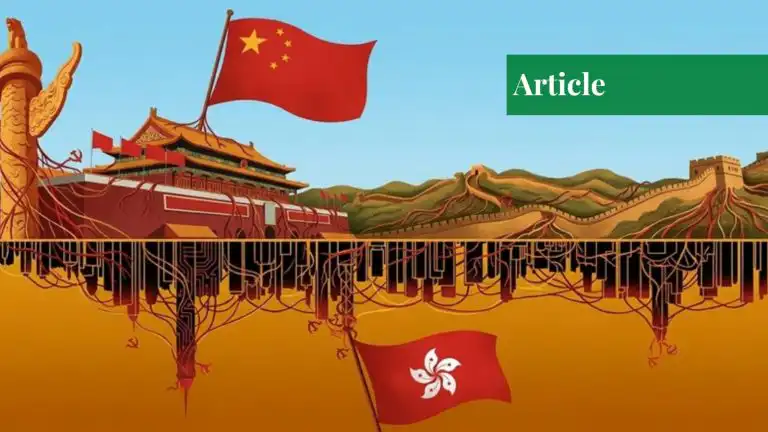
However, the Chinese authorities did not stop at merely brutally suppressing dissenting voices and civil society, but, by using the ‘state of emergency’ in the city as a pretext, they managed to extend the mainland central government’s direct and indirect control to all socio-economic and politico-cultural sectors of Hong Kong:
Censorship Of Hong Kong’s Local Culture
On June 30, 2020, following the 2019 pro-democracy protests, Beijing bypassed Hong Kong’s local legislative body to impose the Law of the People’s Republic of China on Safeguarding National Security in the Hong Kong Special Administrative Region.
This legislation, together with the Film Censorship Ordinance (2021), has had a catastrophic impact on Hong Kong’s unique cultural character, and has radically transformed the city’s civil society and artistic freedoms, fostering a pronounced culture of self-censorship (or artistic expression in an Aesopian tongue and camouflaged within ancient Catonese traditions, as it was also seen in the Hong Kong 2024 film, The Last Dance), as well as a parallel culture developed in exile (as many figures from Hong Kong’s artistic world were forced to choose between self-exile or harsh sentences following the suppression of the protests by Chinese security forces).
Thus today, the Hong Kong artistic world finds itself in the same situation as the Russian one after 2022—condemned to develop within Beijing’s rigid ideological frameworks, which have led to what was once one of the main Asian and global cultural hubs being reduced today to a wasteland with only a few artistic oases, which have themselves become a mirage of Hong Kong’s former splendor.
Dismantling Of Hong Kong’s Local Independent Political And Civic Entities
As we mentioned above, in response to the 2019 pro-democracy protests, on June 30, 2020, Beijing adopted the Law of the People’s Republic of China on Safeguarding National Security in the Hong Kong Special Administrative Region.
This legislation criminalized broad categories of political dissent and effectively dismantled the city’s pro-democracy movement, student groups, trade unions, and independent civil society. At the same time, this legislation was also used as a political instrument to establish a ‘witch hunt’ in Hong Kong, targeting hundreds of pro-democracy politicians, activists, artists, scholars and students.
Meanwhile, on 11 March, 30 March and 27 May 2021, Beijing pushed through the adaption of ‘Patriots Governing Hong Kong Reforms’, which brought about fundamental changes to Hong Kong’s electoral system by introducing vetting committees to review all political candidates on the electoral rolls, ensuring that only pro-Beijing loyalists (also referred to as ‘patriots’) could stand for positions on local administrative bodies.
Extending Legal And Economic Control Over Hong Kong’s Financial System
However, apart from the political and cultural consequences, it could be said that Hong Kong’s economic sector is the one that has suffered the most from the implementation of the Law of the People’s Republic of China on Safeguarding National Security in the Hong Kong Special Administrative Region.
This legislation has brought about a massive exodus of foreign (but also domestic) companies, high-net-worth individuals (millionaires and billionaires) and highly skilled professionals (IT specialists, financial experts, market makers, etc.), causing the city that once was one of Asia’s and world’s leading financial centers to lose its financial standing and global competitiveness, and to end up being completely dominated by mainland Chinese state-alight companies, investors and markets.
At the same time, the broad legal access of the Chinese intelligence services and Chinese law enforcement agencies in Hong Kong’s financial system, as well as allowing the arrest of individuals (not only Hongkongers, but even foreigners) suspected of ‘committing espionage’ or ‘organizing anti-state activities’, and allowance of Chinese authorities of freezing or confiscation of financial assets of suspected individuals or corporates, appears to have not only politicized Hong Kong’s financial sector, but also to have caused that the city to lose its old status as a stable and safe legal and financial center.
Conclusions (A Lesson For Taiwan)
The 2019-early 2020 protests in Hong Kong served as a cold shower for Taiwanese political circles, activist communities and civil society, where the violent response of the Hong Kong law enforcement authorities, as well as the indirect involvement of Chinese intelligence services in discrediting Hong Kong protesters and their cause, showed that Beijing’s proposed ‘one country, two systems’ model does not protect local freedoms and is simply a dead letter, worthless if the Chinese communist leadership feels threatened or even displeased with the way political developments are going in a territory (despite its legal status), part of their country.
It is precisely this fact, as well as the aggressive reaction not only from Beijing but also, largely, from the Chinese mainland population against the protests in Hong Kong, that also helped to further emphasize the curious sociological phenomenon of constructing different national identities despite belonging to the same nation, which is currently unfolding in Taiwanese society.
If in Hong Kong this identity (especially noticeable today among the Hong Kong youth) it has been constructed by the fact that the city and its inhabitants were for around 150 years part of the British Empire, as well as by the fact that modern local Hong Kong culture is a product of the blend of Anglo-Saxon culture with local Cantonese culture; the identity of the Taiwanese people, besides historical processes, today it has increasingly taken the form of socio-political and economic separated belonging for the population of Taiwan, which, like that of Hong Kong or South Korea, is now integrated into global financial institutions, has adopted a capitalist economic model, and is a large consumer of American commercial culture rather to Chinese mainland one.
As a result, Beijing’s actions appear to have had a boomerang effect, causing the people of Hong Kong to feel even more alienated from the Chinese state. At the same time, the gap between Taiwan’s political circles and its people (especially Taiwanese youth), and those of the People’s Republic of China, is deepening even further.
If you want to submit your articles and/or research papers, please visit the Submissions page.
To stay updated with the latest jobs, CSS news, internships, scholarships, and current affairs articles, join our Community Forum!
The views and opinions expressed in this article/paper are the author’s own and do not necessarily reflect the editorial position of Paradigm Shift.
Eljanos Kasaj is a student from Albania currently enrolled at the Institute of Political Science and World Politics. He is specializing in Global Security at the University of Wrocław (Poland).