
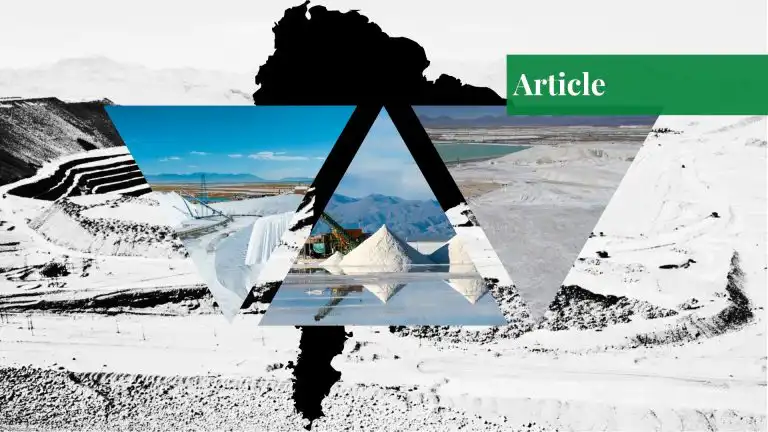
The Salar de Uyuni is located at a height of about 3,700 metres above sea level in the southwest of Bolivia, covering 10,582 square kilometres of brilliant white salt crust. Below this area lies the most important geological structure of the 21st century, the unique deposit of lithium in the world. After travelling for a few hours to the west to reach Chile’s Atacama Desert, one will discover another salar, Salar de Atacama, one of the richest areas concerning lithium resources in the world. When entering Argentina’s high river basin, the visitor will encounter a lot of salars like Hombre Muerto, Olaroz, Cauchari, and Rincon.
Chile, Bolivia, and Argentina form what geologists and economists call the Lithium Triangle, a lucrative area of the world that, according to the latest Mineral Commodity Summaries published by the US Geological Survey, is home to more than 56 percent of the lithium resources available worldwide. With the world rapidly turning to electric vehicles and renewable energy, that concentration of resources in one part of South America has made the triangle one of the most strategically important geographic areas in the world.
The issue at hand is no longer whether the world needs what is buried within the saline desert. Rather, it is whether Chile, Bolivia, and Argentina have the necessary political integrity, institutional strength, and negotiating power to reach an agreement so that their people take advantage of the extraction of the resource as opposed to foreign firms and governments.
What the Lithium Triangle Actually Is
Lithium is not contained in veins in the same way as occurs with gold or copper; rather, it resides in underground brine that has been trapped beneath salt flats for eons. As part of this process, the brine is pumped up to the surface and allowed to sit in evaporation ponds, where the evaporation process occurs over months in the heat of the sun and dries up the solutions to produce material that can be processed to extract lithium carbonate or lithium hydroxide.
The lithium reserve numbers are breathtaking. Up until now, it is estimated that Chile possesses about 9.2 million metric tons of proved lithium reserves, practically a quarter of the world’s total reserves, mainly in the Salar de Atacama region. It is claimed that Bolivia has about 21 million tons of proven lithium reserves according to USGS databases, or around 20 percent of the total reserves of lithium in the world, almost entirely located in the Salar de Uyuni area. Finally, the estimation of lithium reserves in Argentina is 22 million tons of proven resources and 4.4 million tons of poured lithium. All mentioned countries hold more than half of all world recoverable lithium resources.
The concentration of resources in this particular area presents a great opportunity but also a structural vulnerability. With any minor political event, drought, or strike between the state and a mining company, the global lithium supply might decline quickly, which will affect electric car production in Germany, South Korea, and the United States. This triangle is not just a mining region; it is a bottleneck.
Three Countries, Three Very Different Stories
Chile is the recognized producer. It has been producing lithium from the Atacama for decades, and in 2025 remained the second-highest producer globally after Australia. Two companies, American Albemarle and Chile’s SQM, have dominated production for years through concession agreements with the Chilean government. In April 2023, President Gabriel Boric announced a plan to partially nationalize lithium production, such that any new contracts would have to be made public-private partnerships. The aim of the government is to produce 370,000 tons of lithium carbonate equivalent in the year 2030. Negotiations with indigenous Atacameño tribes over their representation have begun by 2025, marking a first in Chile’s lithium industry. However, critics say consultations are not all-embracing.
Bolivia shows the greatest contrast. It has the biggest identified lithium reserves worldwide but produces almost none of it commercially. Currently, it produces approximately 2,000 tons of lithium carbonate equivalent per year, accounting for less than 0.1% of world production while having 20% of the world’s reserves. There are several reasons for this situation: firstly, it is largely geological, since Uyuni’s brines contain a magnesium-to-lithium ratio of up to 20:1 versus 6:1 in Atacama, which makes extraction much more complicated and costly.
However, the country has also not been prepared to welcome private investments and has used the exclusively state-led model of development. At the end of 2024, it signed a $1 billion deal with a Chinese consortium led by CATL to establish direct lithium extraction facilities in Uyuni that will be supervised by the Bolivian state, which will still have 51% of the shares in the project. From the political point of view, the country has witnessed considerable instability, especially after the attempted coup in June 2024, which adds to the difficulties of investments in the country.
Among the three countries, Argentina is more in the limelight and embraced by international investors. Since Javier Milei became president, the country has moved towards a more open and investor-friendly model. Realizing this aim, a new legal regulation has been adopted called the 2025 Incentive Regime for Large Investments (RIGI), which assures foreign companies of legal stability and protection from taxes. In May 2025, the government approved the Rio Tinto lithium project at the Rincon site in Salta, which costs about $2.5 billion.
Also, there are nine lithium facilities and 83 projects in operation in Argentina. As for the forecasts, the country is expected to produce 130,800 tonnes of Lithium Carbonate Equivalent (LCE) in 2025, which is 75 percent more than last year. According to GlobalData research, Argentina will become the second-largest lithium producer in the world by 2030 and attract $10-20 billion of investments till 2029.
Who Is Competing for It
In all three countries, China was the first to arrive, made the most extensive investments, and is now in the strongest position. Chinese companies are involved at all levels in the supply chain in the triangle, from exploration and extraction to lithium processing and battery manufacturing. The Cauchari-Olaroz project in Jujuy province in Argentina, one of the largest lithium projects in Argentina, is a joint venture of Lithium Argentina and Ganfeng Lithium of China. In Bolivia, where CATL leads the consortium, Chinese companies have gained the most significant foothold in the world’s largest untapped lithium reserve. Chile has seen the addition of Chinese investments in the form of minority stakes, offtake agreements, or processing partnerships.
The USA has been slower and less deeply institutionalized in its actions. The Inflation Reduction Act of the Biden Administration created incentives for the formation of lithium supply chains in North America and allied countries, thus persuading American companies to reach agreements with Argentina and Chile. The Trump Administration did not refrain from making bilateral agreements despite its negative rhetoric toward multilateral mechanisms, for instance, signing a memorandum of understanding with Argentina for mineral cooperation in 2025. Washington is in a difficult situation because it has been treating resource extraction in Latin America as a matter of private entrepreneurship for decades while China has been creating long-term contracts with government support.
The European Union has developed its Critical Raw Materials Act and has aimed to acquire no more than 65 percent of relevant resources from one country. Thus, the authorities of the EU have started considering the Lithium Triangle. The triangle is expected to attract more than $30 billion within five years, considering that there are many investors from China, North America, Australia, and Europe. The governments of the three states concerned can effectively promote their interests. However, it is debatable whether they have the means to do so.
The Andean Intercultural Summit of Communities Affected by Lithium Mining was attended by over 200 indigenous representatives from Argentina, Bolivia, Chile, and Peru in El Moreno in January 2025. At the end of this summit, a declaration was released, which demanded the stopping of the mining operations without obtaining the free, prior, and informed approval of indigenous communities, which is guaranteed under the UN Declaration on the Rights of Indigenous Peoples.
The ironic situation of the Lithium Triangle in the global energy transition, as well as in the context of the social and environmental situation of local inhabitants, has not escaped the attention of the local population. The use of lithium that comes from their land will allow car production and storage systems to be less polluting, while these communities deal with the problems caused by the extraction of the mineral. People living in this area bear all the environmental costs of lithium extraction while getting little if any advantages from the economic profits gained by governments and foreign companies.
The Communities at the Centre: Land, Water, and the Cost of Extraction
Lithium Triangle salt flats are not empty wastelands. Lithium Triangle salt flats are home to the native people, the Lickanantay (Atacameño) from Chile, the members of the Aymara and Quechua communities from Bolivia, as well as the Atacameño, Kolla, and Omaguaca from Argentina whose culture, lifestyle, and water sources have shaped their lives for centuries. But now the extensive development of lithium mining is posing pressure.
The controversy around water seems to be the heated one. The conventional brine extraction technique employs plenty of water in one of the most arid places on Earth. Studies conducted by the University of Chile indicate a reduction in the altitude of the ground in the Atacama region. The area sinks by 1-2 cm annually while the groundwater level goes down by ten meters within 15 years. Columbia Law School’s Climate Law Blog mentions that the water level in the area has shrunk by 30%, with many plants disappearing and flamingos becoming less numerous, leading to adverse results for the environment and indigenous communities. In 2025, lithium mining in South America was predicted to endanger the drinking water for 1.5 million local inhabitants.
Conclusion
The Lithium Triangle is located in an area rich in a raw material that is irreplaceable in the 21st century. The growth rate of the global lithium market is forecasted to be about 18 percent per year till 2030, with expected annual production reaching about 3.5 million tonnes of lithium carbonate equivalent. The demand from electric vehicle manufacturers, battery producers, and large energy storage facilities is constant and stable. The three governmental systems in the triangle’s territory have gained a geological advantage.
The question of whether this geological advantage translates into real political and economic influence is a matter of contingent factors that a salt flat alone cannot produce. The availability of resources in Bolivia is hindered by technical limitations, instability, and the lack of private investments to expedite development. Although there are justifiable arguments for partial nationalization in Chile, it creates uncertainties that slow down some investment decisions. Argentina, meanwhile, continues to open its doors to foreign investments, which suggests the risk of a classic extractivist cycle where the profits go to foreign capital while local populations bear the environmental costs associated with the boom.
The phenomenon of the resource curse can certainly be avoided. In fact, this entire process is political in nature as it involves terms of contracts, level of ecological regulations applied, methods of distribution of applicable revenues, and the way authorities are treating the population. Nonetheless, the three governments discussed above are in different places regarding this area. To be more precise, they all are yet to show how much political will, institutional power, and cooperation are necessary in order to dictate the trusting economic term.
What the Lithium Triangle possesses is necessary for the global population. The three nations that have it must ensure that the global populace pays for it under equitable conditions, in technological exchange, and in ecological responsibility, and that it benefits the people living by the land, water, and environment that enable work and extraction.
If you want to submit your articles and/or research papers, please visit the Submissions page.
To stay updated with the latest jobs, CSS news, internships, scholarships, and current affairs articles, join our Community Forum!
The views and opinions expressed in this article/paper are the author’s own and do not necessarily reflect the editorial position of Paradigm Shift.

Kainat Farooq is a passionate International Relations student with a strong interest in diplomacy, policy, and global affairs. She is dedicated to contributing thoughtful analysis and research on international issues.