
A War That Benefits a Distant Rival
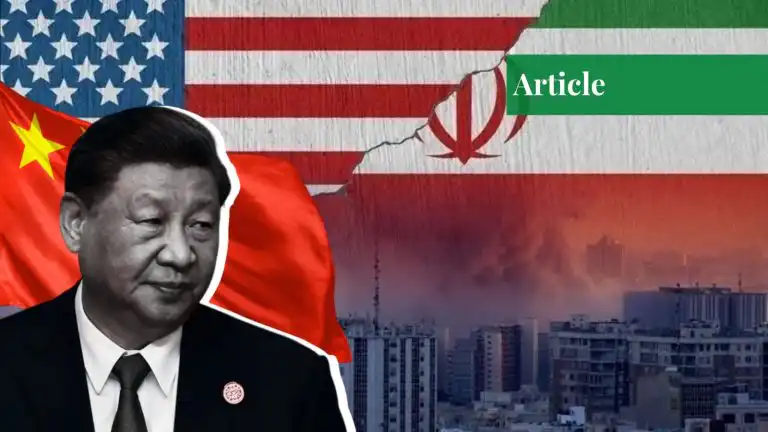
The most consequential winner of the US–Iran war may not be Washington or Tehran, but a power thousands of miles away. While American forces, diplomats and markets absorb the shocks of a Gulf conflict, Beijing has watched, adapted and conserved its strength. China did not start this war, and nobody has shown that it engineered it. But great-power rivalry is a contest of relative position, and a rival that spends its power while you preserve yours is gaining on you. That redistribution of advantage is already under way, and China has not fired a shot.
Washington Pays the Price
Battlefield success is not the same as strategic gain. Elisa Ewers and Michael Schiffer note in their Council on Foreign Relations analysis that the US military has met its objectives against Iran, yet Washington is spending precision munitions, air defences and naval assets, or tying them down in the Middle East. Replenishment is slow, constrained by long production times, fixed budgets and maintenance schedules. Iran never needed to defeat America; it needed to run down the clock, raise the costs and survive. The question is therefore not whether the United States is in absolute decline, which it is not, but what it costs to sustain primacy in two theatres at once. The burden is political as well as military. The CFR authors warn that economic disruption, supply-chain instability and domestic pressure can prove as decisive as military outcomes, particularly when strategic objectives are unclear. A war that spikes energy prices at home and drags on without a clean endpoint taxes an administration’s patience and its credibility alike. Every added burden on Washington is strategic breathing space for Beijing.
The Indo-Pacific Dividend
US forces are not perfectly interchangeable across theatres, and the effect depends on how long and how intensely the war runs. Yet munitions, air defences and political attention are finite, and the Indo-Pacific is where the rivalry with China will be decided. The CFR authors argue that if Beijing concludes America would struggle to sustain two high-intensity contingencies at once, the credibility of US commitments in Asia suffers.
Iran has also handed Chinese planners a free case study. Beijing’s doctrine, the authors observe, stresses disrupting an adversary’s economic and operational system rather than defeating its military outright. By throttling the Strait of Hormuz, Tehran showed that economic and political pressure can constrain American decision-making without any decisive victory. Washington’s efforts to calm markets, including escorting vessels through the strait and promising a war of only a couple of weeks, did not work. China is learning at America’s expense, and it can now plan for coercion, such as quarantine, cyber disruption, and financial pressure, calibrated to stay beneath any single ally’s red line. Beijing gains room to manoeuvre even if the United States remains stronger overall.
Energy Shock, Diplomatic Gain
China is a major energy importer and is not immune to higher prices. But the assumption that it depends entirely on the Gulf, or that Iran is its most important Middle Eastern partner, is shaky, as Michael Sobolik and Grant Rumley argue in The Washington Institute. Tehran also lets its own oil bound for China transit Hormuz while closing the strait to most others, according to CFR. China’s advantage lies not in escaping the shock but in absorbing it better than a rival that owns the war politically. Insurance markets tighten, freight costs rise, and supply chains falter for everyone, but the blame for the disruption lands in Washington, not Beijing. Higher prices do not automatically favour China; managing them better does.
Diplomatically, Beijing’s approach has been precise. Galia Lavi of INSS shows that China cultivated visibility without commitment. Its foreign ministry points to 26 phone calls by Wang Yi, a special envoy sent to the region, and a five-point initiative with Pakistan. Yet Beijing offered Iran no security guarantees, applied no real leverage, and distanced itself from Iranian strikes on Gulf states without explicitly condemning Tehran. The result, in Lavi’s assessment: Iran still sees China as its main partner, the Gulf states still see an economic and political partner, and the United States keeps carrying the region’s security burden. President Trump even praised Xi Jinping for his help, and the help he cited was what China chose not to do. When a rival thanks you for staying out, you have done well.
The Limits of Bloodletting
None of this makes China an unqualified winner. Lavi cautions that it is too early to call the policy cost-free: restraint may leave Iran doubting Chinese support in extremis, and Gulf states doubting that Beijing will restrain Tehran even when its own interests are threatened. Reports of Chinese dual-use components and intelligence help reaching Iran, if accurate, suggest assistance below the threshold of open involvement. That is opportunism, not orchestration. Benefiting from a war does not prove that Beijing wanted it, and this argument does not require that it did. It requires only that the costs fall unevenly, and the evidence suggests they do.
Washington also retains options. Sobolik and Rumley argue that an inconsistent China policy is undermining efforts to turn the conflict into a geopolitical win, which implies such a win remained available. Ewers and Schiffer stress that American advantages are formidable and that a major war would be catastrophic for China too. China’s gains are conditional, not inevitable.
Conclusion: The Power That Conserves Its Strength
The belligerents bear the costs; an external competitor collects the dividends. Great-power competition is measured not only by battlefield outcomes but by readiness, economic resilience, diplomatic credibility and freedom of action. If Washington emerges from this war more stretched and more distracted, while Beijing remains flexible, courted by all sides and untouched by casualties, and trusted by Gulf capitals and Tehran alike, China will have gained relative power without entering the battlefield. Victory in great-power politics does not always go to the state that wins the war. Sometimes it goes to the one that preserves its strength while its rival spends its own.
If you want to submit your articles and/or research papers, please visit the Submissions page.
To stay updated with the latest jobs, CSS news, internships, scholarships, and current affairs articles, join our Community Forum!
Find our FREE quizzes and MCQs here!
The views and opinions expressed in this article/paper are the author’s own and do not necessarily reflect the editorial position of Paradigm Shift.