

The 21st-century contest for power and prestige between nation-states has shifted toward the seas. Countries are expanding their sophisticated and formidable weapons out to the seas. States’ land and air-based forces are now integrating with naval forces to enhance their power projection and defensive-offensive capabilities. Seas provide states with wide shield and stealth capabilities, securing their large naval assets under the blanket of oceanic layers and providing robust maneuver and attacking abilities. Prominent American Naval historian Alfred Thayer Mahan, in his seminal work ‘The Influence of Sea Power upon History (1890),’ stated, “Whoever rules the seas, rules the world.”
In the context of Southern Asia, two important regional rivals – India and Pakistan- have always been in an arms race throughout history. The conventional imbalances between India and Pakistan forced the overt nuclearization of South Asia in 1998, which explicitly clarified that nuclear competition could be stretched to the sea. India is now focusing on the maritime domain to project its regional power, protect and engage with allies, and deter foes. Future crises or conflicts, whether they initiate on land or otherwise, may spill into the sea and escalate to the level of potential nuclear use.
Concept of Doctrines and Strategies
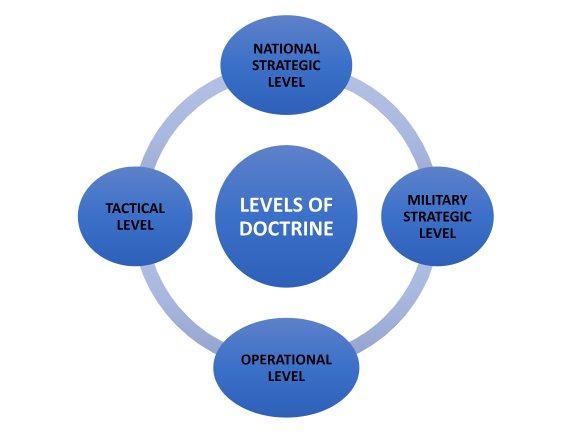
Etymologically, the word doctrine has been derived from the Latin word “doctrina,” meaning a set or system of beliefs, rules, and teachings. In contrast, the strategies are the crucial steps and tactics that form the overall doctrine. Thus, we can say that doctrine is a ladder, and strategies are its steps. Doctrines are composed of various components that form and shape a state’s strategic thinking. These include national values, national aims, national interests, national security objectives, national security policy, national strategy, joint military strategy, and land, air, or maritime strategies.
National Strategic Level
This level is considered the broadest doctrinal level where decisions are made under the umbrella of National Security Policy. As it is national, it is comprised of all components of national power, including economic, political, strategic, technological, and social factors, thus preserving the national interest of a state. The nuclear policy of Pakistan suits best to the national strategic level.
- Military Strategic Level
This level refers to the strategic thinking of a state about its armed forces. It is composed of two major components – doctrines and strategies. Doctrines are a broad framework that devises the role, scope, and application of a country’s military policies and postures. At the same time, the strategies refer to the development and projection of military strength in all the respective domains of forces – land, air, and maritime. Indian maritime strategy, “Ensuring Secure Seas: Indian Maritime Security Strategy,” also known as Naval Strategic Publication 1.2, is considered to be the second most crucial document in the Indian Navy’s military strategy.
- Operational Level
As the name suggests, this level deals with the operational tactics and strategies. It involves employing armed forces in a particular operation to attack and deceive the enemy forces. The most prominent feature of this level is “operational art,” which refers to the skill and aptitude of respective forces to operate in a defined geographical area. As of 2025, Indian Operation Sindoor and Operation Bunyan un Marsoos of Pakistan are its best manifestations.
- Tactical Level
The tactical level involves deploying defensive and offensive military systems in real-time combat. This doctrinal level explicates all the principles, guidelines, and procedures regarding the systematic use of military apparatus during a land, air, or naval skirmish.
Indian Maritime Doctrine (IMD) – 2009
Indian Maritime Doctrine or IMD is an extensive yet aggressive document officially launched in 2009 and updated in 2015. It was drafted in 2009 at Maritime Doctrines and Concepts Centre (MDCC), Mumbai, India, by a team of Indian Naval Chief Admiral Sureesh Mehta, Retd. Admiral Bimal K. Verma, Capt. Arun Singh, Capt. Sanjay J. Singh, Cdr. Gurpeet S. Khurana and Cdr. Sanjay D’Cunha.
IMD or Naval Strategic Publication 1.1 (NSP 1.1) deals with a wide spectrum of goals and objectives, including peace, security and stability, cooperation, competition and confrontation, conflict and combat, subversion, terrorism and insurgency, guerilla warfare, civil war, intervention, limited and total warfare. IMD highlights the significance of seas for India, especially the Indian Ocean Region (IOR). The existence of strategic waterways and choke points, i.e., Suez Canal, Strait of Hormuz, Bab el-Mandeb Strait, etc., the majority of cargo carriage by shipping through the Indian Ocean region with 80 % of trade controlled by foreign powers, natural resources in IOR, i.e., tin, diamond, gold, uranium, etc., piracy and transnational terrorism by sea and maritime disputes are some of the factors that revolve around the Indian maritime environment.
Areas of Indian Maritime Interests
IMD-2015 explicitly provides two types of insular areas of interest: primary and secondary areas.
| Primary Areas |
| Coastal areas and maritime zones of India. |
| Arabian Sea, Bay of Bengal, Andaman, and Nicobar Sea |
| Persian Gulf |
| Choke Points in the IOR. |
| The Gulf of Oman and Aden, & Red Sea. |
| South-West Indian Ocean and African Eastern Coast. |
| Secondary Areas |
| South East Indian Ocean and waterways to the Pacific Ocean. |
| South-China and East-China Sea, Western Pacific Ocean. |
| Southern Indian Ocean Region, including Antarctica. |
| Mediterranean Sea and West Coast of Africa. |
Concept of Sea Control
Indian Maritime Doctrine (IMD) stated, “Sea control is the central concept around which the Indian Navy is structured.” Sea control simply refers to a strategy where one state projects its maritime power for civil and military objectives, denying the rival state to freely operate in the respective area at a particular time. The objectives of sea control strategy include freedom of navigation, protection of sea lanes of communication (SLOCs), assisting expeditionary and amphibious operations, hegemonic control over critical choke points, and blockade of enemy forces. Sea control simply permits free movement at sea for those with the majority of maritime spaces and forbids it for those without it.
Indian Conventional Naval Capabilities
The most prominent maritime asset of the Indian Navy is the aircraft carriers operating in the wider Indian Ocean, including INS- Vikramaditya and INS- Vikrant, which can be utilized at sea for hegemonic objectives and power projection. In the domain of Destroyers, two Indian stealth-guided naval warships, including INS-Kolkata and INS-Kochi, are in operation. Indian anti-submarine warfare ships consist of a series of frigates and corvettes employed for coastal defense, air defense, and patrolling missions.
Second Strike Capability
A massive retaliatory capability of a state in case of a nuclear first strike by the other side is known as second strike capability. It includes the deployment of nuclear weapons on ships, particularly submarines. Submarines that operate underwater are hard for enemies to detect and destroy and therefore, represent the most trustworthy way of ensuring that a nuclear weapon would have the capacity to respond with a second strike in the case of an attack. Currently, the Indian Navy has two operational nuclear-powered submarines – INS Arihant and INS Arighat. A third nuclear submarine is under development. Through the induction of lethal naval warships and equipment, the Indian Navy tries to convert itself from a ‘brown water’ to a ‘blue water’ navy, capable of operating farther in the seas.
Implications for Pakistan
As the Indian Navy has three major naval commands, including the western naval command at Mumbai, the southern naval command at Kochi, and the eastern naval command at Visakhapatnam, most Indian deployment is against Pakistan. Such Indian advancements and naval deployments create strategic imbalances and deterrence challenges for Pakistan. India’s nuclear-powered submarines, i.e., INS Arihant, give it a credible second strike capability, which until now Pakistan does not possess.
Pakistan currently operates diesel-electric submarines in its waters. It has recently inducted Hangor-class submarines to its naval fleet from China. These diesel submarines are required to appear above the sea surface for fueling and repairing purposes, which makes them vulnerable and apparent for the enemy to detect and target. India’s modern surveillance and satellite mechanisms, including the P-81 Poseidon, provide the Indian Navy an edge over Pakistan in anti-submarine warfare, real-time information, and early warning systems.
Pakistan Navy now faces a major threat from India’s large and sophisticated naval fleet. In conventional terms, Pakistan has alternatives to Indian deployments. However, in power projection and nuclear domain, Pakistan lacks an aircraft carrier, a nuclear-powered ballistic missile submarine, and surveillance and satellite mechanisms.
Options for Pakistan
- Maintain its ambiguity in maritime doctrine.
- Convert its conventional submarines to dual-capable systems.
- Acquire modern and advanced anti-submarine warfare capabilities.
- Maintain its long-standing stance of defensive sea-denial strategy.
- Enhance maritime cooperation with allies, i.e., AMAN.
- Bolster its economy to purchase a credible sea-based second strike capability.
Conclusion
With 3/4 of the earth covered with water, the sea provides states with connectivity, trade, commerce, and security. But with these advantages also comes competition and contest. Pakistan Navy must generate alternatives to Indian advancements in the waters. To counter India’s aggressive and hegemonic attitude, the government of Pakistan must combine academia and officials to improve its research wing in the maritime domain, providing the Pakistan Navy with valuable insights and encounter strategies. To conclude, seas are now becoming crucial for regional hegemons, disturbing the status quo and balance of power in the regions.
If you want to submit your articles and/or research papers, please visit the Submissions page.
To stay updated with the latest jobs, CSS news, internships, scholarships, and current affairs articles, join our Community Forum!
The views and opinions expressed in this article/paper are the author’s own and do not necessarily reflect the editorial position of Paradigm Shift.

He is pursuing a BS in International Relations programme from International Islamic University, Islamabad and has a keen interest in research works, policy analysis, defence and strategic studies and conflict resolution.