
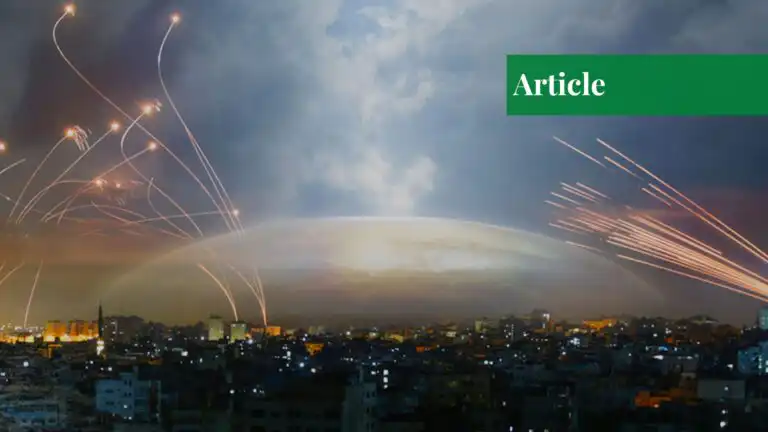

The concept of strategic stability and deterrence is at the core of maintaining peace and tranquility in the international arena. History is clear that states have always been engaged in the production of conventional and non-conventional weapons to attain supremacy and political clout and eliminate danger to their very existence. States build advanced weapons on the one hand to establish a culture of deterrence and on the other hand, build defense systems in an effort to reduce the threat of sovereignty violation. The production of a vast array of missiles ranging from Short Range Ballistic Missiles (SRBMs) with a range of about 300-1000 km, Medium Range Ballistic Missiles (MRBMs) with a range of 1000-3000 km, Long Range Ballistic Missiles (LRBMs) with a range of more than 5000 km, and Intercontinental Ballistic Missiles (ICBMs) of more than 10,000 km range has resulted in a very serious arms race and contest between the adversarial states.
With such deadly and advanced weapons technologies, the efforts for a powerful and robust defense system have become imperative for states to ensure the security of their strategic assets during a crisis. For this, states have built several advanced and somewhat ultimate defense systems, i.e., THAAD, Iron Dome, S-500, HQ-19, etc. These defense systems can detect, destroy, and target missiles and drones from various positions and ranges. These defense systems operate under different protective shields that can defend the homeland from different distances.
With developments in artificial intelligence, states have integrated their defense systems with AI-operated platforms, destroying their targets with precision and accuracy. Despite their multi-layered and real-time tracking capabilities, these defense systems have become limited in their function. Regardless of whether it is Israel’s Iron Dome, the US THAAD, the Russian S-500, or China’s HQ-19, modern warfare tactics have ensured that these defense systems have loopholes and harsh limitations.
Israeli Defense Systems
Israel, right from day one, has invested a lot in its defense and weapons systems. Surrounded by adversaries from all sides in the Middle East, it became crucial for Israel to take strategic superiority over the Arab world. Iran and its Axis of Resistance, comprising Houthis, Hezbollah, Hamas, etc., have always tried to challenge the zionist regime in the region. As Iran and its allies have developed thousands of missiles and drones to deter the Israeli military from attacking the Muslim community in the region, Israeli territory has become more exposed and vulnerable to missile strikes.
Consequently, Israel, with the help of the US and its European counterparts, has created, on the one hand, the deadliest and most advanced weapons and, on the other hand, a progressive multi-layered defense system to protect its homeland. The Israeli defense is composed of a three-tiered framework, consisting of the Iron Dome as the first line of defense, David’s Sling as the middle line of defense, and Arrow 3 as the top tier of defense. These defense layers are categorized into short-range, medium-range, and long-range for Israel’s protection.
Iron Dome System
Iron Dome is Israel’s primary defensive line against approaching missiles and drones. It is mobile because it can travel freely to evade approaching missiles. The Iron Dome system comprises three key components: Battle Management and Weapon Control, a Missile Firing Unit, and a Detection and Tracking Radar. In contrast, a standard Iron Dome battery consists of three or four launchers, each with the capacity for up to 20 interceptor missiles. The Missile Firing Unit is comprised of some 20 Tamir Interceptor missiles. A launcher can defend the space of a medium-sized city.
Battle Management and Weapon Control (BMC) is responsible for the system’s operation by intercepting only those missiles that will land in the defended area. Detection and Tracking Radar can detect the locations of artillery weapons up to 100 km in air defense operational missions. It can assess up to 1100 targets simultaneously in air surveillance mode. The interceptor missile never really strikes the rocket that is coming towards it. It explodes close by. It is a proximity interceptor, and that explosion destroys the incoming target.
David’s Sling
David’s Sling boasts a 40-300 km range compared to the Iron Dome defense system. David’s Sling defense system consists of three primary components: Battle Management and Weapons Control, Tracking Radar, and Stunner Interceptor Missile. The interceptor missile consists of two stages of propulsion. Stage one involves launching the interceptor missile, which separates after the burn. The second phase gives the interceptor missile a maneuvering capability based on the location of the incoming missile.
In contrast to Iron Dome, the David’s Sling system shoots a hit-to-kill interceptor that physically crashes with the approaching target, not a proximity explosion. This defense system is programmed to detect several tactical ballistic missiles, cruise missiles, rockets, and planes. It utilizes a Multi-Mission Radar—EL/M-2084—to follow, intercept, and target several approaching threats.
Arrow 3
The Arrow-3 missile defense system intercepts long-range ballistic missiles in outer space with a range of about 2,400 km. This implies that the interceptor missiles target the incoming threat before it enters the Earth’s atmosphere with a hit-to-kill capability. Like David’s Sling, it can detect and target multiple incoming missiles. One of the distinct features of the Arrow-3 defense system is that it can be combined with other systems, i.e., the US THAAD. It can intercept unconventional intercontinental ballistic missiles (ICBMs). The system is equipped with an EL/M-2080-Super Green Pine Radar, which gives it a multiple tracking and targeting feature with much higher resolution and accuracy.
Limitations of Israeli Defense Systems
As of June 2025, the confrontation between Iran and Israel has revealed the so-called ultimate characteristics of the defense systems of Israel. Israeli authorities assert that the Iron Dome had a 90% success rate. This is only theoretically true. However, in the real-time battle scenarios, just as Iran launched hundreds of ballistic missiles towards Israel, most of these missiles went through the so-called ultimate shield unscathed and successfully landed at their targets. This indicates the serious limitations of the world’s top defense systems and nullifies the concept of their ultimacy.
Limitations of the Iron Dome system are that a large web or barrage of missiles and drones can easily invalidate the defending capability of the systems, interceptors being expensive cuts down the cost-effectiveness, susceptibility to long-range missiles, and it intercepts only those targets that are aimed at populated areas. Limitations of David’s Sling include, unlike the Iron Dome, the system is less susceptible to combat testing, and the interceptors are costly. They can be fired in limited numbers only. The system can fail if a salvo of missiles or drones is simultaneously launched, and its radar can be jammed through electronic warfare measures. Furthermore, the Arrow-3 is vulnerable to Multiple Independently Targetable Re-entry Vehicles (MIRVs), and the massive cost of its interceptor diminished the capability to deploy an ideal number.
All these Israeli defense systems have never been utilized in response to any notable attack by an organized military. They had always intercepted targets approaching from Iran and its Axis of Resistance. This aspect further explains the limited scope of Israel’s missile defense systems. No missile defense system that has proven effective against multiple real-time incoming targets has yet been created. Therefore, the Israeli assertion of receiving 90% of the missile shield is political rhetoric and a theoretical underpinning.
Conclusion
The geostrategic competition to attain an ultimate defense umbrella against adversaries has fallen short in practice. Regardless of how advanced, destructive, or protective a system may be, its real-time combat environment is beyond theoretical foundations. To sum up, relying exclusively on the so-called ultimacy of missile defense systems will surely lead to a false sense of security and safety. Rather, great powers and global institutions must work towards arms reduction and control, disarmament, and conflict prevention to ensure a stable world order. Another better approach is the development of transparency, confidence, and cooperative security regimes between states to minimize dependence on offensive and defensive missile capabilities.
If you want to submit your articles and/or research papers, please visit the Submissions page.
To stay updated with the latest jobs, CSS news, internships, scholarships, and current affairs articles, join our Community Forum!
The views and opinions expressed in this article/paper are the author’s own and do not necessarily reflect the editorial position of Paradigm Shift.

He is pursuing a BS in International Relations programme from International Islamic University, Islamabad and has a keen interest in research works, policy analysis, defence and strategic studies and conflict resolution.