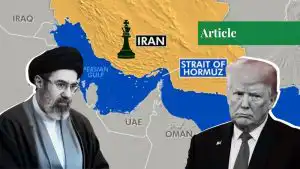

The world has, on occasion, witnessed historic moments in geopolitics and international relations, some inspiring genuine progress and development, others spectacularly demonstrating humanity’s knack for making things worse. The recent joint US-Israel military attacks on Iran fit neatly into the latter category. On 28 February 2026, both the US and Israel carried out coordinated military actions against Iran using surface-to-surface and air-to-air missiles along with drone strikes. The military action by the US was named “Operation Epic Fury”, and Israel named it “Operation Lion’s Roar.” US forces employed Tomahawk cruise missiles and fighter jets to hit Iran’s military installations, missile sites, command centers, and nuclear sites.
Recently, coordinated attacks by the US and Israel carried out with the help of intelligence on the location provided by the American Central Intelligence Agency (CIA) killed Iran’s Supreme Leader Ayatollah Sayyed Ali Khamenei. Sayyed Khamenei became Iran’s second supreme leader after Ayatollah Rohullah Khomeini in 1989. The illegal assassination of Khamenei marks an unprecedented and very terrible moment in the history of the Islamic Republic, altering the country’s entire political landscape and shaping the future regional political order in the Middle East.
Months ago, I argued that Trump’s return to the Oval Office would deepen Palestinian vulnerability and would adopt hardline regional policies in the Middle East region; since then, reality has depicted the same. Trump’s second tenure is, no doubt, closer to the imposition of creating “Greater Israel.” If global politics were a theatre, Washington would loudly declare itself the director. The US behaves less like a responsible state and more like a devoted son eager to please his political guardian, consistently waiting for directions and cues from Tel Aviv before delivering its lines. One can clearly say that Washington’s foreign policy toward the Middle East often resembles filial obedience masquerading as a strategic partnership.
Israeli Prime Minister Benjamin Netanyahu, a man who is accused of carrying out mass killing and genocide of Palestinians and has remained the epicenter of political debate on the international level, consistently receives fatherly treatment from Washington. When Netanyahu raises his political concerns about Iran, American jets seem ready to fly and bomb Iran. And when Gaza erupts, Washington’s statements follow with furious speed. It is a relationship so complex and synchronized that one becomes unsure who actually drafts the script and who merely performs it. Sometimes the duo (Trump-Netanyahu) escalates the tensions; sometimes they suddenly pull chairs, inviting countries for Peace talks. Yesterday, it was a direct invasion and occupation; today, it is management and control through legitimized authorities, economic ties, and strategic dependency, so no country can question their actions.
A very calculated strategic thought of this duo (Trump-Netanyahu) was that first they entangled Muslim-majority states in accord like the Abraham Accords, so the path of war should not be disturbed because states not in any military alliance or trade agreement may halt Washington’s pro-Israeli policies. In the results, Muslim-majority states find themselves bound by conditions created by the US. When a dominating power sets the terms and conditions, smaller states are left with limited room for independent foreign policy. Ultimately, peace seems very conditional; those who accept the rules of the game will enjoy hero treatment, otherwise, they will face harsh consequences, like Iran.
History reminds us that it was very easy for the West to invade Iraq and Libya in the Middle East, but it didn’t work in the long term. The entrances were swift and smooth, regimes collapsed, statues fell, trumpets were blown, and the “Mission Accomplished” banners looked impressive. Predictably, all failed in the long-term regime-change masterpieces. Today’s Afghanistan and Libya stand out as glowing monuments to Washington’s historical failures, which aimed at regime change and democratization, dramatically resulting in regional instability, the kind where chaos is permanent, and peace is theoretical. Iran is not Afghanistan; it is not Libya.
It is not an easy chapter in a regime-change script. Rather, it is ideologically rigid and courageous people who proudly beg for martyrdom. And history has this annoying habit of reminding great powers that toppling a leader is much easier than toppling its idea. Khamenei’s martyrdom in the Middle East for certain Washington policy makers may appear as a victory, but it also carries the weight that Iran may act more decisively now than ever before.
Following the martyrdom of Khamenei, three plausible scenarios can be anticipated, each carrying significance, shaping the regional order in the Middle East and institutional configuration. The post-transition phase, therefore, will be a critical determinant of regional order, stability, peace, chaos, and strategic alignments and balance of power across the region.
As the first scenario, Iran’s strategic direction after Khamenei would extensively depend on the orientation of the next Supreme Leader. If the theocratic framework still sustains, succession is likely to emerge from Shia clerical circles, with figures such as Mojtaba Khamenei, often discussed as potential Supreme Leader. In this situation, Tehran will pursue a more uncompromising and forceful strategic foreign policy aimed at countering Israeli and American influence at any cost. Another scenario is that the Islamic Revolutionary Guard Corps (IRGC), which is the most powerful military wing in Iran, may take over the political reins either overtly or behind the scenes, consolidating more decisive political authority and control over Iran’s domestic and foreign affairs. Under these possible scenarios, Tehran would possibly transform into a more security-oriented state.
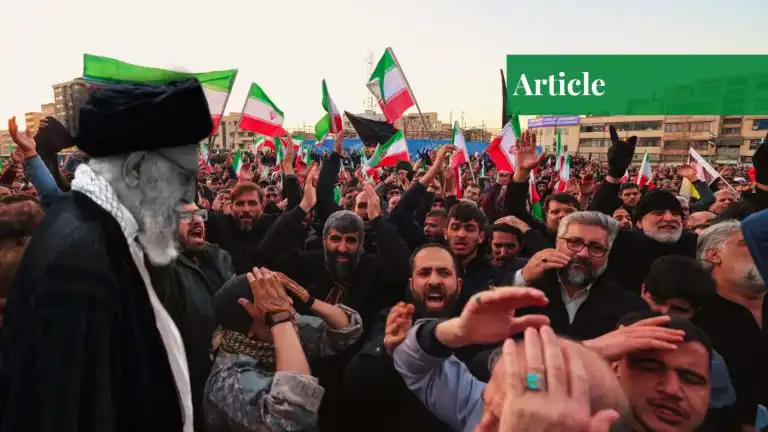
Lastly, though theoretically possible, a reform scenario in Iran remains unlikely. However, recent waves of protest across Tehran and many other cities, despite their intensity, were decisively managed by Iranian authorities, demonstrating strong institutional control rather than systemic breakdown. Moreover, the idea that external war pressure, such as heavy bombing, would compel Iran to negotiate and reach an agreement for democratization and power transition plays straight into what the West has followed throughout history, a familiar Western playbook: create harsh conditions first, then pull chairs for table talk as the only option to escape. Given this, the likelihood of west-oriented so-called reforms under such duress appears even lower.
Khamenei’s fall may appear to the Oval Office and Tel Aviv as the masterstroke of a carefully calculated gambit, yet history has a way of humbling even the most confident experts and architects of chaos. Iran, with its firm standing forged in decades of ideological grit and strategic defiance, is unlikely to surrender or bow to foreign-imposed realignments proposed by history’s lethal architects of geopolitics. The illegal assassination of any leader can grab global attention, but it cannot break the structural, civilizational, and foundational pillars of the Islamic Republic. For Western policy-makers, it is the grim reminder that decapitation may win applause and Twitter trends, but it rarely creates long-term peace and stability.
If you want to submit your articles and/or research papers, please visit the Submissions page.
To stay updated with the latest jobs, CSS news, internships, scholarships, and current affairs articles, join our Community Forum!
The views and opinions expressed in this article/paper are the author’s own and do not necessarily reflect the editorial position of Paradigm Shift.

Sajjad Ali Memon is currently pursuing his bachelor's degree in peace and conflict studies at the National Defence University, Islamabad. He is also a daily contributor to several prestigious newspapers in Pakistan, including Dawn, The News International, The Express Tribune, and The Nation. His area of interest involves Middle Eastern geopolitics, security, and the foreign policy of the US and Russia.