
The Strait of Hormuz and the Fragility of Energy Trade
The conflict in Iran, along with the threat posed to the Strait of Hormuz, has been a stark reminder that we remain very reliant upon maritime commerce. In a world of highways, railways, and aircraft shuttling goods from one location to another, shipping vessels continue to transport over half of international trade by value and almost 85% by volume.
Now, the first thing to stress here is that while there are lots of other potential choke points, the Strait of Hormuz is particularly crucial for global trade for the simple reason that there just isn’t really another way around it. The Strait of Hormuz is the only maritime route out of the oil-rich Persian Gulf into the rest of the world. There are a couple of other potential choke points that fit this bill. The Turkish Straits are the only way out of the Black Sea, for instance, and the Danish Straits are the only way out of the Baltic Sea. But neither of these is as important to international trade and especially energy markets as the Strait of Hormuz. Basically, every other big choke point has alternative sea routes.

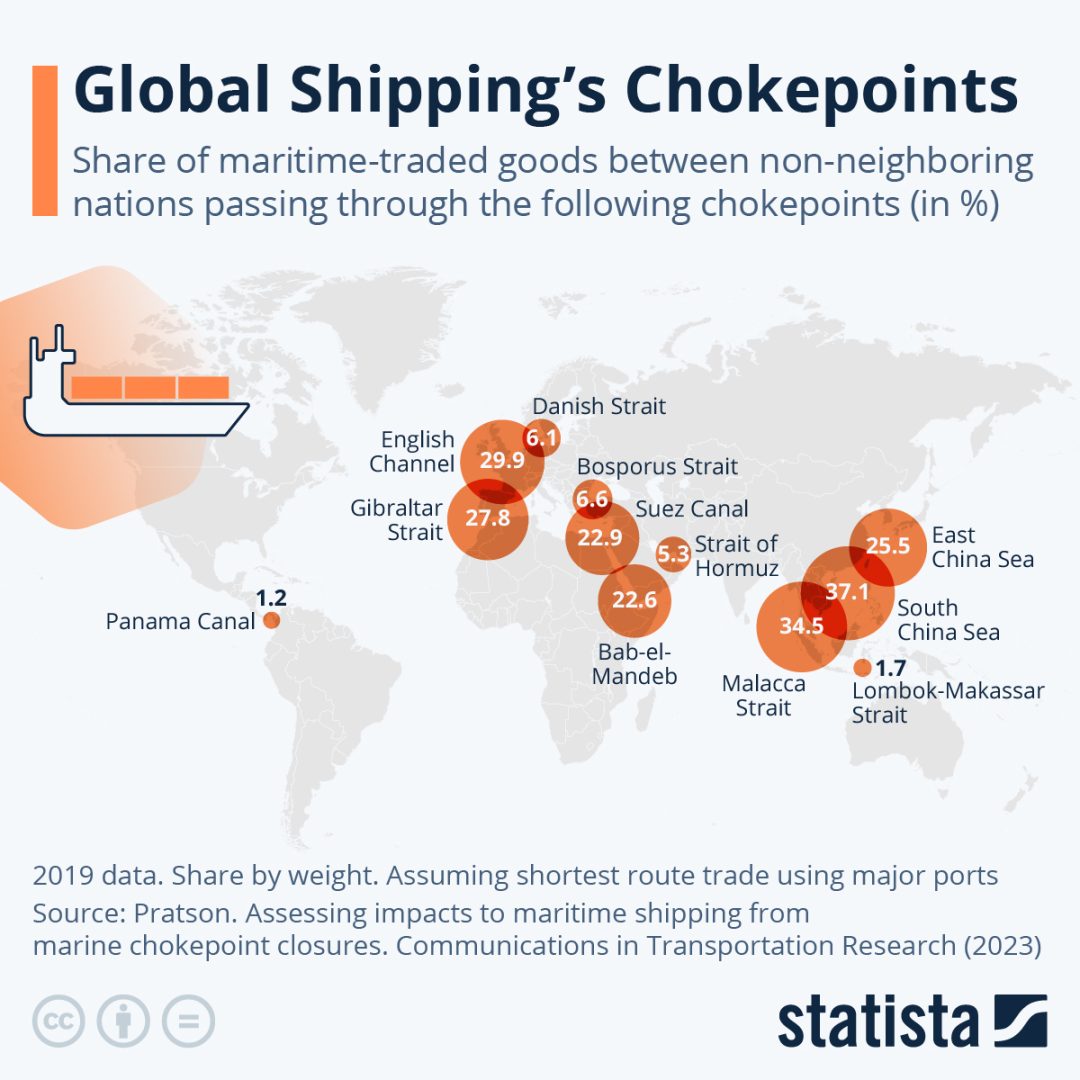
Global Oil Shipments Depend on Major Chokepoints by Anna Fleck licensed by Statista under CC By N.D 4.0
Now, since the de facto closure of the Strait of Hormuz, several affected countries have found creative workarounds to keep their oil and gas exports up. Iraq, for instance, has leaned more heavily on pipeline exports to Turkey. The UAE has exported more from the port of Fuera, which sits on the other side of the Strait of Hormuz. And the Saudis have been using their East-West pipeline to transport oil across the country to the Red Sea. But this is far from a perfect solution. None of these alternative routes has the capacity to fully replace trade through the strait. Otherwise, the world wouldn’t be in this mess. And things could get a lot worse if the Bab al Mandab, the next choke point on our list, were to be shut.
The Bab al Mandab and the Red Sea Corridor
For background information, the Bab al Mandab means “gate of sorrow.” It is a narrow strip of water that links the Red Sea with the Gulf of Aiden, hence the Indian Ocean. The majority of sea trade conducted from Europe to Asia uses the Bab al Mandab route, making it much more significant than the shorter one.
According to an analysis by The Economist, for instance, 16% of all seaborne trade by value passes through the Bab al Mandab compared to about 6% for the Strait of Hormuz. Now, the reason why the Strait of Hormuz gets more attention is that it’s usually more central to the international energy markets. In normal times, 20% of all oil and gas trade consumed by the world passes through the Strait of Hormuz compared to 10% by Bab al Mandab.
This has changed in recent weeks as it has been mentioned previously that Saudi Arabia started relying more heavily on exports via the Red Sea, which mostly flow out towards Asia via the Bab al Mandab. Unfortunately for both the Saudis and the global economy, on March 28th, 2026, the Houthis, who are widely considered an Iranian proxy outfit and who control most of southern Yemen, announced that they would be joining the war. So far, this has mostly involved sending the occasional missile towards Israel. But there’s been some speculation that if the war continues, the Houthis could escalate by targeting ships passing through the Bab al Mandab.
Even if the Houthis, who have a degree of operational independence from Iran, decide against it, it’s still within striking distance of Iran. Last week, an unnamed Iranian military official told the semi-official Tasnim news agency that Iran was considering opening a new front at Bab al Mandab if Trump plans a ground invasion.
If this were to happen, it would be pretty terrible news for trade between Europe and Asia, given that the next most direct maritime route includes an 8,000 km detour of Africa.
Other Major Maritime Chokepoints and the Global Trade System
Suez Canal
In fact, there are only three other choke points in the global economy that would cause a similar inconvenience to shipping. The first is the Suez Canal, which sits at the top of the Red Sea and is effectively part of the same route as the Bab al Mandab. Like the Bab al Mandab, the closure of the Suez Canal would be terrible for Europe-Asia trade, and four ships would have to go around the Horn of Africa.
Panama Canal
The second is the Panama Canal, which is incredibly important for maritime trade between the east and west sides of America and for trade between America’s east coast and Asia. Its closure would force ships going between America’s east and west coasts to go all the way around South America and force ships going between America’s east coast and Asia to go via the Atlantic rather than the Pacific, which takes about 50% longer.
Strait of Gibraltar
The third is the Strait of Gibraltar, which sits between Morocco and Spain and is especially important for trade between the Mediterranean states and both America and the rest of Europe. This choke point doesn’t really get as much attention as the others because, well, everyone sort of assumes it will always be open, but its closure would be incredibly disruptive. Not only would it force an absolutely insane detour all the way around Africa up through the Bab al Mandab and then the Suez Canal, but it would also prove massively disruptive to the global economy. Given that, according to a study, something like 20% of the world’s maritime trade by value passes through here more than any other strait.
Strait of Malacca
In fact, the only strait that hosts more trade is the Strait of Malacca, a stretch of water sandwiched between the Indonesian island of Sumatra and the Malay Peninsula with Singapore at its southern tip. The Strait connects the Indian Ocean in the west with the South China Sea and Pacific Ocean in the east, and as such is vital for maritime traffic traveling between East Asia, the Middle East, Africa, and Europe. China is particularly dependent on the Strait of Malacca, which accounts for something like two-thirds of all of China’s maritime trade and about 3/4 of its oil imports. In 2003, Chinese Premier Hu Jintao coined the term Malacca dilemma to refer to this precarious dependence on the strait and the associated risk that some future adversary, perhaps the US, might block the strait in the event of a conflict.
Taiwan Strait
But it probably wouldn’t be the end of the world, given that there are lots of alternative routes that don’t require massive detours. This is true for most of the nearby straits, too, like the Taiwan Strait between Taiwan and the Chinese province of Fujian and the Korea Strait between South Korea and Japan. They witness a large amount of trade. However, they are easily circumvented.
If you want to submit your articles and/or research papers, please visit the Submissions page.
To stay updated with the latest jobs, CSS news, internships, scholarships, and current affairs articles, join our Community Forum!
The views and opinions expressed in this article/paper are the author’s own and do not necessarily reflect the editorial position of Paradigm Shift.

Muhammad Haseeb Sulehria is a student of Defense and Strategic Studies at Quaid-i-Azam University, and a former internee at Pakistan’s Ministry of Defense. With a keen interest in national and international affairs, he actively explores issues of security, strategy, and global politics, aspiring to contribute to policymaking and peacebuilding.