

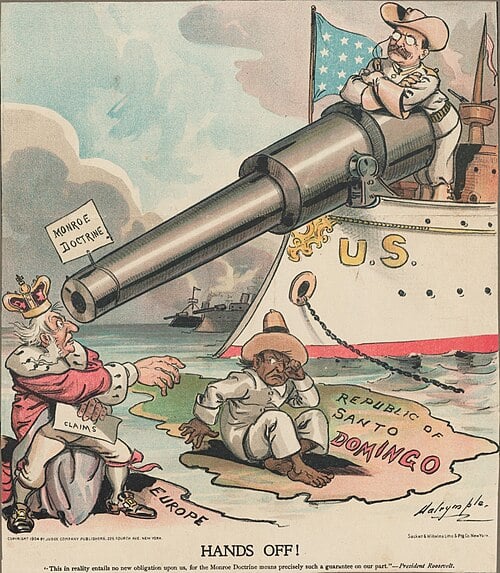
For nearly 200 years, the Monroe Doctrine has loomed above the Western Hemisphere like a historic shade; there is the formal appeal, more commonly exercised tacitly. It was written in 1823 as a warning about the effects of European colonialism in the Americas, but was sold as a means of protection for newly independent states. The shield nowadays, however, is more and more like a sword. It would be no overstatement to assert that what we are currently experiencing in the 21st century is a Monroe Doctrine 2.0: a rejuvenated imperialistic mental approach dressed in the clothing of security, democracy, and rules-based order, but executed by the means of coercion, economic warfare, and geopolitical intimidation.
The most obvious result of this revival is the persistent pressure the US is exerting on Venezuela. Over the years, Washington has sought a course of absolute pressure that includes debilitating sanctions, diplomatic isolation, confiscation of assets, and barely disguised rhetoric of regime-change. Though such actions are often excused as procedures aimed at restoring democracy, the actual effect of their implementation tells another tale. The sanctions have destroyed the economy of Venezuela, aggravated humanitarian misery, and limited access to food, medicine, and other basic facilities. However, the pressure still exists even though this method has failed to generate any political change. Such continuity is telling: it is not about democracy, but more about control, control over political results, over energy supplies, and regional orientation.
The attitude of the United States toward Venezuela has a stronger imperialistic overture, the idea that Latin America is its natural domain. Any government that is not accommodating of US tastes, particularly one that tries to find alternative collaborations with China, Russia, and Iran, is seen as not a sovereign but a strategic threat. This can be called the Monroe Doctrine re-packaged in the era of sanctions and financial warfare.
Tanks are substituted with trade embargoes, and invasions with economic strangles, but the principle is the same: obey or suffer. The thing about Monroe Doctrine 2.0 is that it is not only as harmful as before because it is no longer restricted to Latin America. According to the recent rhetoric and activities, it now seems that even the places that are located far beyond the conventional backyard are to be taken as prey. Greenland is a striking case. That the US leadership, publicly, could contemplate buying or otherwise strategically controlling Greenland was not merely diplomatically preposterous; it was ideologically disarming. It was a colonialist attitude that sees land, people, and even sovereignty as a commodity that can be bargained upon in case the great-power interests are endangered.
To the indigenous people of Denmark and Greenland, the message made was disturbing: strategic value is more important than self-determination. Such an attitude is not unique to Greenland. Washington has become more of a global gatekeeper through coercing the Caribbean states to take the American side, threats to countries that deal with the Belt and Road Initiative of China, and much more. States are not just encouraged to make their decisions responsibly; they will be pressured to choose sides with the help of aid conditionality, threats of sanctions, or diplomatic isolation. Neutrality, which was once a valid sovereign position, is now viewed as being disloyal.
The proponents of the US policy claim that such measures are needed to combat authoritarianism and guarantee worldwide stability. This argument fails on its own, though. The US has been incredible in accommodating authoritarian allies as long as they do not hurt its strategic interests. This hypocritical morality lays bare the true roots of the Monroe Doctrine 2.0; not principles but power. Democracy is turned into an instrument of convenience that is used to strike against enemies but disregarded when it is inconvenient. Besides, this new doctrine is coercive, and it is contributing to the rapid global fragmentation. Those who are under American pressure are turning to other options, trading in non-dollar currencies, regional blocs, and closer alliances with other powers.
Paradoxically, it is the same policy that was supposed to maintain American hegemony, which is destroying it. Through the weaponization of sanctions and financial systems, Washington has transformed interdependence as a liability, thereby inviting others to develop parallel systems outside the reach of US control. The ethical cost is also great. Sanctions or diplomatic isolation cannot serve as a way to promote international law or humanitarianism. It is everyday citizens who suffer due to geopolitical tussles, not of their own choice. The term saving the people is empty in the case of Venezuela, where the very same people are subjected to shortages, inflation, and deteriorating living standards that are directly attributed to the outside pressure. The imperial policy, which boasts of moral superiority and causes mass suffering, is neither ethical nor sustainable. There are also dangerous implications of Monroe Doctrine 2.0 on small states in the world. The meaning of the fact that sovereignty can be subjugated by the so-called strategic interest is that no nation is safe. It is now Venezuela or Greenland, it may be tomorrow any state that has resources or geography or political decisions that conflict with the interests of a great power. This loss of sovereignty legitimizes a world in which might constitutes what is right, a world that the international community was supposed to outgrow after the disasters of the 20th century.
To conclude everything stated so far, the resurgence of this doctrine is a kind of American concern regarding a shifting world order. With the US’s relative power decreasing and the emergence of multipolarity, coercion will replace consent. History gives a clear lesson, though: empires built on pressure and not legitimacy ultimately find opposition, degradation, and loss of credibility. Power gained by cooperation is long-lasting; power by force, resentment. The world should not have a Monroe Doctrine 2.0. It requires a forward engagement about true multilateralism, respect for sovereignty, as well as dialogue rather than domination. The huge resources and world presence of the United States are sufficient to become a stabilizing effect- but only when it sheds the imperial reflexes of a bygone age. Ultimately, it is not merely about America being able to continue to impose its will, as it has so many times, but about whether it ought to. The answer is getting more visible in an increasingly conscious, interconnected, and coercion-resistant world. Imperial visions, regardless of how new their wrappings, have been part of the past. And the faster Monroe Doctrine 2.0 may be buried, the better the prospects of a more balanced and fair international order.
If you want to submit your articles and/or research papers, please visit the Submissions page.
To stay updated with the latest jobs, CSS news, internships, scholarships, and current affairs articles, join our Community Forum!
The views and opinions expressed in this article/paper are the author’s own and do not necessarily reflect the editorial position of Paradigm Shift.

Abdul Rehman is a BS International Relations student at the International Islamic University Islamabad (IIUI). His academic interests include foreign policy analysis, global power transitions, coercive diplomacy, and international political economy.