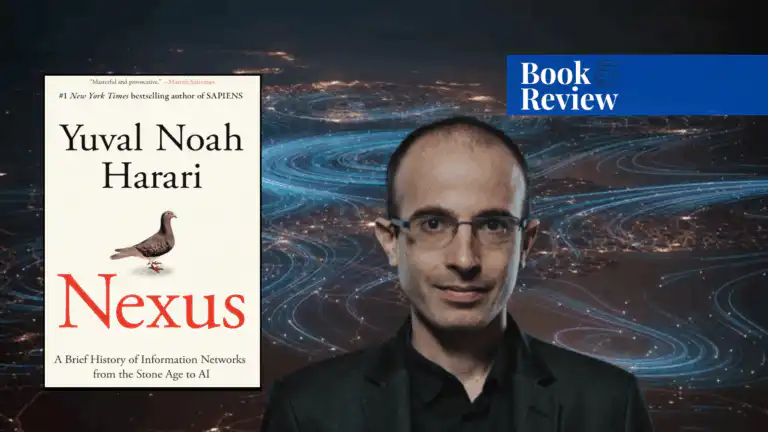

In “Nexus: A Brief History of Information Networks from the Stone Age to AI” (2024), Yuval Noah Harari provides a broad analysis of the role information networks have played in the path of human history, in the structuring of societies, and the shifting dynamics of power relations. He challenges the idea that equates information with truth, arguing instead that information plays primarily as a tool for creating “formation”—that is, connecting disparate parts into networks that form structures of society. This approach redefines information as something that is less about conveying facts and more about forming networks that shape human interactions, politics, and power. This is best explained by Harari’s provocative stance, as in the case of horoscopes, which connect people through astrological “formations” and propaganda and songs that align citizens or soldiers into political and military formations.
Central to his thesis is the notion that power is derived not from individual actions but rather from collaborative efforts enabled by interconnected networks. These networks depend upon various constructs, such as myths, documentation, institutions, and, more recently, algorithms, to establish societal order, frequently compromising truth in the process. Historical networks, exemplified by medieval religious institutions, have managed information strategically to uphold power, illustrated by the Catholic Church’s dominance over sacred writings. Algorithms curate digital realities in modern societies, controlling information flow and also shaping public discourse behind a veil of obscurity often difficult to scrutinize; this is a new sort of power, where the telling of the story is a function not only of institutional control but also of how algorithms determine what people see, believe, and don’t.
Harari also reflects on the role of bureaucracy as a network instrument. Bureaucratic structures, established to address the “retrieval problem”—the difficulty associated with monitoring inter-subjective constructs like laws, currencies, and corporations—are vital for the administration of intricate societies. Nonetheless, Harari emphasizes that bureaucracy frequently skews comprehension by enforcing an artificial order, which he characterizes as a Kafka-esque system of concealed authority. Although these systems are crucial for the governance of extensive networks, they can also be disorienting and repressive, masking the authentic dynamics of power and control.
In his analysis of nascent realities, Harari articulates the concepts of “inter-subjective realities” and “inter-computer realities.” Inter-subjective realities are defined as the common beliefs shared by groups—such as nations, corporations, and religions—which define human cooperation and conflict patterns. These common beliefs are crucial for establishing social norms and sustaining large-scale cooperation. Additionally, Harari explores “inter-computer realities,” referring to the networks of interconnected algorithms and machines. The contemporary realities, shaped by artificial intelligence and algorithmic decision-making, have the power to reshape societies with a depth like that of traditional myths. For example, in China, the social credit system uses AI to analyze the behaviours, financial activities, and choices of citizens, rewarding conformity and penalizing opposition. This shift towards algorithmic governance marks the growing reliance on artificial intelligence in authoritarian governments, where these technologies are used for surveillance and the control of entire populations.
Harari’s analysis extends to modern case studies that illustrate how information networks shape political power. He critiques the role of social media algorithms in political events like the Rohingya genocide in Myanmar (2016-2017) and the rise of Jair Bolsonaro in Brazil (2018). These cases show how digital networks can both reflect and influence societal behaviours, often with devastating consequences. The function of algorithms in the formation of political polarization and their effect on public sentiment underscores the increasing influence of digital networks and their capacity to sway considerable portions of the populace.
When examining the framework of ethical information systems, Harari presents four foundational principles. Initially, he emphasizes the importance of “benevolence,” placing human welfare at the forefront of the development of interconnected systems. Second, he focuses on “decentralization,” which holds that there should be a prohibition of central control over information to protect personal liberties. Third, he appeals to “mutuality,” where information systems are not opaque but transparent so that the users know and access the systems that monitor them. He also emphasizes “adaptability,” arguing that systems that are designed should be human-changeable and allow for self-correction against permanent judgment or control.
In his exploration of the impact of AI on governance, Harari highlights both the potential and dangers of algorithmic control. AI has become integral to human decision-making, from healthcare to governance, as Alan Turing predicted in the 1940s. The efficiency of sectors like health care can be improved by the prediction of diseases and by improving treatments, but he also points out the dark side of this technology. In authoritarian regimes, artificial intelligence is employed to facilitate continuous monitoring, impose penalties on dissenters, and curtail individual liberties. Although this application of AI is more efficient than traditional human surveillance, it simultaneously diminishes the autonomy of leaders, rendering them reliant on technology for the preservation of authority.
Harari delineates the differences in information dissemination between democratic and authoritarian systems, highlighting that democracies permit self-correction via mechanisms such as freedom of expression and an independent judiciary. In democratic systems, errors in information dissemination are gradually corrected, ensuring that the truth reaches the people. In authoritarian systems, however, information is often fabricated and presented as error-free, suppressing truth and manipulating public perception. The “Great Firewall” in China exemplifies this control, as it restricts access to information and creates the illusion of flawless governance. Harari posits that the variance in information dissemination plays a crucial role in influencing a society’s capacity to maintain its democratic status or devolve into authoritarian rule.
The influence of artificial intelligence in shaping these power relations is profound. Harari examines how populist figures such as Donald Trump and Narendra Modi have harnessed AI-augmented mass media and social media algorithms to disseminate false information and sway public perception. The technologies that once were meant to enhance communication had been diverted to spread propaganda, to vilify opponents and create echo chambers in which existing biases are echoed. Such manipulation of information, therefore, is a clear threat to democratic systems that rely on the public for making informed decisions.
Harari further discusses how artificial intelligence supports authoritarian governments by maximizing decision-making processes and adding efficiency to operations. In the Soviet Union under Stalin, the emphasis on defence came at the expense of economic growth and human development. Today, AI allows authoritarian rulers to refine their decision-making processes, increasing their efficiency in maintaining control. China’s social credit system exemplifies this, as AI monitors citizens’ behaviour and rewards compliance while punishing dissent. This reliance on AI reduces the autonomy of the ruler, as they become dependent on technology to maintain order.
Harari’s concept of the “Silicon Curtain” is a final, critical point. He argues that the growing divide between digitally advanced nations and those left behind could create a new global split, much like the Cold War’s “Iron Curtain.” The AI arms race could lead to a new form of global power where technologically dominant nations hold unprecedented control over global affairs. The extent to which artificial intelligence and digital information systems either consolidate or fragment global unity is contingent upon the management of these technologies—specifically, whether societies employ them to bolster democratic principles or to entrench authoritarian governance.
Nexus by Yuval Noah Harari offers a significant and relevant analysis of the impact of large networks on the trajectory of human history and the future dynamics of power. Based on his observations of inter-subjective relations, the influence of networks, and the impact of artificial intelligence, Harari outlines an effective critique of using information systems in the governance and organization of societies. The suggestions he provides for the development of ethical information systems provide a solid foundation for responding to the challenges presented by digital technologies while ensuring the systems are designed around people’s well-being, liberty, and transparency.
If you want to submit your articles and/or research papers, please check the Submissions page.
The views and opinions expressed in this article/paper are the author’s own and do not necessarily reflect the editorial position of Paradigm Shift.