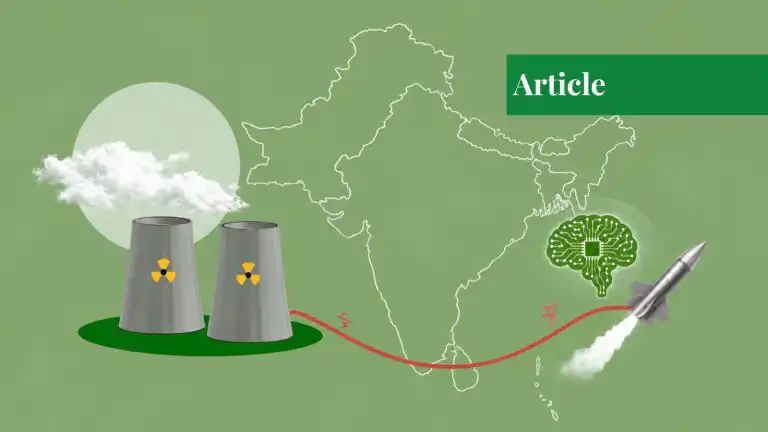
The gap between India’s cross-border airstrike at Balakot and Pakistan’s air strike response was just hours on the morning of February 27, 2019. That one window provided for back-channel political discussion and deliberate escalation control. In the event of a similar crisis in 2026, it could be reduced to minutes or seconds. The difference is the technology of artificial intelligence.
AI is being embedded into the C4ISR system as part of India’s and Pakistan’s nuclear force postures. India’s NETRA-like early warning system and Pakistan’s defense as an Integrated Air Command and Control System (IACCS) have been upgraded to use machine learning to identify, categorize, and suggest countermeasures to threats that are received. This article states that South Asian nuclear stability is unknown structurally as a danger of algorithmic compression in the Observe-Orient-Decide-Act (OODA) cycle. Doctrinal hours turn into tactical milliseconds during the compression process. The next confrontation in the subcontinent could be decided by, rather than a PM or a general, the confidence score of a classifier.
The OODA Compaction Process
In fact, Col. John Boyd’s OODA loop, which was developed to address tactics in air combat, has become a cornerstone element of deterrence theory. The “observe” phase is the sensor collection. Contextual analysis is needed in the “orient” phase. Political authorization is required at the “decide” phase. The “act” phase entails force employment. A classic nuclear incident would take minutes to hours for each phase. This length of time fostered conflict and helped to clarify misunderstandings before escalation.
Temporal architecture has been completely revolutionized by AI. The ground radar, signals intelligence, and satellite imagery can now be combined into one threat picture within milliseconds using machine learning algorithms. The Defence Research and Development Organization (DRDO) of India has openly spoken of the use of artificial intelligence (AI) in the field of ballistic missile defence. These applications can drastically cut sensor-to-shooter response time. In response, Pakistan has pre-delegated the launch authority of its short-range Nasr (Hatf-9) system to battlefield commanders in response to the Cold Start Doctrine. This negates the need for the National Command Authority in tactical situations.
The risk appears to be at the intersection of these two trends. AI’s ability to shorten orientation to milliseconds, and the human decision-maker has already been circumvented in the case of tactical nuclear weapons, making the dividing line between conventional and nuclear escalation obsolete. The probability of unintended escalation increased by a significant percentage when decision timelines were made more urgent in a simulation by the Center for International Security and Cooperation (CISC) in 2024, in which humans were forced to rely on artificial intelligence (AI) to make decisions under ambiguous sensor conditions.
Pre-boost Dilemma and Hypersonic Weapons
With the advent of hypersonic glide vehicles (HGVs), the compression problem becomes severe. The reported development program for HGV in India shortens the early warning period. Ballistic missiles typically have a warning time of 10-15 minutes. For HGVs, this is less than 150 seconds. If missiles are fired from central India to northern Pakistan, then the time of flight is even shorter.
This is called the pre-boost vulnerability by this author. The time is known as this vulnerability, and it’s the interval between when a missile is detected while powered up and when classification of the missile becomes reliable at high altitudes. A normal Agni-P missile test or even a meteorological rocket could be identified as a nuclear-armed HGV by the AI system running at high speed. On the other hand, an AI system designed to be effective at accuracy might be too slow. This delay gives a real first strike the opportunity to take out command and control nodes.
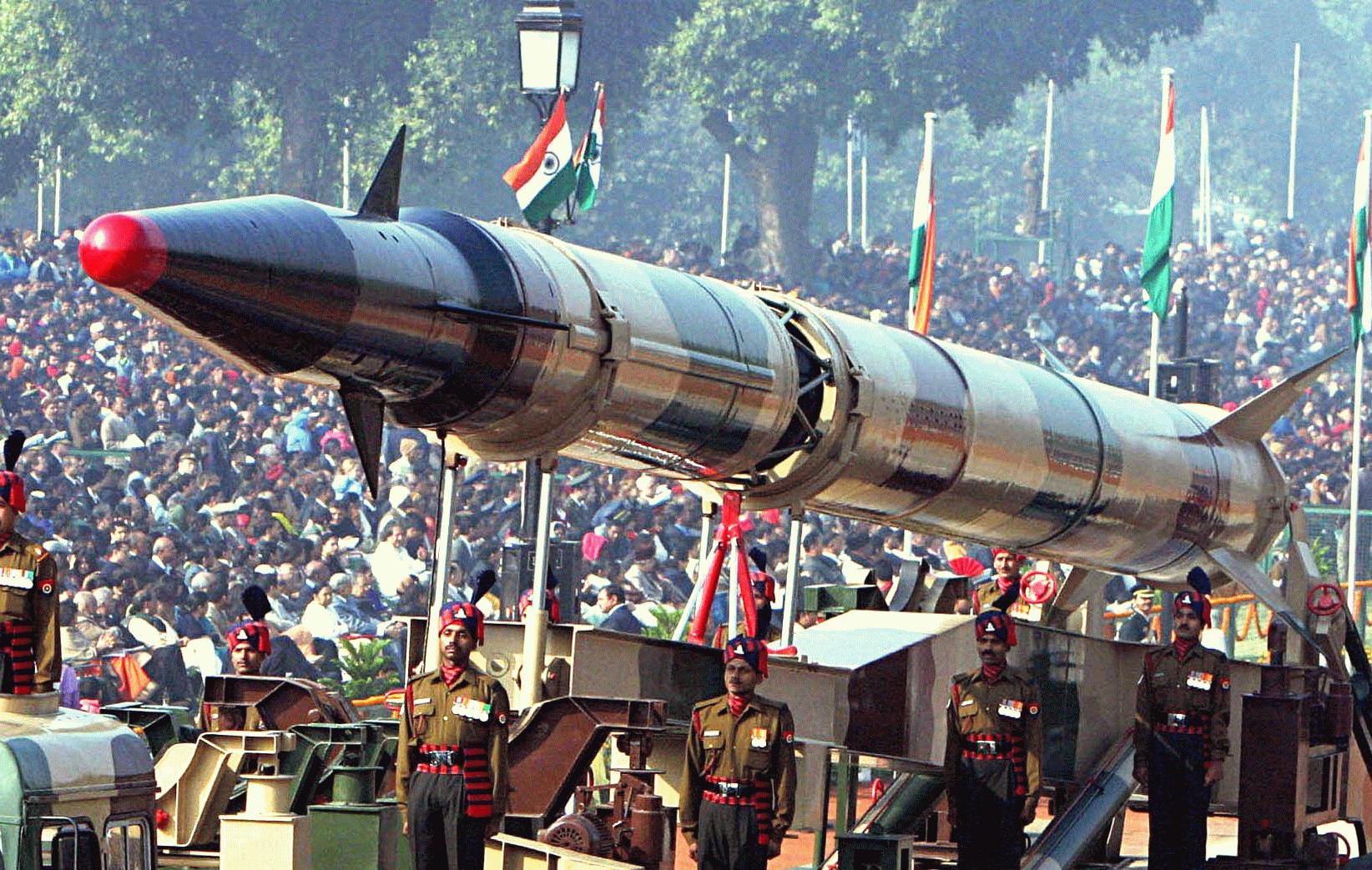
This vulnerability is further accentuated by Pakistan’s Full Spectrum Deterrence (FSD) doctrine. The doctrine is based on the use of short-range battlefield nuclear weapons and swift reaction. Pakistan’s second-strike survivability will be compromised if India’s AI can hit Pakistan’s underground C4ISR bunkers with precision in 90 seconds once they are detected. Once Pakistan detects these bunkers, if India’s AI can hit them with precision in 90 seconds, then Pakistan’s second-strike survivability will be compromised. From a game-theoretic point of view, the rational thing to do is to launch-on-warning or launch-under-attack. But, in the event that the warning is originated by a machine, one that can’t determine the difference between a conventional strike and a nuclear strike, stability breaks down.
The Cyber-Network Liability
OODA compression is no simple technical challenge. It is also a cyber-physical. An adversarial machine learning method exists to “poison” training data or add bogus radar tracks in a crisis. A recent 2023 article in IEEE Security and Privacy showed that even a typical threat-classification artificial intelligence could be tricked by selectively adding noise to satellite images. The AI was fooled into recognizing a commercial airplane as a ballistic missile reentry vehicle.
This is an extreme vulnerability in the India-Pakistan situation. Both countries’ air defense systems can be spoofed and jammed by GPS and EW. A non-state actor or third-party state can create false radar tracks. These could simulate several launches of Agni-V from underground launch pads in Rajasthan. Assume it takes 90 seconds for India’s AI to recommend going for the launch-on-warning and an additional 90 seconds for human overrides, which may cause Pakistan’s AI to consider a mobilization as an incoming strike. Pakistan’s AI is even shorter-term. It might automatically retaliate.
It will no longer be a film set. Documented cyberattacks against the Pakistani air defense networks were seen in the 2019 Pulwama-Balakot crisis. If a crisis were to repeat itself in 2026, it would happen at machine time, as the AI was part of those networks.
Policy Implications
Based on this analysis, three prescriptions of action are derived.
The two countries first need to negotiate algorithmic deconfliction procedures as a technical annex to the Agreement on Reducing the Risk of Accidental Nuclear War signed in 2007. Mutual notification of AI model retraining timelines, a shared cryptographic hash chain for missile test telemetry, and machine-readable semantic tagging of the communications in crisis hotlines would all be part of these protocols.
Second, Pakistan needs to rethink its second-strike survivability in terms of algorithmic redundancy. If deployed three times independently and without communication between the AI classifiers (Bayesian, neural-net, rule-based), with a “two-entity confirm” rule, this would ensure that there would be no retaliation against a false positive. This strategy preserves the efficiency of AI with a safeguard against system-biased errors.
Thirdly, both countries should have a pre-boost phase norm, which is non-targeting. AI systems will be programmed not to set targets on any booster track until it reaches an altitude of over 200 km. The norm sets an implied “keep-out zone” on algorithmic targeting. It brings strategic decision-making with human consideration.
The broader context is not a pleasant one. It is logically forcing the transfer of nuclear power to the machines in advance. South Asia is the most vulnerable part of the world with respect to this algorithmic compulsion due to its geographical location and the doctrinal differences. Technical solutions are not enough to solve the problem. It also demands a change of mindset on how deterrence actually functions in the case of time as a weapon.
If you want to submit your articles and/or research papers, please visit the Submissions page.
To stay updated with the latest jobs, CSS news, internships, scholarships, and current affairs articles, join our Community Forum!
The views and opinions expressed in this article/paper are the author’s own and do not necessarily reflect the editorial position of Paradigm Shift.

Haseeb Ahmed is a student of the National Defence University, Islamabad. He is pursuing his bachelor's in strategic studies from NDU.