“The supreme art of war is to subdue the enemy without fighting.”
— Sun Tzu, The Art of War.
What was once enunciated by the ancient military strategist in his famous work now seems to be evolving not as a tactical gain in warfare but as a pillar of national deterrence. From siege warfare to guerrilla warfare, the post-fact era is undergoing a significant metamorphosis. This shift is changing the dynamics of the world order created after World War II, which still rests on offensive and defensive capabilities. Acknowledging the threat that nation-states may confront, there is a dire need to overcome this form of manipulative warfare. In the following piece, we scrutinize how psychological warfare poses a threat to the existing world order.
Genesis:
The term psychological warfare, also known as cognitive warfare, has gained profound relevance in the modern era, or what we call the post-Cold War era. For a long time, nation-states exercised military combat — hybrid, guerrilla, naval, air, and ground combat — to secure a diverse range of territories. Today, military superiority has taken a quite distinct trajectory characterized by narrative manipulation and the erosion of people’s cognitive abilities. The aim is to widen the gulf between reality and delusion and to weaken the morale of nation-states. Although the work on psychological warfare was first published by Paul M.A. Linebarger in his book Psychological Warfare (1948), followed by Michael T. Stevens’ The Art of Psychological Warfare (2016), the discussion has regained momentum in recent years.
Defining Psychological Warfare:
Psychological warfare, occasionally called PsyOps, is rewriting the rules of modern wartime strategies. Most of us associate psychological warfare with propaganda, yet it is a multidimensional concept ranging from technological, social, and economic domains to political exploitation. Analysts define it as the use of propaganda and disinformation, empowered by algorithms, to captivate immature minds by triggering their emotional values, reshaping individuals’ attitudes and perspectives, and disseminating false narratives to serve petty interests. It aims to outmaneuver rivals by mortifying their morale, diminishing their resolve to fight, distorting their cohesion, and obstructing their efforts by anticipating their next move.
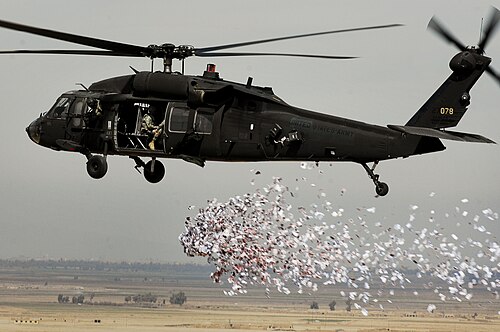
Soldiers from the U.S. Armyís 350th Tactical Psychological Operations, 10th Mountain Division, drop leaflets over a village near Hawijah in Kirkuk province, Iraq, on March 6, 2008. The leaflets are intended to promote the idea of self-government to area residents. DoD photo by Staff Sgt. Samuel Bendet, U.S. Air Force. (public domain)
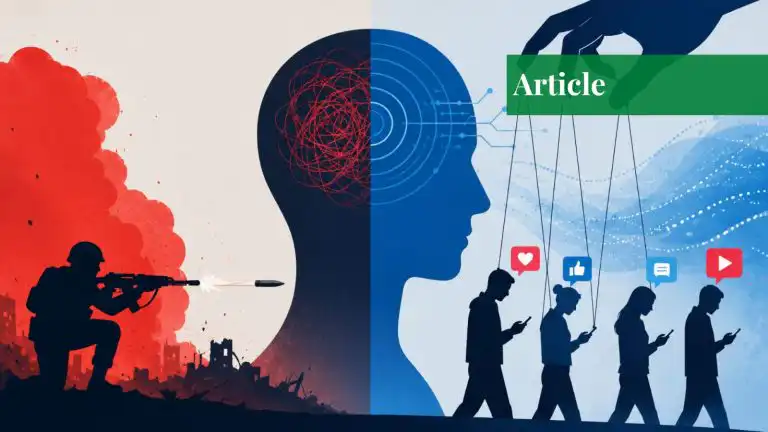
Since the advent of AI, both cyberwarfare and PsyOps have gained prominence as the battles are fought more through technology than through direct military confrontation. This seismic shift—from bullets to algorithms—has blurred the line between war and peace, creating a new reality in which the human mind has become the ultimate battlefield. Previously, battles were carried out to defeat the enemy, but now, defeating cognitive abilities has become an instrument of deterrence.
Background: Transformation from Deceit to Defense
Psychological warfare is not a new concept; its roots are deeply entrenched in ancient civilizations. Before the advancement of technology, ancient civilizations adopted these strategies to weaken opponents before their actions posed any threat to them. Sun Tzu, in his major work, argued that “All warfare is done on deception.” Ancient China, therefore, applied the psychological warfare tactics suggested by the military strategist to their policies. Moreover, the Roman Empire adopted this form of warfare to instill in people a fear of disobeying the ruler. Furthermore, the Mongol emperor Genghis Khan also cultivated psychological tactics to intimidate and terrify ordinary people in general and arch-rivals in particular.
Historically, psychological warfare has taken different shapes, from propaganda leaflets dropped on opponents to radio transmissions, thereby destabilizing their spirit. During the major wars of the twentieth century (WWI, WWII, and the Cold War), both Allied and Axis powers reinforced a scheme of deception and propaganda to sway each other. For instance, the British Ministry of Information encouraged German soldiers to surrender by spreading manipulative leaflets. Then came the Cold War, in which the U.S. and the Soviet Union remained embroiled in ideological conflict to surpass each other. Amid the Cold War, psychological warfare took center stage, and extensive disinformation campaigns were launched to undermine each other’s spirit.
Today, with the integration of AI in every field of life, psychological warfare has entered a new form with new repercussions. Most countries reserve a major chunk of their budget for defense-related purposes. One of the core examples of modern psychological warfare is Russian interference in the 2016 U.S. presidential elections. Critics claim that algorithms were used to shape voter opinions regarding the presidential election. According to some reports, Russian operatives created a thousand deepfake accounts to convince millions of Americans.
Algorithms: The New Frontline
Both cyberattacks and psychological warfare are exacerbated by algorithmic codes. Yuval Noah Harari, in his seminal work Nexus (2024), buttresses the need to rein in algorithmic codes lest they take the reins. Harari further laments that streamlining algorithms for limited ambitions can give rise to unprecedented consequences. The algorithms are designed to know users’ preferences; by exploiting these algorithms, multiple offensives could be carried out.
Compounding the problem is the self-decision-making ability comprising the chains of calculations and miscalculations that, once initiated, could not be restrained. Many countries are framing regulatory frameworks after social media moguls failed to address the rise of misinformation. At its core, the MIT Media Lab reported that false propaganda spread like fire on Twitter regardless of authentic information. This severity is further intensified by the algorithmic codes that engage users in sensational and emotionally driven content.
Psychological Warfare in Action:
As of today, where escalating trade wars continue between China and the U.S., it is crucial to scrutinize the impact of psychological warfare in the contemporary world. Global North is investing heavily in wartime efforts to gain prominence over its counterparts. The application of traditional PsyOps coupled with AI-based algorithmic frameworks in recent conflicts is an indicator that psychological warfare is in action.
The Russia-Ukraine War: Russia’s adoption of psychological warfare can be gauged from the Soviet Union’s reflexive control strategy; the ability to influence the opponent’s decision by manipulating available information. Since 2014, Moscow has used brutal force along with a media disinformation campaign to destabilize Ukraine and attract international attention. The timely deployment of disinformation campaigns remains a strategic tool because of their synchronization with NATO summits. At every moment, Moscow portrayed its actions as maintaining sovereignty.
The India-Pakistan Conflict: An interesting example of PsyOps is the May 2025 conflict between Pakistan and India. The international community has seen how India sought to maintain its posture through misinformation campaigns. Besides drone and missile strikes, both rivals remain engaged in cyberattacks and cognitive warfare. Sections of the Indian media encouraged jingoistic narratives and rhetoric to portray India as a South Asian giant, but Pakistan stood firm against all odds. However, both states have utilized time and effort to regain international confidence and address the grievances of citizens.
The US-Iran-Israel Conflict: Amid the Iran-Israel-U.S. confrontation, the international community witnessed how the psychological battle extended beyond the drone strikes to media campaigns. The conflict escalated into full-blown war when the image of the Iranian Supreme Leader’s dead body was circulated in the media. Iran fought back with valor against US-Israel coordinated psychological operations and cyberattacks. Iranian media also shared videos on the internet showing their nuclear arsenal underground, in response to US-Israel propaganda campaigns.
Impacts of Psychological Warfare in the Modern World:
The far-reaching consequences of “Psychological Warfare” extend beyond geopolitics, affecting the harmony of the nation-state system and disrupting the very multipolar world order created after WWII.
- Psychological warfare can shape political decisions by influencing elections and destabilizing governments, as we noted during the Cold War.
- Modern psychological warfare damages social cohesion by exacerbating social division within multiethnic societies, as seen in the U.S., where malign actors used propaganda campaigns to trigger ethnic divisions.
- Cognitive warfare does not solely affect minds; it also has economic implications because affected countries always face policy crises. Taking advantage of warfare, malign actors can perpetuate rhetoric, thereby destabilizing fiscal policies.
- In conflict-ridden areas, mental health problems become more prevalent. Psychological warfare on an individual basis can lead to mental disorders like an inferiority complex, anxiety, aggression, and paranoia. Moreover, the battle of narratives instills in people an element of hostility that lasts forever.
Looking Ahead:
Although Pakistan is a developing nation with significant potential to overcome the crisis, it demonstrated greater resilience during the recent India-Pakistan conflict. Pakistan also played a mediator role in the Iran-Israel-U.S. conflict by holding high-level talks in Islamabad. Today, Pakistan is also facing multipronged challenges from non-state actors and militants mostly sponsored by Indian RAW. Militant groups like TTP and BLA have published sensitive data on social media platforms to intimidate people as part of psychological warfare. The following suggestions should be considered to stand more effectively against malicious activities:
- Firstly, digital literacy should be integrated into the national curriculum to distinguish between fake information and propaganda schemes.
- Secondly, Pakistan should coordinate with developed nations to curb malicious actors from spreading false information during crises.
- Thirdly, a regulatory framework should be adopted to minimize AI-generated fake content while protecting the freedom of citizens.
- Pakistan should invest in technology to educate citizens, as most of the Pakistani population is under the age of 28, so they can contribute to the cause of Pakistan if they possess broad knowledge.
- Strengthen the public-private partnership network by focusing more on research and data-driven policymaking. Most importantly, awareness campaigns must be run to maintain harmony.
The evolution of psychological warfare from deception to a highly developed network of deterrence has time and again reminded us of policy misconceptions. The architecture of psychological warfare continues to expand with the advancement of technology. Keeping in mind the implications of cognitive warfare, the pathway ahead should be carefully drawn to opt out of this intricate web. Undeniably, cognitive warfare remains a tactic of military superiority and political hegemony; the legitimacy of a multipolar world order still lingers. It is imperative to understand the threat this warfare continues to pose and carve out effective strategies to mitigate its effects and to preserve peace and prosperity.
If you want to submit your articles and/or research papers, please visit the Submissions page.
To stay updated with the latest jobs, CSS news, internships, scholarships, and current affairs articles, join our Community Forum!
The views and opinions expressed in this article/paper are the author’s own and do not necessarily reflect the editorial position of Paradigm Shift.

Mr. Shahzil Khan Niazi is a student at Riphah International University, Lahore. He writes on National and International affairs and has a deep interest in social sciences.