The 1965 war between India and Pakistan lasted for 17 days. On 22nd September, 1965, the UNSC brokered a ceasefire between the two warring parties. Soon after this, the USSR offered mediation for resolving the persisting tensions between India and Pakistan. Both the President of Pakistan, General Ayub Khan, and the Indian Prime Minister Lal Bahadur Shastri agreed to sit at the table under Soviet mediation.
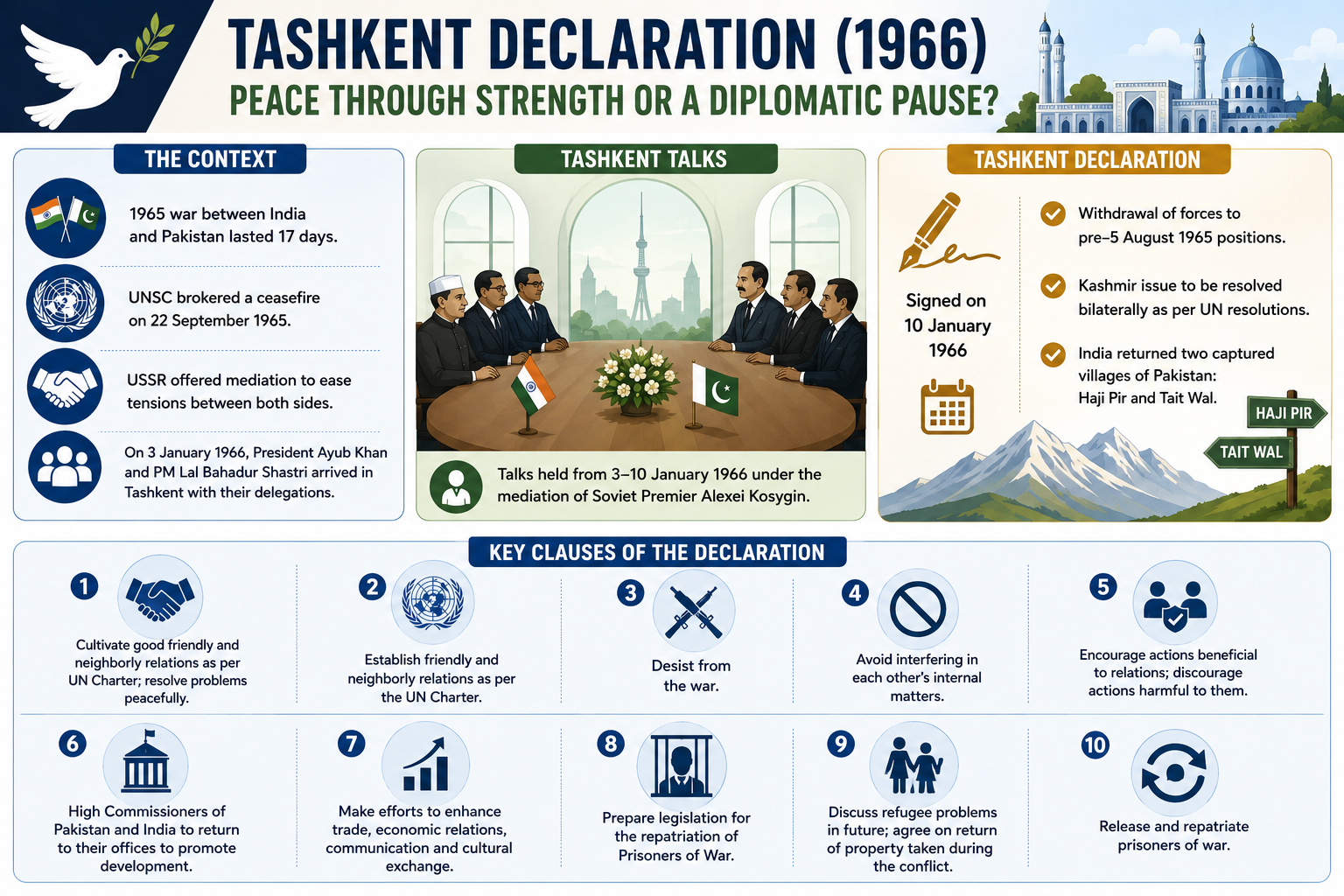
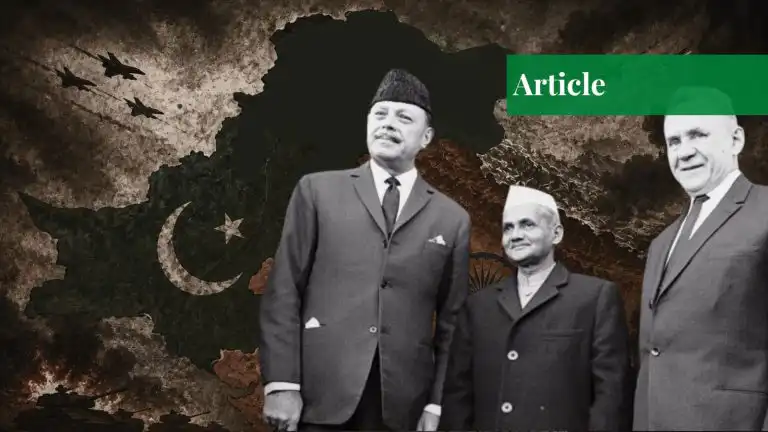
On January 3, 1966, President Ayub and his team of sixteen people came to the Capital of the Soviet Republic of Uzbekistan, which is known as Tashkent. Foreign Minister Zulfiqar Ali Bhutto, Minister of Information and Broadcasting Khwaja Shahabuddin, Minister of Trade Ghulam Farooq, amongst other ministers, were a part of this delegation. Indian PM Lal Bahadur Shastri also arrived with his delegation on the same day.
Kashmir at the Epicenter
The negotiations continued for about seven days. But, during these seven days, the diplomatic environment was constantly changing. PM Shastri held the view that the Kashmir issue should not be discussed in these negotiations. According to him, the Kashmir issue was already addressed, and these negotiations have been ongoing to resolve only the recent tensions between the two states. On the other hand, the Pakistani delegation was not ready to head forward without considering Kashmir.
According to Pakistani members, without discussing Kashmir, these negotiations would be useless, and if the issue is not addressed, then they should return to their country without any talk. In his book, “Shahab Nama,” Qudratullah Shahab has mentioned that most probably due to the Russian involvement, the Indian PM was compelled to discuss the Kashmir issue, but he remained tough and stubborn throughout the negotiations.
Tashkent Declaration
Pakistan’s Foreign Minister Zulfiqar Ali Bhutto was of the view that they should not move forward without ultimately addressing the Kashmir issue. Initially, Ayub Khan favored Bhutto’s view, but later on, he rejected Bhutto’s proposal after holding several private meetings with Soviet Premier Alexei Kosygin. Resultantly, on 10 January 1966, leaders of both countries signed the agreement, which came to be known as the ‘Tashkent Declaration.’ According to this agreement, the Armed Forces of India and Pakistan would retreat to the position that they maintained before 5 August 1965. Both states would resolve the Kashmir issue bilaterally as per the resolutions of the United Nations. Due to this agreement, India returned two captured villages of Pakistan, including Haji Pir and Tait Wal.
Key Clauses
The important clauses of the declaration are
- The President of Pakistan and the Prime Minister of India agreed to cultivate good, friendly, and neighborly relations according to the Charter of the United Nations. Under the UN Charter, they will use their energies to resolve their problems in a peaceful way.
- According to the charter of the UN, the President of Pakistan and the Prime Minister of India promised to establish friendly and neighborly relations.
- The President of Pakistan and the Prime Minister of India agreed to desist from the war.
- The President of Pakistan and the Prime Minister of India agreed to avoid interfering in each other’s internal matters.
- It is agreed that they will encourage those actions that would be beneficial to their relationship while discouraging those actions that can be harmful to them.
- They agree that the High Commissioners of Pakistan and India must return to their offices in order to help both countries develop further.
- They promised to make efforts to increase their trade activities and strengthen their economic relations. They promised to enhance communication and cultural information exchange between each other.
- They have agreed to prepare some legislation related to the repatriation of Prisoners of War.
- It is agreed that they shall also discuss problems related to refugees in the future. In addition, there will also be an agreement regarding returning property taken during the conflict.
- Both countries agreed to release and repatriate prisoners of war.
Domestic Criticism
The Indian media circles criticized this declaration, and according to some analysts, domestic pressure and criticism resulted in the death of Indian PM Shastri. After signing the agreement, approximately at 1:00 AM, PM Shastri had a heart attack, and he died. On the other hand, this agreement was also not so popular in Pakistan. Pakistani media circles were of the view that Pakistan lost its victory on the battlefield after signing this agreement. The second most significant criticism was that by signing this agreement, President Ayub buried the Kashmir issue forever.
Impact on Pakistan’s Political System
The Tashkent Declaration also impacted Pakistan’s political landscape on a large scale. The differences between Ayub Khan and Bhutto were increasing at an alarming rate. According to Qudratullah Shahab, during the Tashkent negotiations, Bhutto tried to give some advice to General Ayub, who angrily responded, “Idiot, just shut up.” Here, in West Pakistan, Bhutto started ramping up his efforts against Ayub.
While in East Pakistan, demonstrations were also recorded against this declaration. Altaf Gohar, in his book “Ayub Khan: First Ten Years of Martial Law,” wrote that Bhutto once again advised Ayub to retreat from the Tashkent Agreement, which he denied categorically. Afterwards, Bhutto traveled to Larkana in Sindh to conduct his campaign against Ayub.
Bhutto also alleged that Ayub signed another secret agreement with Indian Prime Minister Shastri in the Tashkent agreement, which was never disclosed to anyone. Thus, on 17 June 1966, Bhutto resigned from the cabinet. This resulted in political turmoil in the country. Bhutto then started his own campaign in Lahore, Larkana, and Karachi.
Bhutto formally entered politics and established his own party, the Pakistan People’s Party (PPP). Field Marshal Ayub Khan resigned as President of Pakistan on March 25, 1969, due to growing discontent in the public. In West Pakistan, where the PPP emerged as a dominant political faction, the same goes for East Pakistan, where the Awami League party of Sheikh Mujib ur Rehman gained popularity.
Conclusion
The historical prominence of the Tashkent Declaration was quite significant but complicated as well. Firstly, through the declaration, it became evident that it is possible to solve any conflicts between nuclear powers through diplomacy and mediation, even though there were no nuclear powers in South Asia by then. However, the fact is that the agreement did not manage to create lasting peace since it did not address the political conflicts between the two states, nor the status of Kashmir.
And despite such a drawback, the Tashkent Declaration had great significance when it came to later treaties such as the Simla Agreement after the War in 1971. The Tashkent Declaration was perceived in Pakistan as a political controversy and a strategic failure, while for India, it was considered just post-war diplomacy.
If you want to submit your articles and/or research papers, please visit the Submissions page.
To stay updated with the latest jobs, CSS news, internships, scholarships, and current affairs articles, join our Community Forum!
The views and opinions expressed in this article/paper are the author’s own and do not necessarily reflect the editorial position of Paradigm Shift.

Syed Hammad Ali is pursuing a BS in International Relations programme from the International Islamic University, Islamabad, and has a keen interest in research works, policy analysis, defence and strategic studies, and conflict resolution.