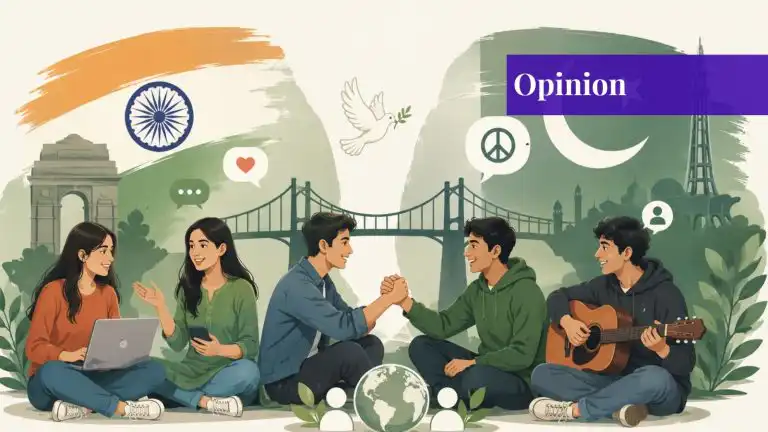
Borders are built to separate territories, not human sentiments. For about eight decades, the fate of South Asian politics has been determined by atrocities, accusations, wars, and crises between India and Pakistan. However, something unusual—a quiet transformation—is unfolding beneath this entrenched geopolitical rivalry. This is Gen Z-driven solidarity and networked citizenship.
As Pakistani students have taken to digital grounds to support student-led protests in India, they are defying the generational perception that territorial disputes and nationalism outweigh empathy. Gen Z is revolutionizing conventional logic by demonstrating that empathy can transcend political borders while diplomacy fails, and common sentiments can lead to common demands while political narratives differ across the border.
This dimension is not to be overlooked but needs serious attention because it represents a fundamental shift in how political identities are being constructed in South Asia. Unlike previous generations whose understanding of cross-boundary relations was largely shaped by historical grievances, state narratives, and political agendas, Gen Zs encounter each other not as national rivals but as students facing the same issues and striving against economic uncertainty, educational inefficiency, unemployment strains, and democratic challenges.
Transnational advocacy networks, individuals, social media activists, and students of Pakistan are raising their voices against student oppression and government inabilities. This support is not another social media trend but signals the emergence of what we describe as algorithm solidarity and clicktivism—the willingness of citizens to support each other not on national identity but on global moral values.
This development also challenges the classical assumptions of international relations that state boundaries inevitably determine ethical loyalties. Though the state narrative remains the central actor in shaping foreign relations, digital communications and empowered non-state actors such as students, activists, and online networks are changing political discourse in unprecedented ways. Digital platforms have become public spheres where support for democratic values travels faster than official diplomacy and state rivalries.
Gen Z is highlighting an important factor of moderation in human behavior and emotions. While on the one hand, they act as digital warriors in preserving national interests, on the other hand, they perceive themselves as a part of a global community. Their alignments are based less on geography and more on shared global values. Whether the issue is climate change, gender discrimination, educational reforms, or humanitarian crises, Gen Z is a united family. National identity remains important, but clearly no longer exclusively defines moral affiliation.
This behavioral transformation is significantly important for Pakistan-India, where longstanding political disparities have successfully translated into social mistrust. Decades of securitization and censorship have grieved the ethical and social disengagement of citizens. Yet, the digital interactions are revealing a more nuanced reality. Human sentiments are bypassing geopolitical rhetoric.
Critics may argue that this digital activism cannot change state behavior. Indeed, hashtags and digital trends cannot surely construct a completely new reality, resolve territorial disputes, or defy security challenges. Nevertheless, history demonstrates that public perceptions often preceded institutional reforms, and emotions frequently drive gathered communities. Both Pakistan and India have younger demographic populations, with youth constituting 70% and 65% of the populations, respectively. Therefore, the power of public opinion, particularly among the youth, who also comprise the majority fraction, cannot be simply ignored.
However, this approbation of solidarity cannot be mistaken for abandonment of patriotism. Supporting the democratic rights of students does not mean abandoning legitimate national concerns. This must not be branded as political naivety. Mature democracies critically demarcate between state priorities and humanitarian concerns. Modern politics cannot be driven solely by hard power, but soft power too.
It is possible to acknowledge geopolitical realities while recognizing the shared global norms of human rights. Interestingly, Gen Z on both sides of the border also effectively carries this balance. When national security was prioritized in May 2025, Pakistani youth and Indian youth defended their state interests and security narratives through the same digital platforms. Now, the same digital spaces are being used for mutual solidarity. Gen Z is less constrained by the binaries that have made the region a red-zone area. They openly embrace the idea that empathy for others doesn’t compromise loyalty to one’s nation.
Ironically, the same generation accused of social isolation, bluntness, and deviation from social norms may be accomplishing what decades of high politics and diplomacy have been struggling to achieve.
If you want to submit your articles and/or research papers, please visit the Submissions page.
To stay updated with the latest jobs, CSS news, internships, scholarships, and current affairs articles, join our Community Forum!
The views and opinions expressed in this article/paper are the author’s own and do not necessarily reflect the editorial position of Paradigm Shift.
Eman Fatima is currently pursuing her Bachelor's degree in International Relations from Government College University Lahore. She has a keen interest in understanding the complexities of global politics and the dynamics that shape international interactions.