
Deterrence comprises 3 C’s (Capability, Credibility, and Communication), and each component plays a crucial role in shaping an effective deterrence strategy for a state. Capability refers to the means or resources at the state’s disposal to impose costs on an adversary. Credibility is the will of the state to cope with threats via capability and political will. At the same time, communication is crucial for conveying capability and credibility to potential adversaries. For nuclear deterrence to be successful, a state must possess the required capabilities, maintain its credibility through demonstrated resolve, and effectively communicate with its counterparts. In the context of nuclear deterrence, communication plays a crucial role.
In the nuclear domain, communication involves articulating nuclear capabilities and the conditions to establish a credible deterrent posture. It is crucial as it will communicate red lines to your adversaries and the cost of exploiting them. For this purpose, nuclear programs and posture documents are given by states indicating their stance regarding the use of nuclear weapons. This dynamic process is for maintaining deterrence but also to avoid miscalculation during crises or conflicts. All those states that possess nuclear weapons have stated their nuclear doctrinal posture except Pakistan and Israel. Israel has neither accepted nor rejected the possession of nuclear weapons, as there is opacity in this case. On the other hand, Pakistan conducted its nuclear tests in 1998, codenamed Chagai-II, signaling the world regarding the accumulation of nuclear weapons. And till today, Pakistan hasn’t stated its official nuclear doctrine.
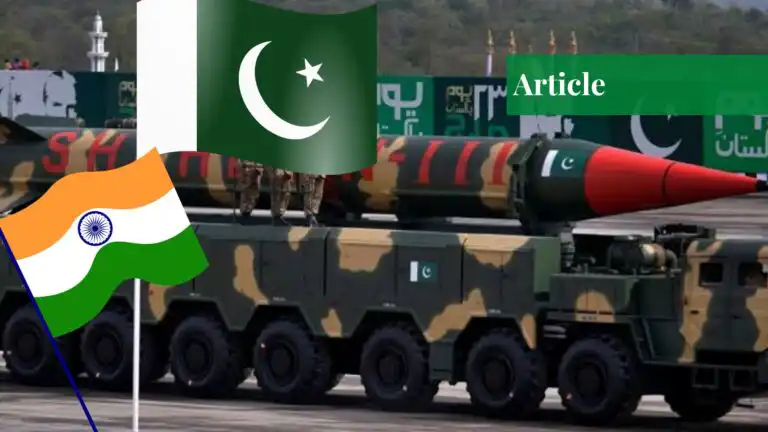
The South Asian region comprises two nuclear states. India declared its nuclear doctrine in 2003, whose main features are No First Use, Credible Minimum Deterrence, and Massive Retaliation. On the other hand, Pakistan has not officially stated its nuclear strategy and deliberately kept it ambiguous. They claim that ambiguity strengthens deterrence. If mentioned when nuclear weapons are going to be used, then the adversary will take certain measures to respond. Creating the element of ambiguity may confuse Pakistan’s adversary regarding its red lines but also enhance the chances of miscalculations in times of crisis. Pakistan devised its Full Spectrum Deterrence (FSD) policy in 2013 in response to the Cold Start Doctrine (CSD), limiting Pakistan to deter conflicts across the spectrum of threats with nuclear weapons, representing the restraint between flexibility and ensuring deterrence.
Rational deterrence theory’s 3Cs ensure and help maintain peace in the region. For deterrence to work, the adversary must know that any provocative action from his side will not be beneficial and that the cost of his action will outweigh the benefits. A state’s nuclear doctrine must be communicated, and it should be credible to avoid any misinterpretation. Without Pakistan’s nuclear doctrine, its adversaries may misread its intentions, which may lead to miscalculations and regional instability. On the contrary, the written nuclear doctrine may prove beneficial for Pakistan, as it will communicate its threshold.
Credibility is the key; if an adversary has any doubts regarding the will or determination to carry out the threat, it will subsequently lead to deterrence failure. Ambiguity in Pakistan’s nuclear doctrine clearly articulates the doubts regarding its intent. India has its written nuclear doctrine, which mentions that it has a “No First Use Policy.” On the contrary, Pakistan has kept an ambiguous posture, emphasizing the use of nuclear weapons under “Credible Minimum Deterrence” without clearly describing the conditions and guidelines. Communicating the conditions for the use of nuclear weapons, i.e., clearly describing the red lines—it can be territory, population, industrial hub, military installations, and what kind of response against conventional or nuclear attack—will reinforce the deterrence.
South Asia has always been the powder keg due to issues between Pakistan and India since 1947. After the 1998 nuclear tests, incidents like the Kargil War, Operation Parakram, and the Balakot crisis took place under the nuclear overhang. Especially the Balakot incident in which Pakistan’s territorial integrity was breached, and both states were on the brink of nuclear war. Such incidents can escalate intensely due to the absence of clearly written nuclear doctrine. In the case of the Balakot incident, Pakistan’s conventional deterrence failed and was restored subsequently. But the matter of fact here is that ambiguity has led to the failure of deterrence. If Pakistan had clearly stated and mentioned its nuclear doctrine, then such an incident could have been avoided.
Diplomacy and Deterrence (D2) work way better side-by-side. It helps in diplomacy and compels adversaries to go for the table talks rather than carrying out military actions. Due to the absence of Pakistan’s nuclear doctrine, Pakistan has been facing a lot of diplomatic problems at the global level. The global system views Pakistan’s intent suspiciously regarding its nuclear weapons. Furthermore, the written doctrine will also facilitate confidence-building measures (CBMs) between India and Pakistan to ensure regional stability. With declared doctrine, Pakistan will get a chance to be part of non-proliferation regimes and to reflect on the world as a responsible nuclear state.
With the mention of risks and potential benefits of having a clearly written and declared nuclear doctrine, Pakistan should take swift action to formulate its nuclear strategy, keeping in view its national interest and national security. Pakistan can take the following steps to generalize its nuclear doctrine:
- Pakistan should mention its stance (offensive or defensive) regarding the use of nuclear weapons, whether Pakistan will be going for a first-use policy or a no-first-use policy.
- There should be a clear mention of the nuclear threshold, i.e., defining the redlines; it can be population, command & control, military installations, population, or critical infrastructure.
- Pakistan should mention the use of its low-yield nuclear weapons and in what scenarios and against what kind of threat they are going to be used.
- It should also be clearly stated that Pakistan will adhere to non-proliferation regimes and will make efforts for disarmament.
After the 2019 Balakot incident, the ambiguity in nuclear posture has served its purpose. Now, Pakistan needs to devise an effective nuclear doctrine and strategy to effectively deter any aggression from its adversary and avoid any chance of Balakot 2.0. The unstable South Asia needs clear transparency concerning Pakistan’s nuclear doctrine. It is not only going to strengthen Pakistan’s security posture but will also represent Pakistan as a responsible nuclear state.
If you want to submit your articles and/or research papers, please check the Submissions page.
The views and opinions expressed in this article/paper are the author’s own and do not necessarily reflect the editorial position of Paradigm Shift.

Zohaib Arif is currently pursuing his Bachelors in Strategic and Nuclear Studies from the National Defence University Islamabad. His areas of interest are Nuclear Deterrence, Geopolitics and Modern Warfare.