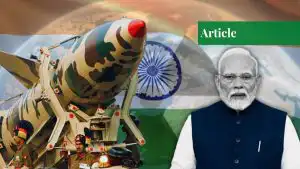

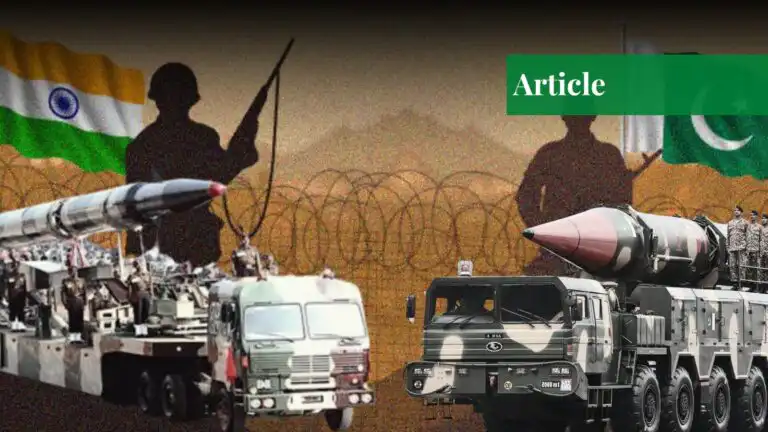
The year 2025 drastically turned the political dynamics of the South Asian geopolitics as two nuclear-armed neighbors, Indo-Pak, long-standing rivalry escalated unprecedently after the recent attack unfolding in Pahalgam on 22 April. The Indian state unequivocally stated that Pakistan orchestrated the incident without presenting any concrete evidence. Within a short period, the conflict dragged both countries into military confrontation, posing the threat of nuclear war. Despite the global community’s immense reliance on international law to mediate and de-escalate interstate disputes, the contemporary Indo-Pak nuclear brinkmanship in 2025 highlighted the loopholes in existing legal frameworks. The crisis laid a disturbing legal vacuum: the absence of an effective legal mechanism to restrain nuclear flashpoints between rival states.
Nuclear Doctrine
Nuclear doctrine is a policy that clearly defines the usage of nuclear weapons by a state during war and peacetime. Pakistan and India maintain their nuclear doctrine, which is elucidated below.
Nuclear Doctrine of Pakistan:
- The nuclear doctrine of Pakistan contains a first-use policy to maintain deterrence by adopting nuclear brinkmanship against the adversary.
- Pakistan has both types of nuclear weapons, strategic and tactical, to develop full-spectrum deterrence.
- Command, control, computerization, and communication (C41) for effective use of nuclear arsenals.
Nuclear Doctrine of India:
- Indian doctrine operates on the principle of minimum credible deterrence, which contains only strategic weapons.
- It holds no first-use policy. However, the Indian aspiration of becoming a regional power has undermined its policy.
- Complete political control over nuclear weapons.
- Nuclear weapons shall not be used against non-nuclear states
The Limits of International Law on Nuclear Brinkmanship
The international law provides only a fragmented set of norms on nuclear weapons that includes:
1. The United Nations Charter (1945): Article 2(4) states that a country can not use force against any other state, and Article 51 states that a country can only use force when that state has been attacked first by using the right to self-defence. However, these provisions are broad and subject to political interpretation.
2. The Treaty on the Non-Proliferation of Nuclear Weapons: It is a treaty signed in 1968 that aims to prevent the dissemination of nuclear weapons. The treaty only endorsed five states, officially termed as nuclear-weapon states under the NPT, which are China, Russia, France, the United Kingdom, and the United States.
Moreover, no country can be compelled to sign it. Afterwards, three countries with nuclear weapons, India, Israel, and Pakistan, have never joined the treaty. It also lacks a sanctions mechanism for withdrawing from the treaty, as in the case of North Korea’s exit
3. The International Court of Justice (ICJ) Advisory Opinion (1996): It stated that the threat or use of nuclear weapons would generally be contrary to International Law, but it left ambiguity in the case of extreme self-defence.
The Legal Vacuum in the Indo-Pak Crisis 2025:
- Absence of Pakistan and India in NPT:
Pakistan and India are not signatories to the Non-Proliferation nuclear Arms Treaty (NPT). This absence exempts both countries from the multilateral framework mentioned in the treaty governing nuclear weapons. Resultantly, the treaty provisions on disarmament, safeguards, and non-proliferation have no legally binding force in the India-Pakistan context.
- The Treaty on the Prohibition of Nuclear Weapons:
This treaty entered into force in 2021 as the first legally binding international agreement that comprehensively prohibits nuclear weapons, including use, threat, and development. Neither India nor Pakistan has signed owing to the intense animosity between the two states. The TPNW also lacks a verification mechanism tantamount to the International Atomic Energy Agency (IAEA). Moreover, P-5 countries also oppose the treaty, reducing its political leverage. Hence, the TPNW does not play any restraining role on either side.
- Lack of Regional Agreements on Nuclear Weapons:
South Asia lacks a regional agreement equivalent to the NEW START and Intermediate Range Forces Treaty (INF). The incumbent mechanism, Confidence Building Measures (CBMs), contains pre-notification of missile tests and agreements on nuclear accident prevention, which are procedural, not legally binding, and lack a verification mechanism.
Remedies to Bridge the Legal Vacuum:
To avoid subsequent catastrophes, there is an utmost need to strengthen regions and international legal frameworks or mechanisms.
- Establishing South Asian Risk Management Agreement:
A legally binding pact should be signed, focusing on crisis management, no-first-use commitments, and mutual inspections to conduct proper checks on nuclear possession states to avoid confrontation.
- Revised UN-established Protocols for Nuclear De-Escalation:
There is a need to rehaul the UN articles by adding specific legal protocols under international law to manage and mediate nuclear crises.
- Reinforced the role of the ICJ:
All states should adopt the binding jurisdiction of the ICJ for disputes involving the threat of nuclear force.
Conclusion
The Indo-Pak crisis 2025 is a hazardous call for the international community about the vulnerability to the threat of nuclear conflict, especially in regions that lack a legal framework. It also revealed a profound need to fill the legal vacuum surrounding nuclear brinkmanship. If the pertinent steps are not taken towards codified, enforceable legal norms, the world would be entering an era where nuclear threats are not governed under the patronage of laws but by coercion.
If you want to submit your articles and/or research papers, please visit the Submissions page.
To stay updated with the latest jobs, CSS news, internships, scholarships, and current affairs articles, join our Community Forum!
The views and opinions expressed in this article/paper are the author’s own and do not necessarily reflect the editorial position of Paradigm Shift.

Arbaz Khan Pathan hails from Hyderabad, Sindh. He has completed his graduation in Information Technology from Sindh Agriculture University.