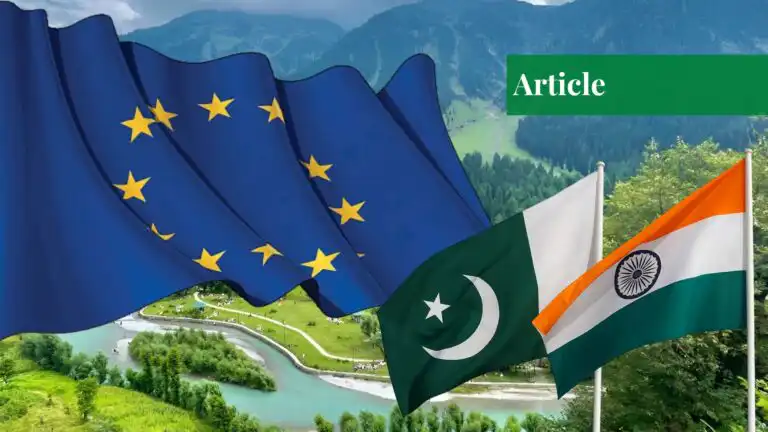

On 22 April 2025, a tragic bus bombing against a Hindu pilgrimage bus in Kashmir’s Pahalgam killed 26 and injured dozens of others. The attack by the Resistance Front (TRF) has been met with a sudden intensification of the previously delicate relationship between Pakistan and India. In response to the attack, India suspended the Indus Waters Treaty. It closed its border with Pakistan, signalling a swift deterioration of the relationship and a risk of a general military conflict. While the risks escalated to date, the international community and the European Union (EU) appear to have largely dismissed the growing risk of nuclear conflict in the region.
Although the Kashmir crisis is usually described in regional terms, Indian-Pakistani nuclear competition is a matter of international concern with international implications, and most critically, to the EU. In this piece, I contend that the EU’s passivity regarding the Indo-Pak crisis is a strategic mistake and that the EU has to be more engaged in preventing nuclear war in South Asia.
India and Pakistan are nuclear-armed nations and long-standing rivals with a conflict-heavy past. Throughout the decades, their competition has been punctuated by military clashes, most prominently the wars of 1947, 1965, and 1971. These were predominantly conventional, though the nuclear connotations of the Indo-Pak competition have completely changed the nature of their confrontation. Both countries hold nuclear weapons in their arsenals, and the possibility of a full-scale nuclear war between them is rapidly being made more likely.
The ongoing crisis in the wake of the Pahalgam attack and the recent decision by India to suspend the Indus Waters Treaty is a grim reminder of the fragile and tense nature of the relationship between the two nations. There is always the possibility of a nuclear confrontation, and with the increasing deployment of tactical nuclear weapons on both sides, it cannot be ruled out. There is a greater chance of miscalculation, misperception, or accidental deterioration; thus, there is every reason to be more cautious now.
The Impact on European Security and Economy
Whereas the main concern of conflict has been in South Asia, the effects of nuclear conflict would spill over onto the international level, with a significant impact on Europe. The European Union’s long-standing disengagement from South Asian geopolitics has seen it largely oblivious to the current tensions unfolding. This lack of engagement has exposed Europe to several key perils with far-reaching implications for its economic stability, food security, and geopolitical role.
Food Security: A Global Crisis
The implications of a nuclear war between India and Pakistan may stretch far beyond the Indian subcontinent itself. In 2019, Rutgers University conducted a study that determined that even a limited nuclear war between the two countries may release enormous quantities of soot into the environment, creating a nuclear winter situation. Such conditions would drastically reshape weather patterns on Earth and cause devastating crop failures globally.
Europe, which is already exposed to the effects of climate change with altered weather patterns, would be in serious jeopardy. Disruption in European farm production—caused by the cooling effects of nuclear fallout—would result in dramatic hikes in the price of food, serious shortages and scarcities, and even civil disturbances. The EU, which is already threatened with disruptions of food supply chains from causes such as climate change and geopolitical tensions, would be exposed to such a food security crisis of record proportions. The impacts on the ag-dependent industries of the European economy would be immediate and drastic, and put the EU’s internal market and external trade exchanges in serious jeopardy.
Trade and Economic Stability: The Domino Effect
Aside from food security, the entire global trade network is also highly vulnerable to a nuclear war in South Asia. Pakistan and India play significant roles in the global economy, and a full-scale conflict will massively disrupt vital trade routes and regional investments. The EU-India and EU-Pakistan trade relationships that serve important industries such as textiles, machinery, chemicals, and automobiles will be massively disrupted. This will likely drive Europe to an economic crisis as the EU already faces trade imbalances, inflationary conditions, and energy weaknesses.
The 2024 global trade report of the European Commission stated that any significant destabilization in Pakistan or India has ripple effects in global markets, with specific weaknesses in those markets that are most dependent upon the market in South Asia. Europe has important financial exposure to the region, so any disruption in trade resulting from a conflict is widely felt. A significant trade decline jolts the EU’s financial system and induces a global economic downturn.
Geopolitical Implications: Europe’s Strategic Blind Spot
The EU’s inaction in the Indo-Pak nuclear competition is most concerning in light of its long-term geopolitical stakes. While the EU has been busy with other affairs around the world — seeking to manage the relationship with Russia, the competition with China, and the ongoing conflicts involving the Middle East — the region of South Asia is fast transforming into a vital axis of global geopolitics.
India has become a rising military and economic power and has, in turn, shifted closer to the United States and other Western partners, whereas Pakistan has moved closer to Russia and China. The EU has paid little heed to rising geopolitical polarization and has not come forward to intervene in South Asia to stem the growing conflict in any way that it can. The current conflict between India and Pakistan has far-reaching implications for the strategic influence of the EU.
By ignoring engagement with South Asia, Europe risks being left behind by global powerhouses such as the US, China, and India, which are shaping the global order more and more. The EU’s lack of political clout in the region not only reveals its economy’s weakness but also stifles its capacity to shape global peace and security.
The Way Forward: Europe’s Role in De-escalating the Crisis
The European Union can no longer turn a blind eye to the growing nuclear tensions between Pakistan and India following the recent incident in Pahalgam. In a nuclear war, the EU has to play a proactive role in promoting conflict resolution and de-escalation. The EU can pressure the two countries to revisit negotiations and pursue nuclear disarmament through its economic clout and international influence in diplomacy. Being a primary trading partner for both nations clouts Europe to promote measures that decrease military tensions in the region. In addition, the EU can promote arms control accords and provide financial incentives to promote peace. Indo-Pak is a ticking time bomb that can have disastrous effects on Europe, ranging from food shortages to economic instability.
In conclusion, the EU must recognise that South Asian stability will directly impact its future security and prosperity. Active intervention, diplomacy, and strategic engagement are essential to preventing nuclear escalation and safeguarding Europe’s future.
If you want to submit your articles and/or research papers, please visit the Submissions page.
To stay updated with the latest jobs, CSS news, internships, scholarships, and current affairs articles, join our Community Forum!
The views and opinions expressed in this article/paper are the author’s own and do not necessarily reflect the editorial position of Paradigm Shift.

Muhammad Sheharyar Khan, a Gold Award-winning International Relations graduate, actively contributes to policy discourse and academic research. He has worked with national institutions including Pakistan’s National Assembly and authored the Urdu poetic book Khayaal Nagri.