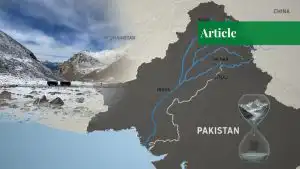
Islamabad, May 4: In the wake of India’s claims that the Indus Waters Treaty (IWT) is ‘in abeyance,’ Pakistan has a strategic opportunity to think creatively, reframe the discourse on the treaty, assert its water rights, and highlight the treaty’s structural flaws at international legal and environmental forums.

This was the consensus at a seminar titled “Indus Waters Treaty ‘in Abeyance’: Implications and Strategic Pathways for Pakistan” held at the Institute of Policy Studies (IPS), Islamabad. The speakers included Dr. Hassan Abbas, a noted water expert; Mirza Hamid Hassan, former federal secretary for water and power; Khalid Rahman, chairman of IPS; Cmdr (R) Azhar Ahman ad, IPS associate; and public policy lawyer Ameena Sohail.
Speakers emphasized that while the IWT is often portrayed as a safeguard for Pakistan, it contains multiple structural flaws that disproportionately benefit India. These include lopsided water distribution and diversion, provisions permitting pollution through effluent drains, and limited protection for Pakistan’s rights as a lower riparian state.

Dr Hassan Abbas underscored that the water conflict originated soon after independence in 1947. He pointed out that India has consistently used water as a tool of dominance and began constructing major dams and other infrastructure years before the treaty was signed. He highlighted that water wars are fought not with weapons but with infrastructure, deceitful treaties, diplomacy, and alliances.
He described the treaty as more of a “capture agreement” than a fair water-sharing treaty, arguing that it constrains Pakistan’s sovereignty over its water resources. With global momentum building around ecological justice and sustainable water use, Pakistan is in a strong position to challenge the status quo, provided it develops the institutional capacity, scientific data, and political will to do so.
Dr Abbas called for a broader rethinking of how Pakistan views its river systems. He said water must be seen as a national security concern and a driver of regional economic transformation. Over the longer term, he proposed building trade corridors along river systems, citing a potential route from the Arabian Sea to Jalalabad in Afghanistan, which could serve as a hub for commerce with Central Asia.

The discussion also addressed India’s assertion that the treaty is “suspended.” Participants clarified that such unilateral claims have no legal validity, as the IWT contains no provisions for suspension or abeyance. However, this development presents Pakistan with a political and legal opening to assert its position internationally.
The seminar highlighted Pakistan’s potential to pursue its case by invoking internationally recognized legal doctrines such as prior use and prior appropriation. Speakers urged the government to challenge treaty violations and unauthorized diversions at global forums, including the World Bank, a party to the treaty, the UN, and international legal institutions.
Khalid Rahman emphasized that Pakistan’s responses have historically been defensive. He called for a shift toward a proactive stance that protects Pakistan’s interests and reframes the international narrative, raising questions about India’s reliability in honouring global treaties and agreements.
While most speakers advocated assertive legal action, Hamid Hassan advised caution regarding renegotiating the IWT. He noted that the treaty involves layers of complex hydroengineering and geopolitical intricacies, and attempting to renegotiate could involve high political, legal, and financial risks. Instead, he argued that Pakistan should focus on enforcing compliance, especially in data sharing, and escalate violations to international bodies.
Azhar Ahmad stressed that Pakistan must invest in capacity and intention to bring about meaningful change. Knowledge and intention are critical, he said, urging the development of long-term technical and legal expertise to manage and protect water resources.
If you want to submit your articles and/or research papers, please visit the Submissions page.
To stay updated with the latest jobs, CSS news, internships, scholarships, and current affairs articles, join our Community Forum!
The views and opinions expressed in this article/paper are the author’s own and do not necessarily reflect the editorial position of Paradigm Shift.

The Institute of Policy Studies (IPS) is an autonomous, not-for-profit civil society organization dedicated to promoting policy-oriented research, dialogue, and human & technological development for better governance. IPS provides a forum for informed discussion and dialogue on national and international issues. The contributions spanning over forty-three years and the overall impact signifies the importance of pragmatic research on policy issues. The institute highlights the role of think tanks in modern democratic polities.