
“Afghanistan is more than the ‘graveyard of empires.’ It’s the mother of vicious circles.”
-Maureen Dowd
Afghanistan, also known as the ‘graveyard of empires,’ can be considered a horrific and sometimes miserable part of the South Asian region. This country, or formerly the empire, has always been involved in conflicts, wars, and insurgencies. History is continuously yelling at the changing faces of Afghanistan, bouncing between blood and dust. From the reign of Darius I to the rise of the Taliban, historical evidence has proved that the domestic lords of Afghanistan had always backed out of their words, agreements, and treaties.
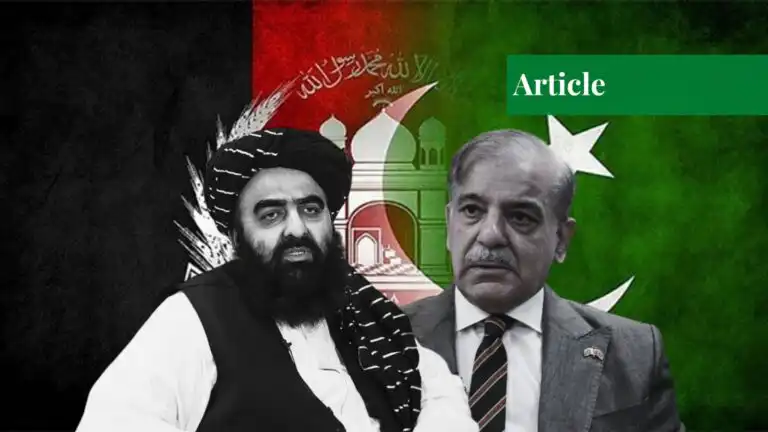
Soon after the independence of Pakistan, the regional state after India that opposed Pakistan’s recognition was Afghanistan. Despite this fact, Pakistan remained positive towards its Muslim brotherly nation. The support of Pakistan for the Afghan brethren needs no explanation, but what we are witnessing now and over the past decade is a continuously growing sentiment of enmity, hatred, and rivalry against Pakistan. This article will provide a critical analysis and a case study of pre-partition Pakistan-Afghanistan relations and the decade-long Afghan deception against Pakistan.
Afghanistan: A Natural Ally
The relations between the rulers of Pakistan and those of Afghanistan traced back to the pre-partition era. Our visionary leader, Allama Muhammad Iqbal, declared Afghanistan as the heart of Asia and the best place for Muslim fraternity and brotherhood. Our forefathers, including the Ali brothers, i.e., Muhammad Ali and Shaukat Ali, officially met with the Afghan leadership, including King Amanullah Khan, to seek their support for the Khilafat movement and the rights of Muslims of India. Afghan leaders provide moral support but are restrained from adopting any practical measures to assist Muslims of India.
Similarly, the leadership of the Muslim League, i.e., Khan Abdul Qayyum Khan and Sardar Aurangzeb Khan, met with their Afghan counterparts to get their support for the cause of Indian Muslims. Only moral and goodwill gestures were provided, with no concrete support. Despite all this, when Pakistan emerged on the world map as a sovereign independent state, Afghanistan didn’t recognize Pakistan and voted against Pakistan in the UN, raising the issues of the Durand Line and Greater Pashtunistan claims.
Russian Invasion of Afghanistan
The Durand Line was formally recognized as an international border in 1893 when Afghan ruler Amir Abdul Rehman Khan signed an agreement with the British. Later on, Afghan rulers also signed an agreement with the British that no spying assistance would be given to the Russians against Great Britain. Despite this, Russians were given high value, and as a result, a communist government was formed in Afghanistan. Thus, in 1979, Russia invaded Afghanistan for almost 10 years. Russia was defeated and forced to leave because the US and Pakistan provided strategic support to the Afghan Mujahideen. Without the material and moral support of Pakistan, the Russians would have destroyed Afghanistan from top to bottom.
Deception of Empty Land
When the Muslims of the subcontinent initiated the Hijrat Movement in 1920, Ulema stated that India under British rule was “Dar-ul-Harb” (land hostile to Islam), and that Muslims must emigrate to a “Dar-ul-Islam” (land of Islam) where they could live freely according to Sharia. Afghanis during that period also misled Muslims. It was publicly stated that Afghanistan was a free country for Muslims and that the Afghan state had invited Indian Muslims to come and settle there. Some were told they could cultivate and own large tracts of fertile land that were uninhabited. Now, in the hope of finding asylum in Afghanistan, masses of Muslims in the Punjab, Sindh, and North-West Frontier Province sold their property, incumbents, and migrated with their families.
However, at the Afghan border, which the migrants reached, things worked out to be disastrous. Afghanistan was not ready to accommodate that many individuals. The ruler of Afghanistan, Amir Amanullah Khan, had initially embraced but had to close the borders as soon as the migrants had tens of thousands. There were cases of many migrants being stranded on the border due to malnutrition, illness, and weather conditions. Those who were able to get there had to survive in deplorable conditions with no land or support. Most of the rest were left back in poverty after losing all they had, and many hundreds died of starvation and disease.
Iqbal’s Connection with Afghanistan
Allama Iqbal landed in October 1933 in the city of Kabul in Afghanistan through the legendary Khyber Pass. Iqbal referred to Kabul as a heavenly land, the air of which is more pleasant than that of Syria and the Roman Empire. During his visit to Kabul, Iqbal also had a meeting with the Afghan King Mohammad Nadir Shah, among other representatives of the Afghanistan government. The meeting was held in the Dilkusha Palace, where Allama Iqbal kissed the hand of the Afghan king as a sign of respect. Iqbal himself noted:
جانم از سوزِ کلامش در گداز
دست او بوسیدم از راه نیاز
His [Nadir’s] burning speech set my soul on fire
I kissed his hand out of a yearning desire
After visiting Kandahar, the former capital of the Durrani Empire, Iqbal crossed the Chaman border to return to India. Iqbal described Kandahar as a “paradise-like” place, much like Kabul:
قندهار آن کشورِ مینو سواد
اهل دل را خاکِ او خاکِ مراد
Kandahar is such a paradise-like place that
For the people of the (loving) heart, its soil is (like) the soil of shrines.
Pakistan’s Unwavering Support to Afghanistan
- Afghan Independence
Before independence, there were some prominent Muslim figures from the Indian subcontinent, i.e., Allama Iqbal and leaders from the Muslim League, who really stood up for Afghanistan. They viewed it as the only independent Muslim state right next to India and offered their moral and political backing. Then, after 1947 rolled around, Pakistan quickly recognized Afghanistan and jumped into establishing diplomatic relations, even though Kabul didn’t recognize Pakistan and voted against it in the UN.
- Afghan Refugee
With the invasion of Afghanistan by the USSR, Pakistan opened its borders and received millions of Afghan refugees, almost 3.5 million. That put it in the position of the greatest population of refugees in the world at the time. Pakistan established free camps and gave them food, education, and even healthcare. It was all said and marginally achieved with little assistance from the international community in the early years.
- Afghan Mujahideen
Pakistan really became the center of the anti-Soviet Afghan Jihad back then. They teamed up with the Mujahideen, joining forces with not just the West but also the larger Muslim community to support Afghanistan in its fight for independence. Resultantly, Pakistan was affected badly, including humanitarian losses and economic downturns. And it also laid the groundwork for extremism in the region. But, even with all that turmoil, it did lead to the Soviet Union pulling out in 1989.
- Afghan Peace Process
Pakistan was the one that played a key role in putting the Taliban and the US at the negotiation desk. They made much effort to accommodate such conversations, which eventually, in 2020, led to the Doha Agreement. Islamabad did not simply stop there, and they contacted all the groups in Afghanistan, including the Ghani government, attempting to urge them to a peaceful political solution. Thus, Pakistan played an important role in ending 20 years of feud and leaving Afghanistan to discover its own path into governance.
Afghanistan’s Consistent Opposition to Pakistan
Afghanistan was the only nation that voted against Pakistan joining the UN. The leaders in Afghanistan, particularly under King Zahir Shah, just wouldn’t accept the Durand Line as a de jure international border. They argued that the Pashtun regions and some parts of Balochistan should either be part of Afghanistan or have their own independent state, which they called “Pashtunistan.” Moreover, Afghan officials didn’t recognize Pakistan’s western border at all, which kind of challenged Pakistan’s territorial claims right from the start.
When Kabul asserted that the Pashtun territories of Pakistan, or the NWFP region, needed to be annexed to Afghanistan or should be granted independence, it resulted in some stiff support by Afghanistan of insurgent organizations amongst the Pashtun tribes directly along the border. Afghan agents began infiltrating the tribal territories in Pakistan and causing disturbances and revolutions. They put across anti-Pakistan propaganda and sponsored tribal leaders who were resisting the control of Pakistan. Consequently, the government of Liaquat Ali Khan was forced to intervene with some rough actions to bring the situation in such frontier regions under control.
On October 16, 1951, an Afghan national, who was also a terrorist, carried out a horrifying act in the history of Pakistan, and that too was on the Liaquat Ali Khan, the first prime minister of this country, who was killed during his speech to a mass of people in Liaquat Bagh, Rawalpindi. He was viciously shot by a man named Said Akbar Khan, who was an Afghan belonging to the Pashtun community. The assassin came face-to-face with the security services.
Afghan PM Daoud Khan took an active role in favor of Baloch and Pashtun separatist leaders, such as Abdul Wali Khan and Mir Ghaus. He gave them a secure environment, finance, and political patronage. Besides this, Afghanistan established secret services and military training camps in such locations as Kandahar, Jalalabad, and Khost. The Northern Alliance under Ahmad Shah Massoud and Burhanuddin Rabbani took an anti-Pakistan and pro-India position during the Taliban government’s (1996-2001) first term. India used the Afghan land for training and facilitating anti-Pakistan intelligence activities. As a result, Pakistan faced immense cross-border terrorism in the western regions.
Several acts of terror within Pakistan, such as the APS Peshawar massacre (2014), as well as attacks in Quetta, Turbat, and Zhob, are linked to militants residing in Afghanistan. Pakistan had also many times offered intelligence and insisted on TTP hiding places being attacked, but the Afghan authorities never took such a step. The situation in Afghanistan was not cooperative, as further evidenced in border conflicts at Torkham and Chaman. And now, once again, the region is witnessing deep border clashes.
Conclusion
In essence, the Afghan government needs to take the path of reconciliation with Pakistan. The most appropriate scenario can be a combined political and military effort. Pakistan has never been hesitant to offer intelligence services to the Taliban government to demolish TTP and other terrorist groups operating in the country. The relationship between the two states will be fruitful in the realm of transparency and trust. The Taliban should make sure that their soil is not exploited against Pakistan or any other state. When the cross-border terrorism and extremism are eliminated from the scene, Pakistan and Afghanistan can be able to cross through other significant concerns, i.e. Durand Line, and find peaceful solutions based on international norms and laws.
If you want to submit your articles and/or research papers, please visit the Submissions page.
To stay updated with the latest jobs, CSS news, internships, scholarships, and current affairs articles, join our Community Forum!
The views and opinions expressed in this article/paper are the author’s own and do not necessarily reflect the editorial position of Paradigm Shift.

He is pursuing a BS in International Relations programme from International Islamic University, Islamabad and has a keen interest in research works, policy analysis, defence and strategic studies and conflict resolution.