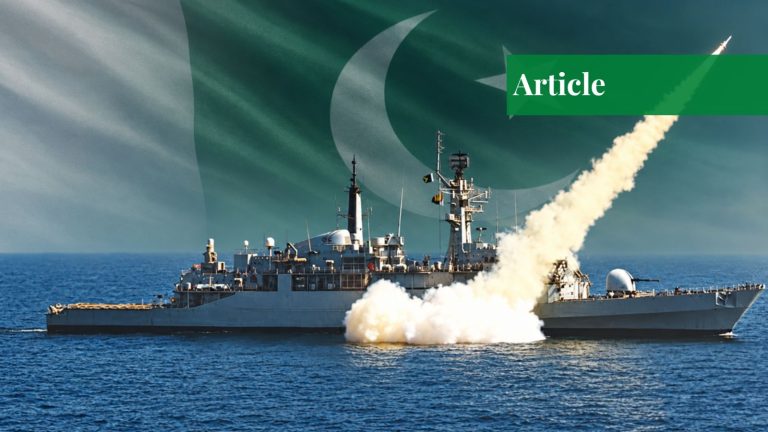
Pakistan has roughly 1,000 kilometres of coastline, and over 90 per cent of its trade moves by sea. Even so, its strategy has always faced inland, toward India and the Afghan border. My research asks a simple question: did the maritime moves of 2019 to 2026 change that habit? Attention has changed a lot. Ships, ports and institutions have changed only a little.
A Coastline the State Overlooked
The numbers show how wide the gap is. Pakistan’s national carrier, PNSC, lifted only 9.33 per cent of seaborne trade in 2020, down from 16 per cent in 2016, according to a PIDE policy paper. The government now admits that foreign companies carry about 90 per cent of imports and exports, as Minute Mirror reported. The same paper counted just 57 Pakistan-flagged vessels in 2021, and none was a container ship. India had 1,801. The ministry puts the blue economy at around 0.4 per cent of GDP, close to one billion dollars, as Zameen.com noted.
History explains the habit. Pakistan was born in conflict with a larger neighbour, and the army shaped national priorities from the start. The navy stayed small, and its main job was to guard Karachi and the sea lanes leading to it.
The Paper Turn of 2025
Policy moved fast in 2025. A prime ministerial task force proposed a single maritime authority, common port tariffs and a new model for PNSC, as Nukta reported in January. A National Maritime Policy followed in February, announced through the Press Information Department. By November, the ministry was talking about a 100 billion dollar blue economy by 2047, a plan covered by Arab News. Money has not followed the talk. A parliamentary committee approved only Rs3.046 billion for the ministry’s development projects in 2025-26, according to Profit. That is small next to the target.
What Has Actually Been Built
The navy has the clearest result. Pakistan commissioned the first of eight Hangor-class submarines in April 2026, as Naval News reported, and the boat reached Karachi on 11 June, per Baird Maritime. Four of the eight will be built at Karachi Shipyard. Still, the design suits denial and deterrence against a stronger navy. It does not give Pakistan control of the sea, and it comes from China.
Ports tell a mixed story. The minister has said Karachi Port and Port Qasim run at about half their capacity, according to Profit. A plan to grow the national fleet by 600 per cent was announced, as Arab News reported, but I found no independent proof that the 2026 fleet target was met.
The Hormuz Windfall
In March 2026, the war involving Iran disrupted shipping through the Strait of Hormuz. Karachi handled 8,860 transshipment containers in the first 24 days of the month, compared with about 8,300 in all of 2025, according to Business Recorder. The government cut port charges by up to 60 per cent from 18 March, as Datamar News reported. A ministry statement gives a much higher monthly figure of 111,300, which I could not reconcile with the first. Both agree on the direction. Karachi gained because someone else’s route broke. That is luck, and it can fade once Gulf services recover.
Gwadar Is Still Waiting
Gwadar shows the distance between plan and result. In July 2026, the prime minister’s task force said Pakistan needs no new seaport and that Gwadar cannot be fully developed until security, roads, water and electricity are fixed, as The Express Tribune reported. The port received its first dedicated transshipment vessel in 2026 and four by late April, according to the Press Information Department. It is a start, but a small one.
Ambition, Capability and Power
My study separates three things that officials often blur. Ambition is what a state says it wants. Capability is what it can do. Power is lasting influence from the sea. Pakistan scores high on ambition in every area. Capability is real mainly in the navy. Power shows up as deterrence and as a temporary gain from the Hormuz crisis. So Pakistan sits in between: no longer blind to the sea, and not yet a maritime power.
What Holds Pakistan Back
Several problems repeat. Ports are a federal matter, but coastal land and fisheries sit with Sindh and Balochistan, and many agencies each hold a piece of the picture. The proposed maritime authority needs a law, and I found no sign that it has passed. Money is tight. The environment gets little attention too. I found no public environmental assessment attached to the 2047 plan, even though the Indus delta and the coast face rising seas and storms.
What Should Happen Next
Five steps would help. Pass the maritime authority law and staff it. Tie every target to a funded project with yearly public reporting. Build shipping and shipbuilding skills, and go beyond fleet announcements. Use the Gulf disruption to win lasting transshipment business with better digital systems and rail links. Check the environmental impact and consult the provinces before fixing targets.
Pakistan has started to look at the sea. Whether it gets power from it will depend on ships, laws, and budgets.
If you want to submit your articles and/or research papers, please visit the Submissions page.
To stay updated with the latest jobs, CSS news, internships, scholarships, and current affairs articles, join our Community Forum!
Find our FREE quizzes and MCQs here!
The views and opinions expressed in this article/paper are the author’s own and do not necessarily reflect the editorial position of Paradigm Shift.

Azhar Ud Din is a student of international relations at Government College University, Lahore.