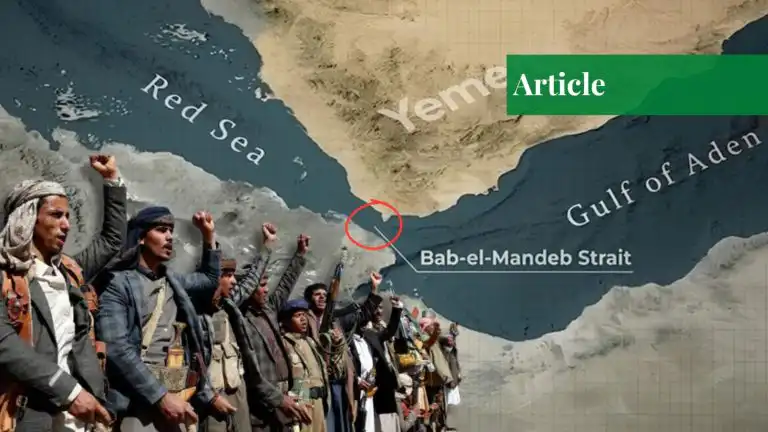
Recently, we have seen that globalization has created the illusion that distance matters less than ever before, but the crisis unfolding in the Bab al-Mandeb (or Bab el-Mandeb) corridor sets an example of how dependent the global system is on geography. The strait is a narrow passage between the Horn of Africa and Yemen.
However, it is far more than just a maritime route. It is actually a strategic checkpoint through which multiple important functions take place, such as international trade, network pass shipping between Asia and Europe, and energy trade. The conflict in Yemen has increasingly placed this vital corridor under threat, which can be seen as a regional struggle with consequences far beyond the Middle East. The Bab al-Mandeb conflict signifies a major challenge to the question of an interconnected global economy.
The Conflict Behind the Strait
To understand why this trade corridor has become a major source of international concern. Firstly, it’s absolutely necessary to understand the conflict unfolding around it. The Yemen dispute is not only a domestic issue, but over time it has developed into a larger and wider regional struggle involving the Yemeni government, the Houthi group, and external authorities with competing security interests.
The Houthi movement, which maintains control over substantial areas of Yemen, has established itself as a pivotal actor in the region, increasingly attempting to extend its strategic influence beyond its domestic borders. Their position or location along Yemen’s western coastline is significant due to its placement becoming close to the Bab al-Mandeb. This gives them the geopolitical and geographical leverage to threaten or influence maritime vessel traffic transiting through the strait.
Simultaneously, Saudi Arabia has viewed the expansion of Houthi influence as a major territorial security concern, while on the other hand, Iran’s relationship with the Houthis has added another aspect to the problem. This results in a struggle in which local regional control clashes or intersects with wider regional power politics.
This is the important reason why the crisis should not be limited to the question of whether Bab al-Mandeb will close. The more fundamental problem is who really has the ability to influence or control access to it. An important and strategic waterway does not need to be completely blocked to prevent an actor from exercising power over the system. The capacity to disrupt shipping, create uncertainty for commercial vessels, or influence companies to alter their routes can itself provide significant strategic leverage.
The Bab al-Mandeb has consequently become a point of intersection between Yemen’s internal conflict, regional rivalry, and the interests of the global economy. Although it is geographically a narrow passage, its political significance lies in the wider struggle over who can control access, exert influence, and shape what happens there.
A Strategic Chokepoint
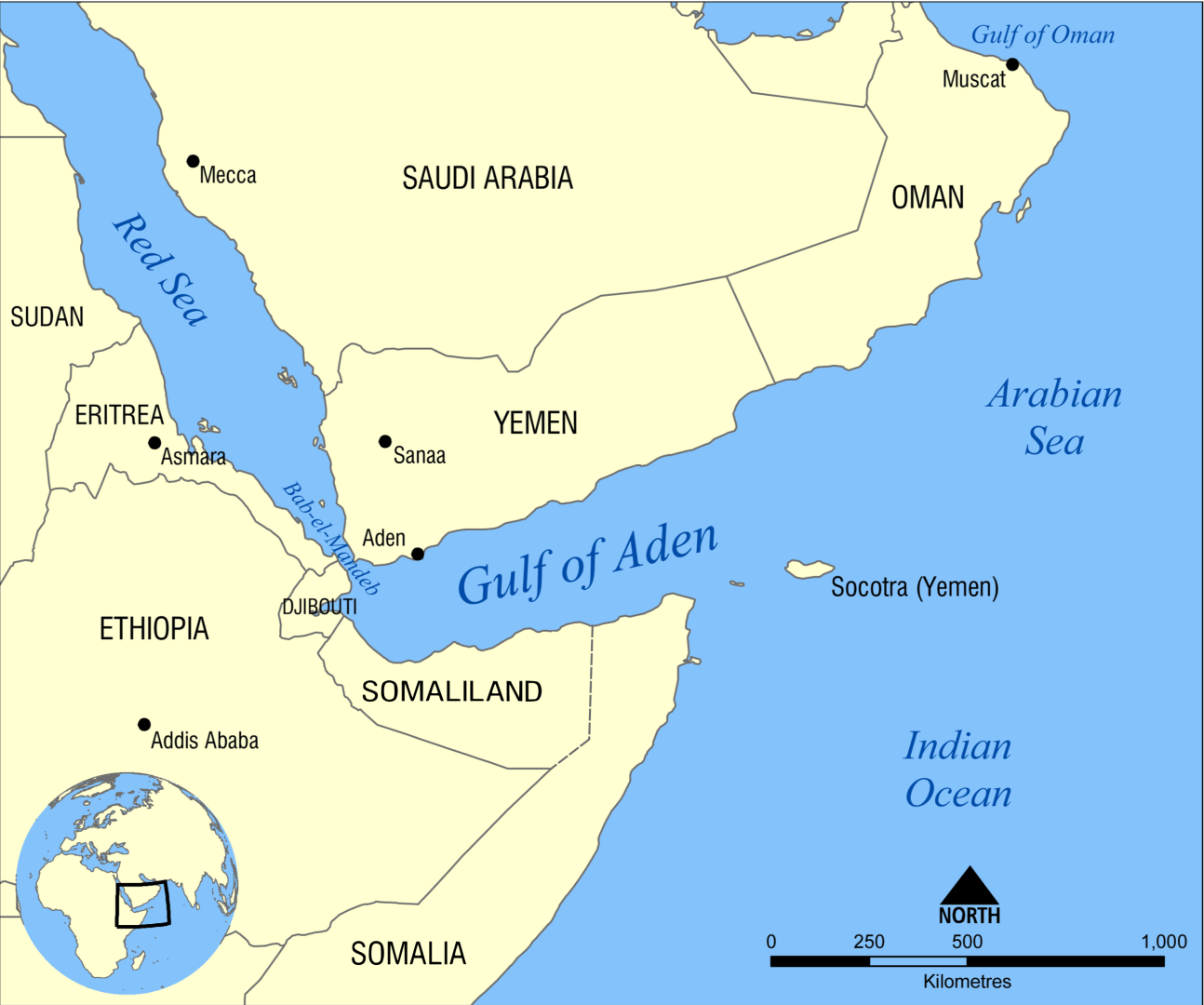
Bab al-Mandeb has strategic importance due to its geography. It connects the Red Sea to the Gulf of Aden. The strait forms the opening of the southern gateway to the Suez Canal, placing it at a central position on the world’s most important trade corridors. Ships travel from Europe and Asia along the Red Sea and the Suez Canal since this corridor offers a shorter alternative to sailing around the Cape of Good Hope.
This makes the location of Bab al-Mandeb a geopolitical affair. Vessel delays are only the first symptom of a disruption, which ultimately compromises the entire logistics network. It can force important shipping companies to change or reconsider routes, increase transportation costs, and increase the time of journeys. Therefore, the strait exposes a fundamental truth about global geopolitics: economic interdependence creates severe vulnerability when major supply networks rely on a single geographic bottleneck.
When Geography Becomes Powerful
However, the significance of Bab al-Mandeb cannot be measured only by the amount or volume of trade that passes through it. The real importance shows that real power can be exerted over a narrow strategic corridor for trade. The conflict in Yemen has altered the strait from a geographical location into a focal point for provincial rivalry where the interests of local stakeholders intersect with major international powers. When freedom of navigation is threatened, nations relying on maritime trade respond immediately, while the potential for disruption gives local actors a form of strategic leverage that reaches far beyond Yemen. The geopolitical reality of the Bab-al-Mandeb leaves a nation with no choice but to align its strategy with its geography.
The Broader Picture
But the main problem now is that the consequences of this regional competition have extended beyond the states surrounding the Red Sea. The corridor is now connected to a wider link to the chain of maritime trade with Asian manufacturing and European markets. This means the instability in the region can quickly turn into an international economic conflict.
This strait conflict can cause companies to shift their shipping routes around the Cape of Good Hope. This cannot be viewed as a solution because distance, fuel consumption, and time would further complicate an already complex supply chain. The result is a bizarre juxtaposition: a conflict focused on one of the world’s most fragile geopolitical regions, which can be used to generate economic pressures far beyond. What is going on with the Bab al-Mandeb demonstrates how interconnected the world actually is and makes the global economy an even more complex affair.
Conversely, protection of Bab al-Mandeb is not only about keeping commercial cargo moving. It creates a predicament for the international community. How can multilateral cooperation stabilize global trade routes without exacerbating existing security dilemmas? The expansion and growing involvement of international naval focus reflect the extent to which the security of the strait has become an important concern.
States have become increasingly interested in preventing attacks on trade shipments, but military intervention also indicates the risk of creating further tensions, which would amplify the conflict more. This creates a difficult and complex situation for the international community. Securing an important maritime corridor or choke point may cause an immediate threat to trade, but it does not necessarily solve the political instability and threats.
Globalization’s Geopolitical Paradox
In the long run, the crisis in Bab al-Mandeb exposes a deeper contradiction within the concept of globalization. The modern interconnected global economy depends on free trade and free movement of goods across the borders. However, this movement still remains dependent on political stability. This shows that a more interconnected economy does not guarantee a safe and secure international system.
In some circumstances, it can cause instability to become more widespread. In the case of the conflict in Bab al-Mandeb, we saw that Yemen caused a disruption that reverberated through shipping markets in Asia, which also affected the supply chains in Europe. This also forced the governments of the Middle East to reconsider their security plans and priorities.
Nevertheless, the conflict rising in Bab al-Mandeb is not only due to economic issues. The corridor also shows how quickly geography has started to shape international power and affairs, despite the growth of technology, international institutions, and the global markets. The international market may connect states together economically but then predominantly remain dependent on territorial security and strategic water channels that can be threatened.
This creates pressure and uncertainty at the heart of globalization: mutual economic dependence cannot completely shield nations from the political rivalries and border conflicts that threaten to tear them apart. The Bab al-Mandeb therefore demonstrates the paradox of globalization.
Power Struggle
The importance of the Bab al-Mandeb is further highlighted by the regional rivalries around it. Yemen’s conflict does not exist in isolation; it is linked to the wider struggle for influence. This struggle for influence expands across the Middle East and the Red Sea. The Houthis have become a significant actor in this territorial competition, while, on the other hand, Saudi Arabia, Iran, and other dominant powers have prioritized and pursued their own security and interests in the region.
This makes the Bab al-Mandeb more than a mere artery of global trade; it acts as a stage where domestic warfare meets international power politics. For states that are linked and dependent on maritime trade, the conflict and the surrounding instability represent both strategic concern and economic pressure. Accordingly, situations unfolding on the Yemeni coastline frequently engage foreign powers whose geopolitical interests lie far beyond the state itself.
One Strait, One Global Trade Route
The significance of the Bab al-Mandeb has become even more vivid when it is seen as part of a much larger and complex maritime system. Ships passing through the strait enter the Red Sea before arriving at the Suez Canal, creating a cycle of continuous trade between the Indian Ocean and the Mediterranean. The disruption at the southern doorway can place pressure on the entire cycle or route. This indicates how interconnected strategic bottlenecks can magnify the consequences of a regional conflict.
The Human Cost
This whole conflict exclusively focuses on trade and strategic competition risks, overlooking the citizens in the middle of the crisis. International markets see the strait as an economic calculation of cost and transit time, whereas local Yemenis face its consequences as a raw, physical reality of the conflict. The ongoing instability threatens livelihoods and contributes to displacement and deepens an already severe humanitarian crisis.
This contrast reveals a glaring blind spot in how we debate global politics. This distinction exposes an important failure in the way geopolitical conflicts are often debated. The international community may view the security of the corridor principally through the protection of commerce while leaving neighboring communities to face the direct consequences of heightened insecurity and displacement. Any serious discussion of the Bab al-Mandeb must recognize that security and protection of global trade and the security of human security are interconnected, but that is not necessarily the same aspiration.
The Reveal
Eventually, the Bab al-Mandeb exposes that globalization has not made geopolitics tangential; instead, it has made certain geographical locations even more consequential. Modern economies might depend on international markets and tightly coupled supply networks, which suffer from spatial lock-in or geographic rigidity. Therefore, the strait symbolizes global security challenges. It is an assessment of how flexible the international system is when economic interconnectedness confronts geopolitical imbalance.
If a dispute is on, the Bab al-Mandeb crisis proves that globalization is a double-edged sword: while it opens up massive trade opportunities, it also exposes the entire world to shared risks from a single chokepoint.
If you want to submit your articles and/or research papers, please visit the Submissions page.
To stay updated with the latest jobs, CSS news, internships, scholarships, and current affairs articles, join our Community Forum!
Find our FREE quizzes and MCQs here!
The views and opinions expressed in this article/paper are the author’s own and do not necessarily reflect the editorial position of Paradigm Shift.

Aima Hussain is currently a student at the Lahore School of Economics, with a keen interest in politics, international relations, and the forces shaping an increasingly interconnected world. Drawn to the intersection of power, history, and society, she enjoys questioning conventional narratives and examining the stories behind major
political developments. Her writing reflects a curiosity about the world beyond the headlines and the ideas that continue to shape it.