

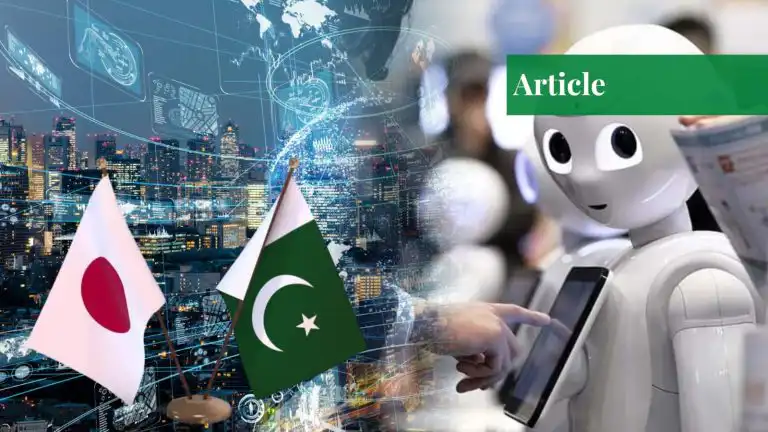
Pakistan has made another attempt to connect with Japan. This time, the focus is mainly on technology, rather than the older stories about textiles and auto parts that have long shaped the relationship.
Federal Minister for IT and Telecom Shaza Fatima Khawaja spoke at a business seminar in Tokyo. The seminar was organized together by the Japan External Trade Organization (JETRO) and the Pakistan Software Export Board (PSEB). The event was called “Pakistan’s Digital Transformation and Opportunities for Partnership with Japan”.
She invited Japanese companies to invest in Pakistan’s technology sector, especially to open research and development centres (R&D). Ambassadors, the CEO of PSEB, and senior officials from Japan’s Ministry of Economy, Trade, and Industry were all present at the meeting. This was not a small or unimportant event.
Why Japan Matters to Pakistan’s Technology Goals
The minister leaned on a handful of numbers that Pakistan has been repeating a lot lately whenever it talks to foreign investors. More than 161 million people are broadband subscribers, with a fiber optic backbone that now runs over 17,200 kilometres. Over 750 MHz of spectrum was released this year to make room for faster connectivity and 5G. None of these figures are new, exactly, but stacking them together is meant to send one message: the basic digital groundwork exists, so investors don’t need to start from scratch.
Then came the demographic pitch, which is honestly the part Pakistani officials tend to reach for the most. 68% of Pakistan’s population is under the age of 30, and each year more than 75,000 IT graduates and software engineers enter the job market. Put simply, she argued that Japan brings precision engineering and world-class technical know-how, and Pakistan brings the scale of young talent needed to actually build things at volume. It’s a fairly standard framing for this kind of seminar, but it isn’t a baseless one either, given what’s happening in the sector right now.
Pakistan’s Growing IT Industry and Export Ambitions
Because Pakistan’s IT exports have been emerging, it’s clear that the sector is growing stronger every year. More companies are entering the market. The number of skilled professionals is rising too. The government has started supporting tech startups with policies and infrastructure. This has helped the industry attract investment and create more jobs. The increase in exports shows that Pakistan is becoming a player in the global tech space. In comparison with previous years, IT exports have reached a 29% high of $4.5 billion in the fiscal year July 2025 – June 2026, and this record-breaking growth is coming from the IT software industry, outsourcing, online platforms, and gaming. The report showed a slightly higher final number, closer to 4.6 billion dollars, once all the fiscal-year data was in. That’s still shy of the government’s 5-billion-dollar target, but it’s the highest the sector has ever posted.
One detail that’s easy to miss here: earlier reporting out of the Prime Minister’s Office mentioned that Pakistani software firms have already been expanding into Asia-Pacific markets, Japan among them, alongside Singapore. That’s a small but useful clue. It means Pakistan isn’t asking Japan to leap into the unknown here; some commercial ties already exist, even if they’re modest.
Why Previous Investment Efforts Delivered Mixed Results
It’s worth being upfront about something. Japan and Pakistan have had this conversation many times before, and the results have been mixed at best. JETRO’s Karachi office has been around since 1954, making it one of the organisation’s oldest overseas posts anywhere in the world, and over the years it has run seminar after seminar, trade mission after trade mission, trying to nudge Japanese firms toward Pakistan. Despite all that effort, Japanese FDI into Pakistan has never been particularly steady. One assessment from the Japanese consulate in Karachi noted that it dropped from around 131 million dollars in 2008 to just 31 million dollars in 2013 and pinned much of the blame on law-and-order problems, chronic energy shortages, and policy that kept shifting under investors’ feet.
From Manufacturing Concerns to Technology Opportunities
That backdrop helps explain why this latest pitch focuses so tightly on technology and R&D rather than manufacturing or heavy industry. Tech investment doesn’t depend on the same things that scared off Japanese manufacturers in the past. It depends far more on whether there’s enough skilled talent and less on the state of the roads or the power grid, which is exactly the argument Pakistan is now trying to make its whole case around.
What Would Make Japanese Investment Work?
A ministerial speech at a seminar doesn’t move money on its own, and it’s naive to treat this as a done deal. What usually decides whether R&D centers actually get built is a lot less glamorous: consistent policy, reasonable ease of doing business, decent intellectual property protection, and whether Pakistani firms can deliver work at the standard Japanese corporate clients expect over the long run. Still, having officials from Pakistan’s IT ministry, PSEB, METI, and JETRO in the same room talking specifically about digital collaboration is nothing. If the export growth holds up and the infrastructure promises turn into something concrete, this could end up being one small building block in a much longer relationship. If not, it’ll join a fairly long list of well-intentioned seminars that didn’t quite translate into investment.
Find our FREE quizzes and MCQs here!
If you want to submit your articles and/or research papers, please visit the Submissions page.
To stay updated with the latest jobs, CSS news, internships, scholarships, and current affairs articles, join our Community Forum!
The views and opinions expressed in this article/paper are the author’s own and do not necessarily reflect the editorial position of Paradigm Shift.
Hooria Akbar is an independent researcher and content writer with a strong interest in contemporary issues across AI, technology, society, and emerging trends. She writes research-informed articles, thought pieces, and blogs on a wide range of topics, aiming to present complex ideas clearly and engagingly for diverse audiences.