Theoretical Foundations and Historical Realities
It is evident in recent times how relations among states have been reshaped. Realists believe that the international system is in a state of anarchy, where no central regulatory body exists to regulate state affairs. The survival mechanism of states is based on self-help, and the main goal is to achieve power and security. However, liberalists preach the message of cooperation, shared values, and mutual gains. States speak the language of liberalism but practice realism.
Over time, history has witnessed the evolution of state partnerships based on economic and strategic gains. During the Cold War, Pakistan joined the US-led Southeast Asia Treaty Organization (SEATO) and Central Treaty Organization (CENTO) pacts, not because of ideological conviction. It was an interest-based alliance: Pakistan needed a strong ally against India, while Washington needed bases against the Soviet Union. In 1979, the Soviets invaded Afghanistan, and Pakistan became a frontline state overnight, receiving billions in aid and weapons tied to a single interest. Once the Soviet Union collapsed in 1991, the Pressler Amendment cut off military assistance. This shows that once the interest disappeared, the alliance faded.
Pakistan and China’s friendship, celebrated as an “all-weather friendship,” is not immune to this phenomenon. The Iron Brothers have shared a steady relationship since 1951, reinforced by reciprocal benefits: China, being a permanent member of the United Nations Security Council (UNSC), provides diplomatic cover to Pakistan. The China-Pakistan Economic Corridor (CPEC), launched in 2015, brings a $62 billion long-term investment to Pakistan, developing infrastructure, energy, roads, power plants, and the Gwadar Port.
However, it also carries heavy loan repayments and interest. China also provides support on the technological front; the JF-17 Thunder fighter jet is a testament to its endurance in the skies. China’s investment in Pakistan is not an act of unidirectional generosity. Gwadar Port offers Beijing a shorter route to the Arabian Sea, bypassing the Strait of Malacca, providing an efficient trade route across the Middle East and Africa.
The Trilateral Shift: The Makkah Joint Defense Pact
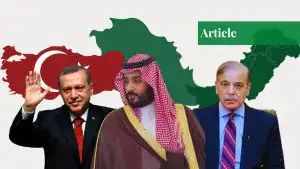
The contemporary geopolitical dynamics are increasingly transformed by the formation of alliances and agreements to achieve economic and security benefits. On August 7, 2026, the Makkah Joint Defense Agreement was signed, in which Pakistan, Saudi Arabia, and Türkiye made a mutual trilateral defense pact. According to the pact, an armed attack against one signatory shall be considered an attack on all three. In September 2025, the Strategic Mutual Defense Agreement (SMDA), a bilateral defense agreement, was signed between Pakistan and Saudi Arabia. However, it has since expanded strategically to include Turkey, and the pact implicitly indicates a NATO-style Article 5 commitment.
Pakistan, being a nuclear power, holds a crucial position through its diplomatic and mediatory role. The three signatories of the pact share a distinct historical pattern and ideology. Pakistan and Saudi Arabia developed trust over decades: Pakistan has provided military cooperation, training, and personnel, while Saudi Arabia has provided economic assistance, energy support, and trade. Pakistan and Türkiye have built a relationship of mutual respect, with military-technical partnerships and the exchange of warships and training aircraft.
Türkiye’s democratic system and Saudi Arabia’s hereditary monarchy create an ideological contradiction. After the Arab Spring, both experienced deeper disagreements following the 2017 Qatar Blockade, and the 2018 murder of Saudi journalist Jamal Khashoggi in Istanbul pushed relations to their lowest point. Now, the alliance and reconciliation are converging towards the concept quoted by Lord Palmerston: “We have no eternal allies, and we have no perpetual enemies. Our interests are eternal and perpetual, and those interests it is our duty to follow.” Hence, nations do not have permanent friends or enemies; they only have permanent interests.
Strategic Advantages and Foreign Policy Risks
Since May 2025, Pakistan has emerged as an epitome of defense and diplomacy, rewriting the fate of regional stability. Turkey, being an active member of NATO, has joined this trilateral defense pact, adding a secondary security shield of military deterrence. This comes amid the current volatile scenario, where US reliability and Trump’s commitments regarding NATO remain ambiguous.
For Pakistan, it is an opportunity to attain not only regional prestige but also economic leverage and foreign capital investments. The Makkah Pact has strategically placed Pakistan as a formal stakeholder in Middle Eastern security architecture, opened access to Gulf capital, and created new means of trade. Turkey brings technological support and advancement, Saudi Arabia brings capital funding, and Pakistan brings workforce, manufacturing capacity, and geography.
However, this pact could also involve Pakistan in future confrontations unaffiliated with our national interests, resulting in conflict entrapment and civil-military imbalance. The pact aligns the mutual benefits of all stakeholders. Pakistan’s way forward is to exercise the defense pact while maintaining an independent stance on regional conflicts. By focusing on diplomatic goodwill and developing economic and technological gains, this alliance can be translated into an asset for Pakistan.
Economic Dependence and the Path to Self-Reliance
Interestingly, the dynamic transformation of partnerships among states carries a significant economic impact: the boom-bust cycle. Pakistan’s economic system is heavily influenced by foreign aid; with strategic partnerships, there is a sudden influx of funds into the country, but it makes Pakistan a victim of external patronage, leaving the domestic economy fragile and dependent, far from sustainable growth. A weak economy triggers political instability; hence, the long-term costs are not only fiscal but also structural.
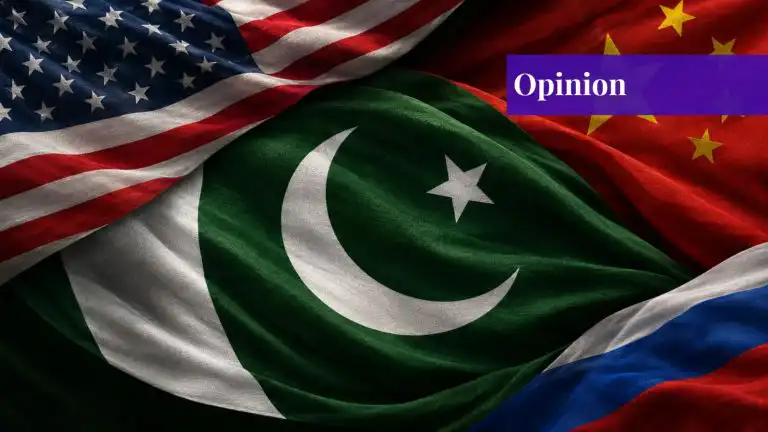
Every nation, from Washington and Beijing to Riyadh, follows the same pattern. Palmerston’s 1848 statement is still valid today, describing Islamabad in 2026. Pakistan has spent seven decades being useful to the United States against Russia. Partnerships are also a means of survival, as no nation can survive in isolation. Pakistan’s current standing as a mediator on the global stage carries lessons and responsibilities. Diplomatic negotiations and foreign policy are the fundamentals of this game. Pakistan should take worthy action, build matters on its own terms, rise as a regional power, and create sustainable economic institutions for national prosperity.
If you want to submit your articles and/or research papers, please visit the Submissions page.
To stay updated with the latest jobs, CSS news, internships, scholarships, and current affairs articles, join our Community Forum!
Find our FREE quizzes and MCQs here!
The views and opinions expressed in this article/paper are the author’s own and do not necessarily reflect the editorial position of Paradigm Shift.

Maria Imran studies management sciences at Sukkur IBA University and is an academic researcher at NSRI (MIT), a regulated global research center. She is a freelance columnist who writes on various issues of national significance. She can be reached at mariaimran.bbaf24@iba-suk.edu.pk