
Over the course of history, catastrophes seem to arrive twice. First, the event itself, and then in a more elaborate form where the “experts” confidently claim that “Yeah, it was obvious”. People are led to believe that indications of that catastrophe were there, but we failed to see them. I believe that the second arrival is far more harmful and epistemically ailing than the first arrival; that’s because we somehow manage to present an unpredictable event with self-explanatory simple models and graphs which flatter us into believing that failure was one of attention rather than of knowledge. Upon failure of prediction, we question our own actions: why didn’t we listen to the experts? Or did we build the right model? These are far less uncomfortable questions to answer and, on top of that, the wrong ones.
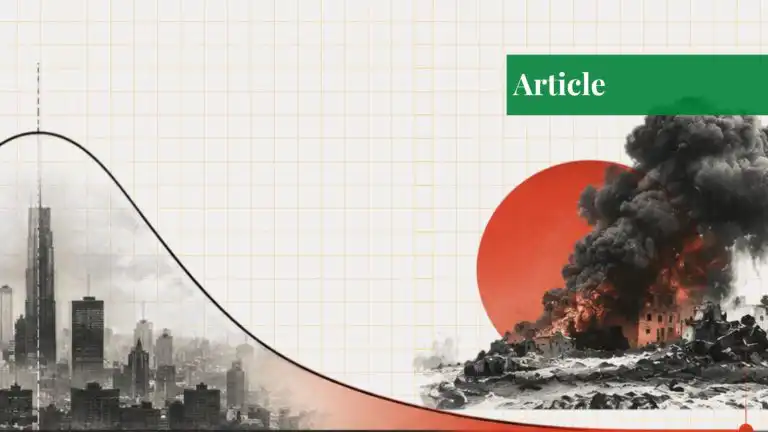
The core flaw behind this has less to do with the catastrophe than with the methods or models we use to predict it. Anything that we term as risk management depends upon the most basic and common assumption that the world and its trends behave like a bell curve, with outcomes bunched around an average or mean, and the extremes fading into near impossibility at the edges. To predict something within the realm of an ordinary stretch of life, this assumption is harmless enough. However, you cannot predict something that happens once in a decade or a century by looking at the normal clues. The events which actually rearrange the political and economic dynamics of the world do not sit in the comfortable middle of the distribution. These rare events live in the tails of these curves with an insignificant presence on the overall graph, yet they have a capacity to turn the dynamics upside down. The same applies to currency crises because a currency does not soften politely; it leaps off the ledge, and when it does, it takes decades of savings with it. They do not happen every day, so when you are looking at a currency analysis of some country which underwent a crisis at some point, you are most likely to ignore the crisis period. Nassim Taleb has spent a career making this point, and his sharpest version of it is that these tail events carry nearly all of the consequences while our models, trained rigorously, however, in the quiet years, have learned everything about the calm and nothing about the calamity.
The trap we fell into is not of ignorance but of accepting a clean, tidy picture, which hides the tails, as truth. This, in Taleb’s words, is called Platonicity, our tendency to make clean, elegant, and deceiving models for reality itself. We create boundaries around knowledge when we do not know what lies ahead, and take that boundary as an end point. And the funny thing is we don’t do it on purpose; we do it because we fail to recognise that sometimes we do not know what we do not know. A smooth model that explains the past and promises a stable future is far more satisfying than the honest admission that the world is wild and only partly visible. This is a classic example of how we rather choose to live in a delusion than to face the bitter truth. So we shave the jagged edges off reality until it fits the diagram, and then we forget that we ever did the shaving. The bell curve is the great idol here. It is clean, laymen can understand it, and it makes a frightening world of uncertainty feel manageable, right up until the tail event is dismissed as almost impossible and walks through the door. The failure is never that the model was crude, because every model is crude and quite honestly it is supposed to be that way. The failure is that we believed the model instead of the world and its randomness.
And once the catastrophe has struck, we lie to ourselves all over again, this time by telling stories. We cannot sit comfortably with raw randomness and uncertainty, so we take a mess of disconnected events and string them into a clean chain of cause and effect, ultimately falling into the pit of ad hoc fallacy. After the fact, the past always reorganises itself into a neat trail of clues that anyone could supposedly have followed. But that trail is drawn in hindsight. In real time it was one of a hundred possible trails, and the other ninety-nine, which led nowhere, have been quietly forgotten or ignored. This is why the confident post-mortem is so seductive and so useless. It describes a story we have imposed on the past, not a mechanism we can carry into the future.
There is a subtler trick at work too, and it may be the most important of the three. We build our sense of what is likely almost entirely from what we can see, which means the survivors, the winners, and the disasters loud enough to be remembered. What we never count is the silent evidence, the enormous mass of fragile systems that broke without warning and confident predictions that failed and were never mentioned again. Because these leave no monument, we badly overestimate both how visible danger really is and how skilled our past forecasting was. Somewhere in the pursuit of accurate prediction, we blur the difference between an absence of evidence and evidence of absence, and quietly convince ourselves that because we have not seen the danger, it must not be there. The analyst who happened to call the last crash becomes an oracle, while the dozens who got it wrong disappear from the conversation. We are reading a history of the sea written only by the ships that made it back to harbour, and concluding from it that the water is safe.
Pakistan lived through all three of these illusions between 2022 and 2023, and the human cost turned the theory into something painfully real. For years the economy ran on a reassuring set of averages, a managed rupee, cheap imports, and steady borrowing, a picture of stability that everyone had an interest in believing. Then the tail arrived. Foreign reserves drained to around three billion dollars, barely enough to cover three weeks of imports, and the country edged towards default. When the State Bank finally removed its cap on the exchange rate, the rupee did not adjust gently. It lost close to a tenth of its value in a single day in late January 2023, part of a slide that would strip away roughly a fifth of its worth over the year. Inflation then climbed to a record of about thirty-eight percent by the middle of the year, and for households already living close to the edge it meant that wheat, cooking oil, and fuel began slipping out of reach. None of this was genuinely unforeseeable. Analysts had warned about the country’s fragility for years. But knowing that a structure is fragile is not the same as knowing when, or how violently, it will give way, and the soothing story of stability held right up until the moment it collapsed.
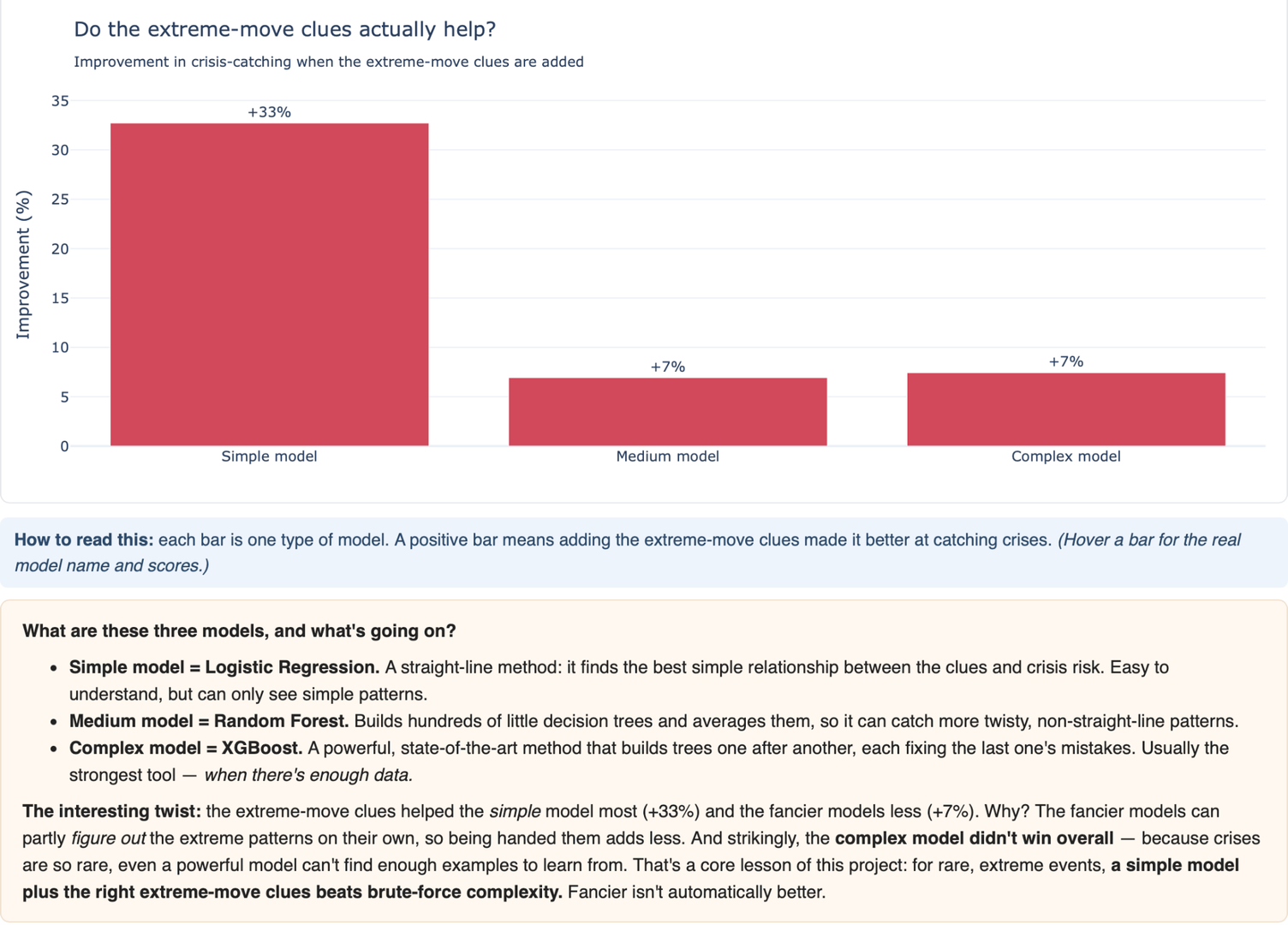
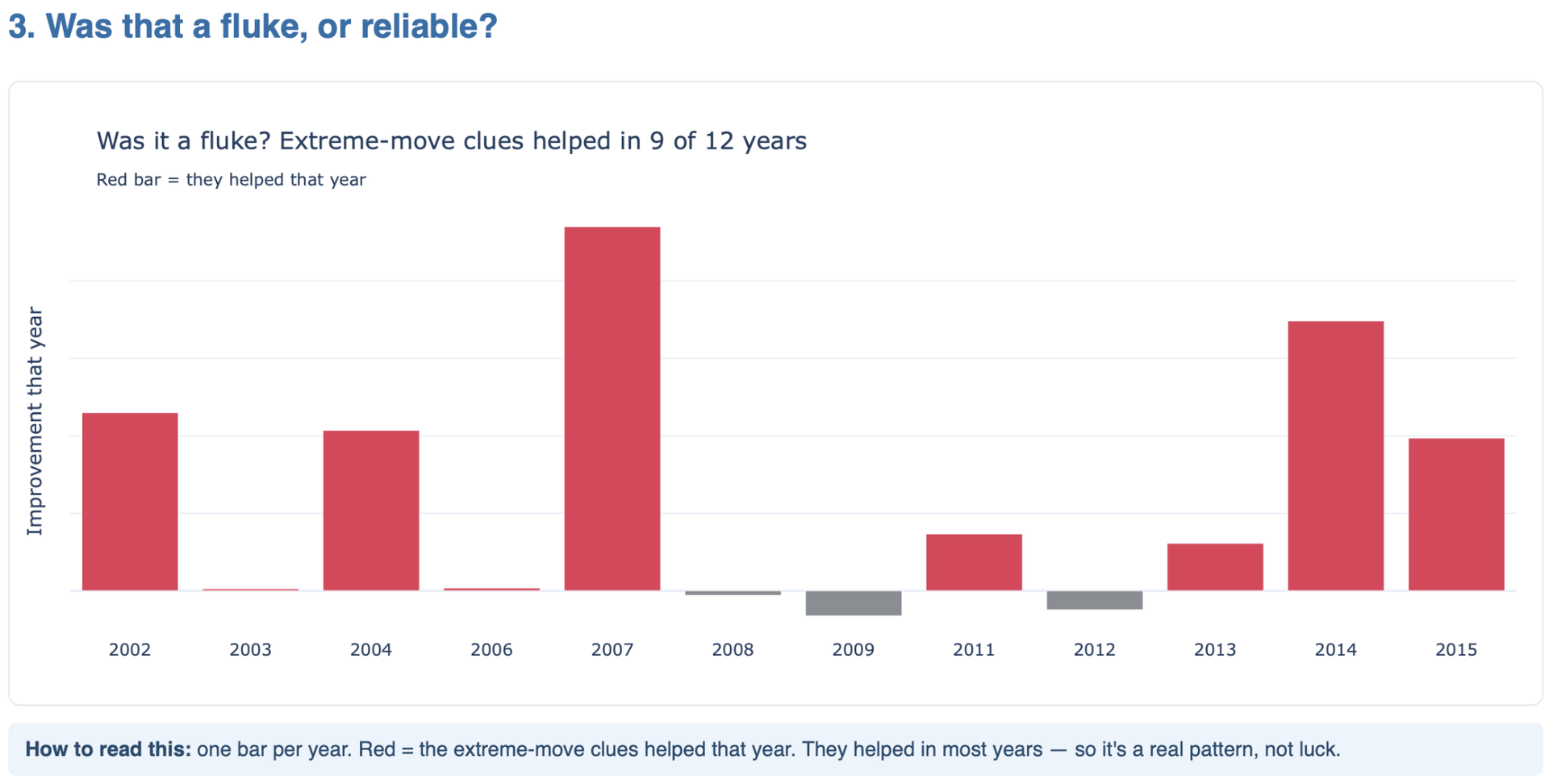
I wanted to see this tension for myself, so I spent some time building a machine learning system to predict currency crises across more than a hundred economies. The question I put to it was narrow. Does information about extreme behaviour, the violent swings and the abnormal volatility, actually predict crises better than the conventional indicators everyone already watches? It turned out that it did, and the tail risk signals did most of the predictive work, which is exactly what the theory promised. But the finding that stayed with me was the one that punctured my own ambition. Even when the model leaned fully into the tails, prediction remained genuinely hard. The gains were real but modest, and the most complex model I could build never beat the simplest one. When I forced the system to speak in honest probabilities, a raised but still uncertain chance rather than a confident alarm, those humble numbers were the truthful ones. A model can tell you where the danger lies. It cannot tell you the day the dam breaks. To pretend otherwise would be to commit, in code, the very error the whole exercise was meant to expose.
Now here I am not arguing that predictions and forecasting are inherently pointless; instead I am simply saying that doing it all honestly is far more important than the forecasting itself. Rare and extreme events resist prediction not because we are lazy but because they are thin on data and thick with chaos, and a model that manufactures confidence anyway is not powerful; it is hazardous, especially in the hands of people who have to act on what it says. Picture an overconfident crisis predictor let loose in the real world. A false all-clear lulls a central bank into doing nothing, or a false alarm sparks the very panic it claimed to foresee, and in both cases the damage runs downhill to the pensioner whose savings evaporate and the family priced out of medicine. In that setting, honesty about uncertainty is not an academic nicety. It is a moral responsibility.
So can we predict the unpredictable? Not in the way the hindsight charts pretend we could have. The crystal ball is a fantasy, and a mildly dangerous one. But there is a better ambition hiding inside the failed one. It asks us to resist the pull of the elegant model, to distrust the tidy story, and to keep in mind the graveyard of evidence we never see. It asks us to build tools honest enough to mark both where the danger lies and where our knowledge runs out, and to treat the words I do not know not as an embarrassment but as the starting point of responsible forecasting. The aim was never to abolish surprise. It was to learn to live wisely alongside it, which is a humbler goal than seeing the future, and unlike seeing the future, it is one we can actually reach.
If you want to submit your articles and/or research papers, please visit the Submissions page.
To stay updated with the latest jobs, CSS news, internships, scholarships, and current affairs articles, join our Community Forum!
Find our FREE quizzes and MCQs here!
The views and opinions expressed in this article/paper are the author’s own and do not necessarily reflect the editorial position of Paradigm Shift.

Danial Waheed is a final year student at King's College London studying BSc. Philosophy Politics and Economics