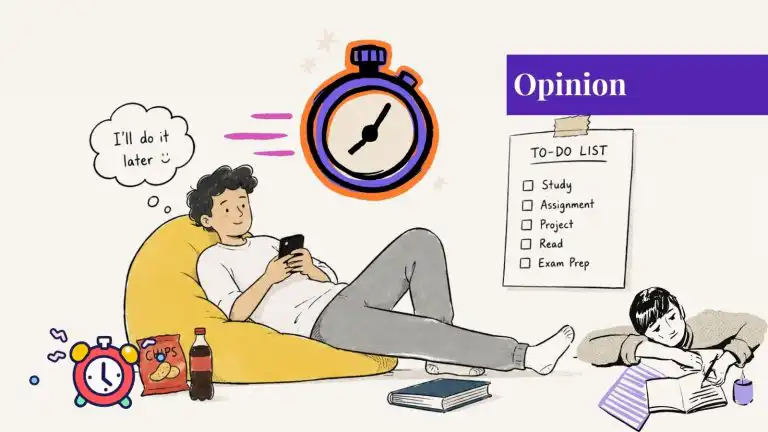
A procrastinator is a person who keeps putting things off. Their task is always very clear, and yet they do not get started on it. Instead, they make tea. They reorganise a drawer. They follow a thought down a seven-tab rabbit hole on a topic entirely unrelated to the work they should be doing. And in the doing of all this, they feel something that the productivity literature never quite acknowledges: relief. Ease. A not-unpleasant hum of the present moment, uncontaminated by the anxiety of beginning. This sensation, the specific pleasure of putting things off, is not a character flaw dressed up in feeling. It is a neurochemical event, an evolutionary inheritance, and one of the more fascinating puzzles in the contemporary psychology of human behaviour.
The word procrastination carries its reproach etymologically. It derives from the Latin procrastinare: pro meaning “forward” and crastinus meaning “belonging to tomorrow.” The Romans apparently had the same problem. But the moral weight that modernity has attached to the concept, the idea that delay is laziness, that laziness is failure, that any moment not directed toward productive ends is squandered, is a more recent invention, inseparable from the Protestant work ethic and its secular descendants. It is worth pausing on this before reaching for the neuroscience, because the guilt that procrastination produces is not a natural response to delay. It is a culturally installed response to a culturally defined obligation. The question of why procrastination feels good is, therefore, also, underneath it, a question about what our relationship to work, pleasure, and time is, and whether the framework we have inherited for thinking about all three is honest.
The brain’s role in making delay pleasurable is now reasonably well understood. According to neuroscience research, when a person is confronted with a task, two systems are in constant negotiation: the limbic system, which is old, fast, and concerned only with immediate emotional comfort, and the prefrontal cortex, which is slower, more recently evolved, and in charge of planning, delayed gratification, and abstract future orientation. The limbic system reacts to an aversive task, something that is difficult, uncertain, boring, or that makes one fear doing poorly, as a mild threat and seeks relief. That relief is an evasion. The moment the procrastinator turns away from the task, the discomfort is gone. The brain interprets the disappearance as a reward, releasing a little dopamine into the system. The brain doesn’t know or care if relief is temporary. It records the avoidance as working. It files it as a successful coping mechanism. So the next time the aversive task comes around, the neural pathway toward avoidance is already there and a little more worn.
Dopamine’s role in this dynamic is worth examining carefully, because it is widely misunderstood. The popular account of dopamine frames it as a reward chemical, the brain’s way of saying “that felt good.” The more accurate account, developed by neuroscientist Wolfram Schultz and elaborated by Anna Lembke in Dopamine Nation, is that dopamine is primarily an anticipation signal: it fires in response to the prediction of reward rather than the reward itself. This distinction matters enormously for understanding procrastination. When a person sits at their desk with the task undone and reaches instead for their phone, the dopamine hit they receive is not from the phone’s content. It is from the anticipation of distraction; from the moment they decide to look. Every potential scroll, every new tab, every cup of tea represents a micro-reward loop: predict pleasure, receive a dopamine pulse, act, receive slightly less dopamine than predicted, seek the next prediction. The procrastinator is not, in any meaningful sense, relaxing. They are operating a slot machine with their own neurochemistry.
The temporal dimension of this dynamic is captured by what psychologists call temporal discounting; the universal human tendency to prefer rewards that arrive sooner rather than later, even when the later reward is objectively larger. A 2024 study in Scientific Reports by researchers at New York University found that individual differences in temporal discounting robustly predicted procrastination behaviour in real-world settings: people who valued immediate rewards over delayed rewards procrastinated more, controlling for conscientiousness, anxiety, and other personality factors. The finding confirms what one might suspect: the pleasure of procrastination is partly the pleasure of the present tense. The unfinished task is weeks away, abstract, and surrounded by the uncertainty of whether it will be well done. The cup of tea is here, warm and certain. The brain’s arithmetic, evolved on the time horizons of immediate survival rather than semester deadlines, consistently chooses the tea.
But procrastination is not always an avoidance of difficulty or aversiveness. One of the more surprising findings in recent research is that people also procrastinate on things they genuinely enjoy, and for a reason that is, in its own way, almost touching. A 2025 study published in PNAS Nexus by Linda Hagen and Ed O’Brien found that individuals postpone the resumption of enjoyable activities following an absence, in the hope that the return will be more special, more meaningful, more commensurate with the importance the activity has for them. After the COVID-19 lockdowns ended, surveyed Americans said they waited longer to return to restaurants, movie theatres, parties, and family gatherings, not because they didn’t want to go, but because they wanted the reunion to feel worthy of the yearning they had accumulated. In another experiment, adults asked to send a brief text message to a friend were less likely to do so the larger they perceived the friendship gap to be. The longer the absence, the higher the threshold for return. This is the same reason we procrastinate on tasks. The imagined version of the thing is, for a time, more satisfying than the actual thing. This is a remarkable finding. It means that procrastination is not simply the avoidance of pain. It is, sometimes, the cultivation of pleasure’s anticipatory form; a kind of deliberate longing that heightens the thing by deferring it.
This connects to a broader psychological phenomenon that Neil Fiore explored in The Now Habit: the counterintuitive observation that scheduled, guilt-free leisure is not the enemy of productivity but its precondition. Fiore’s central argument is that procrastination is not fundamentally about laziness. It is a response to the experience of work as a threat to the self, specifically, the threat of imperfect performance, judgment, and failure. When the stakes attached to a task are high enough, the mind retreats from beginning it because beginning it forces a confrontation with the possibility of doing it badly. Delay preserves the comfort of the unlaunched attempt: the essay not yet written cannot yet be bad. There is, in this framing, something almost protective about procrastination; a self-preserving instinct that, taken too far, becomes self-defeating. The solution Fiore proposes is not willpower but play: the restoration of pleasure to the present tense, reducing the task’s monopoly on future identity and making the present moment safe to inhabit without the shadow of performance anxiety.
The LSE’s Behavioural Science blog took a similarly sympathetic view in a 2024 analysis, arguing that procrastination can produce genuine cognitive benefits under specific conditions. Deadline-induced time pressure concentrates attention and can produce a form of focused, rapid cognition, the “last-minute miracle” of its title, that more leisurely approaches sometimes fail to summon. Procrastinators who work in bursts of compressed intensity often describe the quality of their late-stage thinking as sharper than the diffuse, uncertainty-ridden efforts that early starters produce over longer periods. This is not a universal truth, and the research based on “active procrastination” is contested, but it gestures toward something real: that urgency is itself a cognitive state with productive properties and that the pleasurable deferral that precedes it is not always pure waste. The period of not-working contains percolation, unconscious processing, and the quiet development of ideas that have not yet been asked to perform.
In The War of Art, Steven Pressfield refers to the force that causes delay as “Resistance” and makes the case that it is strongest when the task at hand is crucial. He states, “We will feel more resistant toward pursuing a call or action, the more important it is to our soul’s evolution.” There is something psychologically accurate about this observation, even when translated from Pressfield’s somewhat mystical vocabulary into plainer cognitive terms. Trivial jobs are not the ones that individuals tend to put off the most. They are the ones that are connected to identity, ambition, and anxiety: artistic endeavour, the challenging discussion, the job application, the item that, in the event of failure, reveals something about your identity. Administrative duties are completed. The novel sits untouched for months. The avoidance is proportional to the meaning, and the meaning produces a dopamine spike of avoidance more reliably than any trivial errand could.
What the longitudinal evidence suggests, however, is that the pleasures of procrastination are not evenly distributed across a life. Procrastination tends to decrease as people become older and take on more defined tasks, according to an 18-year study published in the Journal of Personality and Social Psychology in 2026, which followed 3,023 people from late adolescence into adulthood. Individuals who transitioned from school to the workforce had the sharpest declines in delay behavior, not because they became more moral, but rather because the repercussions of delay became more severe and urgent. Long-term harm was more startling: over two decades later, lower academic attainment, lower income, fewer promotions, and worse health outcomes were all predicted by higher procrastination in young adulthood. The pleasure of the afternoon drawer-reorganisation compounds, in other words, into a measurable shortfall in the shape of a life. The brain’s arithmetic, always weighted toward the present, misses this entirely.
The digital environment has aggravated this ancient dynamic almost beyond recognition. The smartphone is, from the limbic system’s perspective, the most perfectly engineered procrastination device in human history: it offers an essentially infinite supply of novel stimuli, each carrying its micro-dopamine prediction, each receding as soon as it is consumed, each demanding a successor. Social media platforms, as James Clear notes in Atomic Habits, exploit the cue-routine-reward loop with a precision that no previous distraction technology could approach. The book you put down when you were bored offered finitude; you could read it through and be done with it. The feed has no end. It is designed for indefinite looping, calibrated to the exact threshold of boredom at which a user would disengage, offering novelty at precisely the rate required to sustain engagement. Against this machinery, the prefrontal cortex’s instruments of self-regulation, intention, planning, and delayed gratification are neurologically outmatched. This is not a matter of weakness. It is a matter of engineering.
What emerges from all of this is a picture of procrastination that is considerably more complex and more human than the simple moral failure its cultural reputation suggests. It is a neurological event with identifiable mechanisms. It is an evolutionary strategy repurposed by a modern environment with incentives its designers did not intend. It is, sometimes, a form of self-protection; the mind declining to expose itself to a judgment it fears. It is, occasionally, a form of creativity; the incubation period before the concentrated burst. It is, in its most poignant form, the deferral of pleasure in the hope of making that pleasure more worthy of itself. None of these things excuses the drawer reorganisation or the seventeen-tab afternoon. But they do suggest that the question procrastination poses is not simply “why don’t I just start?” It is the older, harder question: what do I actually want and what am I actually afraid of? Waiting on the desk is rarely just a task. It is a mirror that the procrastinator, in the pleasurable act of looking away, is precisely trying to avoid.
The solution, such as it is, lies not in the elimination of pleasure but in its redistribution. Thibaut Meurisse’s Dopamine Detox and Anna Lembke’s Dopamine Nation converge on a similar prescription: that the overstimulated reward system, which has had its sensitivity calibrated by years of instant gratification, cannot be conquered by willpower alone. It must be recalibrated by deliberate reduction; by boring stretches of present-moment discomfort that allow the prefrontal cortex to reclaim territory from the limbic system. This is neither quick nor enjoyable. But it has the virtue of working with the brain’s actual architecture rather than against it. The goal is not to abolish the pleasure of procrastination but to restore the deeper pleasure of the finished thing; to allow the completed task, the sent message, the returned friendship, to deliver the satisfaction it was always capable of delivering, but which the brain had outsourced to the preview and forgotten to collect.
As it has always been, tomorrow is still a mysterious place. Rarely is intelligence, skill, or even discipline the difference between the individual who resides there and the one who returns to the present. It is the readiness to start imperfectly, in a moment that is never as hospitable as the one that is envisioned in the future. The drawer will remain disorganised. The tea will become chilled. If the task is started poorly, it will eventually become something. Ultimately, that is the only pleasure that endures.
If you want to submit your articles and/or research papers, please visit the Submissions page.
To stay updated with the latest jobs, CSS news, internships, scholarships, and current affairs articles, join our Community Forum!
The views and opinions expressed in this article/paper are the author’s own and do not necessarily reflect the editorial position of Paradigm Shift.

Abdul Basit | MS International Relations | Researching soft power, cultural diplomacy and global politics | Writing on geopolitics, foreign policy and defence affairs.