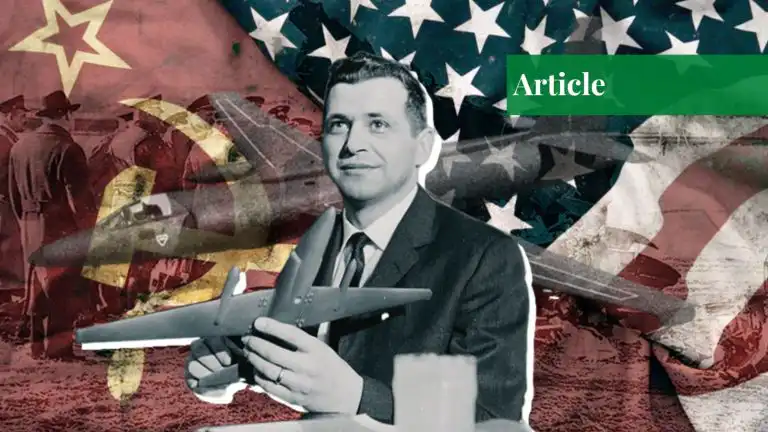
“I was a pilot flying an airplane, and it just so happened that where I was flying made what I was doing spying” (Francis Gary Powers)
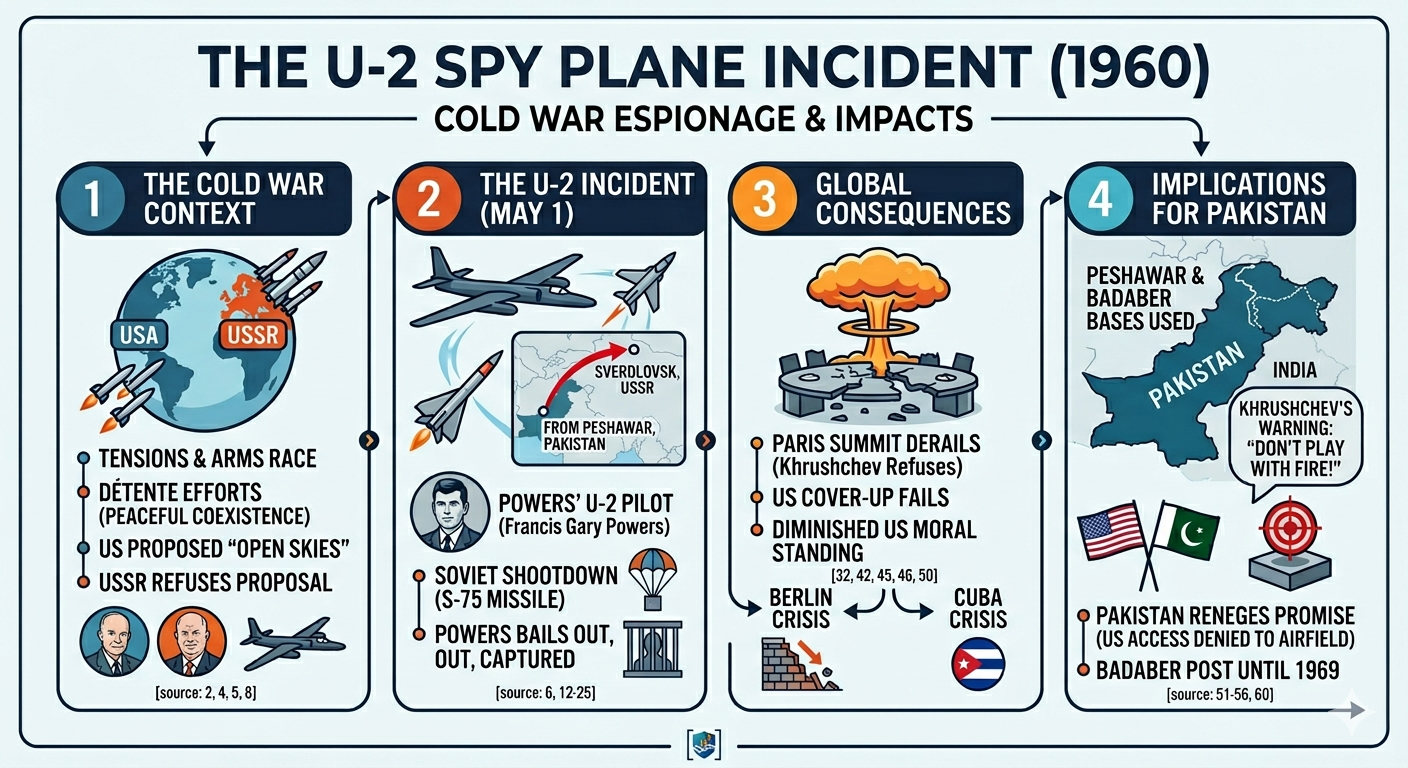
The relationship between the United States and the Soviet Union in the late 1950s was one of contradictions. While both sides were rapidly building stockpiles of nuclear weapons and were highly suspicious of each other, the period was also notable for the efforts made to de-escalate the possibility of armed conflict, led by Nikita Khrushchev’s idea of ‘Peaceful Coexistence.’ This included the resumption of the Four Powers Summit as well as Khrushchev’s visit to the US in 1959. An incident in May 1960, however, derailed these attempts at bridge building between East and West. It was the Soviet shootdown and capture of American U-2 pilot Francis Gary Powers.
Open Skies Policy
In 1955, US President Eisenhower had proposed that the US and the USSR agree to a plan for ‘Open Skies.’ This plan would allow both powers to perform serial reconnaissance over each other’s territories and monitor their respective nuclear facilities in the process. Premier Khrushchev refused the proposal, which prompted Washington to authorize the development of a spy plane that would be virtually impossible to detect. This was the U-2 built by Lockheed Martin and operated by the CIA. The first U-2 mission over Moscow and Leningrad took place on 4th July, 1956, with many more overflight missions being conducted.
How Was the U-2 Shot Down?
On the first day of May, 1960, leaders of both the Armed Forces and the Communists in Moscow were preparing for the traditional May Parade. However, at dawn, Khrushchev was informed that there was some rather humiliating news: an unknown foreign airplane had trespassed into Soviet territory, and their supposedly superior air force had failed to shoot it down once again. The Premier himself phoned Marshal Miryuzov, Commander-in-Chief of the Air Defense Forces, angrily shouting, “Shame! The country was giving air defense everything it needed, and still, you cannot shoot down a subsonic aircraft.”
This specific subsonic airplane belonged to the U-2 spy class. The plane was flown by Francis Gary Powers, who was a 30-year-old CIA pilot. He had taken off from the runway of Peshawar, Pakistan, on the plane with the designation number 360. What Powers did not know was that his aircraft, which was very hard to detect, had been detected by the Soviet radar as soon as he had left Pakistan. According to Colonel Alexander Orlov of the Air Defense Forces,“an alert was sounded immediately, which summoned all staff officers to their command posts.”
The Air Defense Forces sent out one Sukhoi Su-9 Fish-pot, which was an interceptor capable of reaching high altitudes, and gave the pilot an instruction to ram the U-2 at all costs. However, the pilot flying the Su-90 could not find the target as Powers went about his business, unaware that he had started quite a ruckus. In addition, a missile was launched at the U-2 when it entered the area defended by a battery of S-57 Dvina/SA-2 Guideline surface-to-air missiles close to Sverdlovsk. The U-2 was finally hit.
Powers managed to free himself from the cockpit and bailed out safely. In addition, as revealed in April 1990 by a Red Army newspaper, the Sverdlovsk batteries had also shot down a MiG-19, which was in pursuit of the U-2, killing its pilot, Sergei Safronov. Powers landed near a collective farm and was quickly captured and handed over to the KGB. He was under strict oversight of the Russian intelligence for almost 61 days. Powers was then issued a 10-year sentence for crimes of espionage.
But his sentence was cut short by a prisoner exchange. On 10th February 1962, Francis Gary Powers crossed the Gliencke Bridge in Berlin in exchange for Soviet spy Rudolf Abel. Powers was welcomed by the CIA and American political circles, but his public stature was quite low. The New York Sunday Herald Tribune noted, “Why, knowing that neither he nor the U-2 should fall into unfriendly hands, didn’t he blow himself up and the plane? Why didn’t Powers use the poison needle he had on hand? Or the pistol he had with him?”
Paris Summit Agenda
Test Ban Treaty
Both parties were aware of the danger of nuclear arms and wished to avoid irradiating further regions of the globe.
Berlin
The Russians were tired of seeing people from East Berlin defecting en masse to West Germany.
Cuba
The Americans feared that the new communist regime set up in Cuba was now dangerously close to them.
Post U-2 Ramifications
After the U-2 was shot down by the Soviets, Washington issued a statement claiming that the U-2 was part of NASA’s fleet of aircraft, conducting a routine weather flight. The pilot had blacked out due to a fault in the aircraft’s oxygen delivery system and accidentally drifted over soviet territory as a result. Denouncing the US, Khrushchev noted that the USSR had been committed to a spirit of détente, but that this turn of events could jeopardize the upcoming Paris Summit with the US, UK, and France, the first Four-Power summit since 1955.
“I consider myself to be an incorrigible optimist. I regard the provocative flight of the American intelligence plane over our country not as a preparation for war, but as a probing. They have not ‘probed’ us, and we boxed the nose of the probers.” (Nikita Khrushchev, May 1960)
The Americans were humiliated because they were caught spying on their rivals and because they were found to have lied about the purpose of the mission carried out by the U2 plane. Their moral standing in the war was diminished. There were certain conditions that were set by Khrushchev to hold the meeting. One of the conditions was that the President of the United States should openly ask for forgiveness for what happened. The other condition was that the responsible persons who were in charge of the mission would be punished and that the Americans would never fly over the territory of the Soviet Union again. Eisenhower agreed to the last condition but turned down the first two conditions. Therefore, no agreement was made on the issue of Berlin and Cuba.
Implications for Pakistan
Almost immediately following the downing of the U-2 spy plane in Soviet airspace in 1960, Nikita Khrushchev caught an ambassador from Pakistan in a diplomatic setting and told him that he had personally looked at the map and circled the city of Peshawar with a red marker on his pen. As was characteristic of Nikita Khrushchev, he delivered a message that no more U-2 planes would fly over Soviet airspace originating from Pakistani territory, particularly the Badaber base near the provincial capital of Northwest Frontier Province. It is in reference to this event that Khrushchev made the following statement in a public address for the first time: “Gentlemen, don’t play with fire!”
Despite a secret “letter of understanding” providing the US unrestricted access to the Peshawar air base and Badaber listening post for a decade, the Pakistani military leadership reneged on its promise when it came under global scrutiny. The flights belonging to the US intelligence services were denied access to the Peshawar airfield, but the US “rental” of the Badaber post continued until its expiry in July 1969. During the ensuing two decades and three years, irrespective of the level of cordiality and discord between Pakistan and the US, successive regimes within Pakistan never felt secure enough to offer such facilities to the US again.
Conclusion
The U-2 incident represents one of the most significant events of the Cold War era, whereby both world powers were trying to undermine each other. Just like the Cuban Missile Crisis, the U-2 incident also marks a very dangerous precedent set by the US, which could have met serious consequences with respect to world peace and security. The role of Pakistan in the provision of base facilities to the US further dragged the conflict into the South Asian region. Had Pakistan not wisely and immediately retreated from providing the US military a strategic location against the Soviets, the Cold War between the US and the USSR might have reached the Indo-Pak borders, resulting in the horizontal escalation of the conflict.
If you want to submit your articles and/or research papers, please visit the Submissions page.
To stay updated with the latest jobs, CSS news, internships, scholarships, and current affairs articles, join our Community Forum!
The views and opinions expressed in this article/paper are the author’s own and do not necessarily reflect the editorial position of Paradigm Shift.

Syed Hammad Ali is pursuing a BS in International Relations programme from the International Islamic University, Islamabad, and has a keen interest in research works, policy analysis, defence and strategic studies, and conflict resolution.