
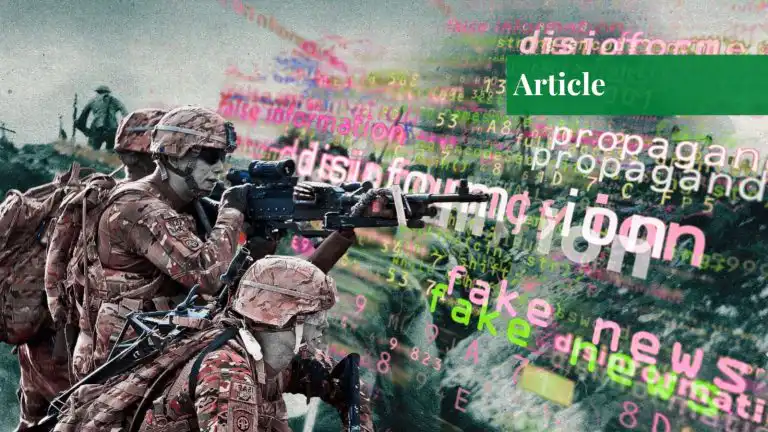


In the present era of non-conventional warfare, the lines between peacetime and wartime have been blurred, thereby further complicating the animosity and anger. In the 21st century, war trends have witnessed this paradigm shift, and hybrid warfare has been a defining feature. Such warfare has given rise to grey zones, a scenario where the dissection of truth and objectivity has been a mystery and a complicated challenge. In hybrid warfare, when lines are blurred, the purpose and objective is to psychologically damage the enemy to attain a bloodless victory through deception, emotionalism, and stratagem. In such a transformed political landscape, geopolitics has shifted from guns and grenades to manipulating minds by strategy.
Colin Gray, in his book on Future Warfare, argues that futuristic and modern warfare will focus on specificity and interconnected threats. Such warfare, according to Gray, isn’t new; rather, such warfare has existed since ancient times, but prevalence and relevance have been more urgent in contemporary times. (Puyvelde, 2015) In the contemporary era, post-Cold War, mankind has witnessed a new kind of warfare, i.e., war without bloodshed but with damaging consequences. In such a warfare, bombs and guns aren’t the only weapons. Rather than the use of methods like stratagem to attack the enemy, it has become a more prevalent weapon. Utilization of these weapons has multiple methods beyond traditional military actions, i.e., the spread of false information, attack on computing devices, the use of hypersonic technology, utilizing deepfakes through AI, etc. Such a kind of warfare, scholars, military strategists, and academics label as hybrid warfare.
In hybrid warfare, military motives and national interests are achieved without resorting to direct military action. However, traditional military attacks aren’t completely excluded in strategies of hybrid warfare; rather, such warfare combines both military and nonmilitary actions. (Cambridge University Press, n.d.) The reason is the fact that no matter how one evolves, the nature of conflict remains the same because, despite the fluidity and dynamic geopolitics, the motives of states remain static, i.e., a zero-sum military mindset, economic gains, and escaping the insecurity. But the execution and strategic tactics to achieve these goals can no longer be done solely through physical attacks because the prevalence of non-conventional warfare has brought with itself a paradigm shift in modus operandi, i.e., Fighting conflicts innovatively and less lethally through calculated risk strategy and following the maxim “prevention is better than cure” in its letter and spirit. (Bilal, 2021) This rise of hybrid warfare has opened doors for new threats, calling states, departments of security, and ministries to adapt accordingly because motives are smartly achieved without bloodshed through deceptive tactics, paralyzing the enemy for a long time.
Prevalence of hybrid warfare spans over centuries and has been seen in works of ancient strategists, i.e., Sun Tzu, Kautiliya, Clausewitz, etc. The best-selling book on warfare by Robert Greene, i.e., 33 Strategies of War, presents a multitude of ways and tactics to win warfare and presents examples through case studies of Napoleon, Queen Elizabeth I, and Athena and their non-physical and non-combatant strategies that led to victory without bloodshed. The account of such leaders and strategists given by Greene reflected the prevalence of non-kinetic and non-conventional tactics and warfare beyond the contemporary era. (Greene, 2007) However, in the policy and defence sector, the debate on hybrid warfare and its popularity is credited to two of the most important developments. First, in 2025, US military officials wrote on “the rise of hybrid wars”. The officials emphasized the development of strategies and tactics that involve conventional as well as non-conventional aspects. The second development that led to policy debate on hybrid warfare was in 2014, when Russia invaded Crimea and achieved objectives through conflating “deniable” special forces, local armed actors, economic clout, disinformation, and exploitation of socio-political polarisation in Ukraine. (Bilal, 2021)
According to Bilal (2021), in the NATO review, hybrid warfare has the following key characteristics.
- Fusion of conventional and non-conventional tools and tactics.
- Synchronization of such tools to exploit the vulnerabilities of an antagonist, inflict damage on a belligerent state in an optimal manner, and achieve synergistic effects.
- Blurry lines and grey zones make it harder than ever to identify the war threshold. Making war elusive and difficult to operationalize
- Hybrid attacks are generally marked by a lot of vagueness, making it complicated to attribute and respond. Because targets are made in a way that it is difficult for the opponent to detect them and to find out objectivity and truth
- Hybrid warfare is less or negligibly costly, providing a way to achieve objectives without spending money. Traditional warfare has been costly, impacting the economy regardless of military muscle. Unlike such traditional warfare, hybrid warfare is asymmetric in nature, making all-out wars ineffective even vis-à-vis powers that have relatively less resources and clout. Victory might thus become an extremely tough proposition.
- The war-politics matrix has become more complex since war has become a range of possibilities, manifesting the words of Clausewitz: “War is nothing more than the continuation of politics by other means.”
Hybrid Warfare aptly utilizes strategies of warfare as outlined by Sun Tzu, Clausewitz, Kautilya, and others. The purpose of using such tactics is to psychologically pressure the opponent until they collapse, i.e., to achieve political motives bloodlessly without a fight. Such methodology has been widely seen in Russian Approaches during World War II, Cold War, proxy wars, and in the present Russia-Ukraine invasion towards warfare that Bērziņš accurately sums up as follows: … the main battlespace is in the mind and, as a result, new-generation wars are to be dominated by information and psychological warfare … The main objective is to reduce the necessity for deploying hard military power to the minimum necessary, making the opponent’s military and civil population support the attacker to the detriment of their government and country, maskirovka, or military deception.
The main strategy to cause psychological damage, i.e., gaining strategic leverage over adversaries, serves as a primary motivation and objective behind waging non-linear hybrid warfare. Hybrid Warfare tactics have been utilized aptly by Russia, China, and even America, and it can be waged against or by anyone, be it state-on-state, state on nonstate actor, or nonstate actor on state. Combining conventional, irregular, guerrilla, terrorist, criminal activities, subversion, sabotage, etc., on the battlefield or targets and venues of opportunity within and beyond the known geometries of actual war zones, psychological motives to damage are achieved in hybrid warfare. Due to these psychological underpinnings, war is becoming more of a holistic process of organized “creative destruction” played out between the adversaries, through the integrated efforts of their government, military, and the masses. (Khan and Naz, 2022)
Hybrid warfare has a severe psychological impact, opening doors for a new avenue of warfare, i.e., psychological warfare. Psychological warfare, due to its aim to weaken opponents’ morale and spirit, has remained an integral part of non-conventional, non-kinetic warfare, particularly hybrid warfare. The manifestation of psychological warfare is assured using sniper-like strategies of precision and using deceptive tools that are most of the time non-material. Hence, in contemporary times, countries rely on non-conventional ways to achieve their objectives by, for instance, creating perceptions and weakening the ideologies to create factions in society, igniting a divide and rule situation, such that laymen and citizens are stuck in a multitude of conflicts within themselves and with the international community. Hence, the psychology of hybrid war attempts to obtain the greatest impact on the moral and political-strategic resilience of the opponent. Therefore, the danger of waging such warfare is far more dangerous than ever, as it has the potential to create vulnerabilities that cause both physical and psychological injuries.
Countries with greater fault lines suffering from a lack of technological advancements and economic challenges are a haven for opponents to manifest their motives. Pakistan is the pertinent example, a country with a lethargic past, unstable present, and uncertain future, that has been a victim of such warfare by its concentric enemy, India. India, in its enmity, has been exploiting Pakistan’s fault lines using propaganda and disinformation to break apart Islamabad, be it the 1971 tragedy or the war on terror exploitation. One thing is clear here: for any non-conventional strategy to work and achieve its aim, the fault lines are always identified and prepared by the inherent and internal elements. (Siddiqui, 2022)
Dr Salma Siddiqui identifies some important tools weaponized psychologically for hybrid warfare below:
- According to Edward O. Wilson, war is “humanity’s hereditary curse”. Human behaviors studied in psychology as a major discipline show how people can manipulate others to gather maximum benefits for themselves while being oblivious to the damage caused. In war as well as peacetime, this human nature is aptly embodied when psychological tactics are used to shape opinions, regardless of betrayal and distrust. In hybrid warfare, such strategies work aptly by exploiting existing faults and already persistent divisions within society.
- Building upon this, media is smartly weaponised to cloud minds with so much confusion that people find it difficult to tell what is a fact and what is an opinion, sowing the seeds for misinformation.
- Hope, according to victor frankl, is a driving force, and when humans lack willpower, they become the most vulnerable target. Propaganda like framing a country as “hard country”, “failed state”, “incubator of terrorism”, etc, breaks the spirit of laymen, pushing them into the darkness of hopelessness, brainwashing them to doubt their national identity and self-worth.
In the contemporary era of warfare, overreliance on guns and grenades does more harm than good. Reason being, today the security architecture is more unconventional and grey in nature, in which mind is more of a primary weapon utilised to achieve strategic goals by dismantling morale and propagating misinformation. Therefore, in such a scenario of hybrid warfare main goal is to break the opponent psychologically rather than bombing the land.
If you want to submit your articles and/or research papers, please visit the Submissions page.
To stay updated with the latest jobs, CSS news, internships, scholarships, and current affairs articles, join our Community Forum!
The views and opinions expressed in this article/paper are the author’s own and do not necessarily reflect the editorial position of Paradigm Shift.