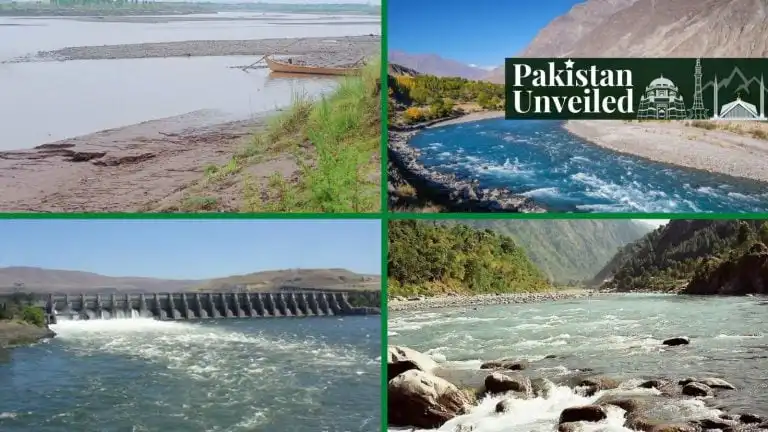

Pakistan is a gift of the Indus. You will see how literal that is, till you begin to research the complicated geography and the stakes that the hydro-politics of our part of the world have. Suppose all these rivers were dried up tomorrow, the lights in our towns would be extinguished, and our dinner tables would be bare!
This piece is an adventure through the rivers of Pakistan, founded on the research and the interesting (and even worrying) history that can be traced from 1947 until the latest tensions of late 2025.
The Great Map: Where Do the Rivers of Pakistan Actually Flow?
Looking at the rivers of Pakistan map, you will see a network resembling the veins of a human being. Nearly all the water flows down to the Indus River, which serves as the great conduit.
Rivers in Pakistan are primarily formed in one of the ruggedest environments on Earth, the Himalayas, Karakoram, and Hindu Kush. Melting glaciers (somewhat frightening in the light of climate change) and seasonal monsoon rains are the main sources of their food.
The Famous 5 Rivers of Pakistan (The Punjab Connection)
Punjab can be literally translated as the Land of Five Waters. The breadbasket of Pakistan is made of these five rivers:
- Jhelum River: The river is famous with the huge Mangla Dam.
- Chenab River: The second in volume and length of any on our territory.
- Ravi River: It is a sad story that the river is mostly dry due to upstream diversion.
- Sutlej River: The longest of the five tributaries, which flows in the vicinity of Kasur.
- Beas River: It is usually combined with the other ones, but it remains primarily in India, and then enters the Sutlej.
Battle of the Giants: The Largest River of Pakistan vs. The Runner Up
You can become confused in regards to which rivers are really the largest. We have found the following breakdown:
The Undisputed King: Indus River
Indus (Sindhu) is definitely the largest river of Pakistan. It’s roughly 3,180 km long. It originates in Tibet (China) and traverses India and the whole of Pakistan, from the northern ends of Gilgit-Baltistan to the Arabian Sea. It is not a river only, it is a national symbol.

The Powerhouse: Which is the 2nd Largest River of Pakistan?
This is the place of debate. Considering the entire length (including that in India), the Sutlej is technically longer. But by far, water volume, route through the heart of Pakistan, the Chenab River is broadly regarded as the 2nd largest river of Pakistan. It is the one with the heaviest load following the Indus.
1947 to 2025: A History of “Water Wars” and Treaties
History tells that the initial issue India and Pakistan clashed over after the partitioning in 1947 was water. At the time of drawing the border, the headworks (the “taps”) remained in India, whereas the fields remained in Pakistan.
The 1960 Indus Waters Treaty (IWT)
The World Bank intervened in 1960 to prevent a war. They facilitated the Indus Waters Treaty.
India got: The three Eastern rivers (Ravi, Beas, Sutlej) went to India.
Pakistan got: The three Western rivers (Indus, Jhelum, Chenab).
Decades later, this treaty was referred to as the most successful in the world since it survived three major wars. However, in 2026, it is tense.
The 2025 Crisis: Is the Treaty Dead?
The treaty is under enormous pressure, as recently reported at the end of 2025. India, in its turn, declared that given the earlier geopolitical attacks, it was keeping the treaty in abeyance. Only a few months ago (December 2025), the Foreign Office of Pakistan wrote letters to India, complaining about sudden changes in the flow of the Chenab and Jhelum rivers. It seems water is being used as a tactic, and that is a nightmare to a country like us that is lower riparian.
Transboundary Realities: How Many Countries Share the Water?
The first thing you will come to realize with the information presented by the FAO (Food and Agriculture Organization) is that the Indus Basin is not a Pak-India affair. It involves four countries:
- Pakistan (47%): It has the largest vested interest and the largest number of individuals who rely on it.
- India (39%): The upstream of most of the Punjab rivers is controlled there.
- China (8%): This is where the Indus and the Sutlej take their actual beginning.
- Afghanistan (6%): This is the origin of the Kabul River that drains into the Indus at Attock.
The “Dirty” Politics Over Rivers of Pakistan: Internal and External Controversies
It’s not just about India. Our inner politics over water have so many headlines.
The Kalabagh Dam Deadlock
The Kalabagh Dam is not a new term to you if you live in Pakistan. Punjab desires it as power and storage. However, Sindh is afraid that its lands will run dry, and KPK is afraid that its cities (such as Nowshera) will be inundated. It is a political crisis that has been decades-long, and in the meantime, our storage space is decreasing.
The Dying Delta
The Indus Delta is dying down south in Sindh. We channel too much water to the farms of Punjab so that there is nothing left to make it to the sea. The result? The sea is indeed retreating into the land and turning good agricultural lands into salty wastelands. It is a disaster of the environment that hardly receives the attention it deserves.
The Economic Engine: Why These Rivers Matter to Your Pocket
In case the rivers of Pakistan dry up, our economy would be lost.
The Breadbasket: The Indus Basin Irrigation System is the largest in the world, feeding more than 90 percent of our agricultural crop (wheat, rice, and that Basmati) to the world.
Hydropower: The cheapest electricity we have is the hydropower generated by dams such as Tarbela and Mangla. In their absence, our monthly bills, which are already astronomic, would go four times higher.
Jobs: Pakistan has nearly half of its labor force that is bound to agriculture. No water means no jobs.
Is the Future of Pakistan’s Rivers a “Super Flood” or a “Permanent Drought”?
The truth is deplorable, as the data released by the Pakistan Water Week 2025 tells us. It is no longer a question of geography; we are talking survival. As the river flow of the Indus decreases to below the average, and the experts are saying that the monsoon that will come in 2026 may be 22-26 times stronger than the last few years, the lifeline itself is turning unpredictable.
At least in our eyes, the Indus Waters Treaty will be tested to the last in the next few years. Will it be the so-called super floods that AI models forecast or the so-called water shortage that the UN predicts, but in any case, we should not assume that we will ever again have the same luxury of taking our 5 rivers for granted. This is a historical change in which water has come to be more valuable than oil. The significance of our capacity to store, preserve, and diplomatically safeguard the biggest river in Pakistan will dictate whether we will prosper as a nation or just run dry.
If you want to submit your articles and/or research papers, please visit the Submissions page.
To stay updated with the latest jobs, CSS news, internships, scholarships, and current affairs articles, join our Community Forum!
The views and opinions expressed in this article/paper are the author’s own and do not necessarily reflect the editorial position of Paradigm Shift.