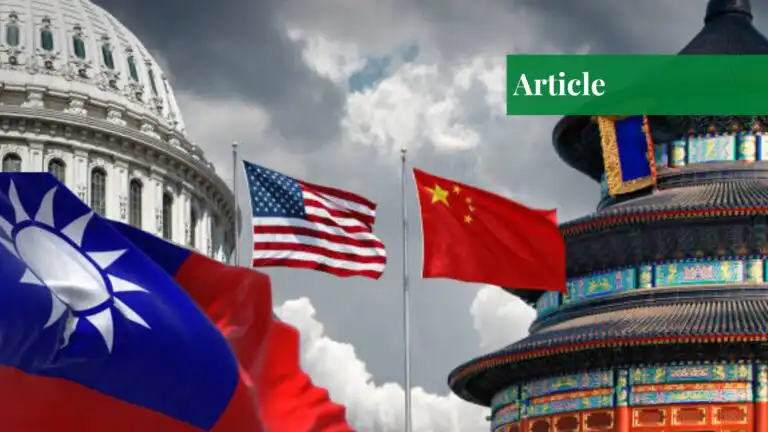
In May 2024, Taiwan experienced Chinese military drills that were described as strong punishments. This has ensured the region’s instability and its implications for relations across the Taiwan Strait. These exercises, which included military operations by the army, navy, air force, and rocket force. had been deemed reactions to provocations and threats to China’s sovereignty by Taiwan. These military activities have been characterized by the intensity and maneuvers that include China’s People’s Liberation Army around Taiwan, particularly in the Taiwan Straits.
This has been considered an effort to respond to the inauguration of new leaders in Taiwan who have rejected Beijing’s sovereignty claims and emphasized rights in Taiwan. The timing of these exercises targeting Taiwan is not arbitrary, as they are always conducted before important political events in Taiwan.
The possible purpose of the Chinese military exercises around Taiwan can be explained by the fact that China regards Taiwan as its territory. The People’s Republic of China continues to view Taiwan as a part of its territory and has been against any trends toward independence and foreign interference in Taiwan’s domestic affairs. The exercises are intended to demonstrate China’s capability and preparedness to quell secessionist movements and regional adversaries. By these exercises, China wants to show the world that it is ready to defend its interests and confront Taiwan or any other hostile entity on the issue of Taiwan.
Outcomes of Chinese Exercises Near Taiwan
These military exercises were not only unpredictable but had several implications for some actors involved in the matter regarding the Taiwan Strait. From the Taiwanese side, this act by China represents a heavily armed military threat to the security and stability of Taiwan. The current government of Taiwan has condemned any military aggression from China and has also made its position clear regarding defense in case of any aggression.
Due to the size and frequency of the exercises that China conducted, there are concerns that escalation is inevitable and that Taiwan needs strong defenses against its neighbors. Furthermore, the military activities around Taiwan affected not only the military regime of the country but also geopolitical consequences. These drills were conducted close to the international maritime and flight zones and misunderstanding the situation can have fatal results. These developments draw the interest of other countries that surround it as well as the global powers.
These developments near Taiwan are quite important in terms of strategic rivalry between America and China. The US has had strong relations with Taiwan. The US has sold weapons to Taiwan even though it does not officially recognize the region and refers to it as a part of China under the “One China” policy.
China’s military exercise near Taiwan threatens US influence in Asia and adds tension between the United States of America, China, and Taiwan. The fact that these exercises may also deepen the confrontation and produce reactions from outside actors contributes to the point that regional security and threats interconnect and that the Taiwan issue plays a significant role in US-China relations.
China’s Decision to Halt Arms Talk with the US
In the latest geopolitical events, China has decided to suspend nuclear arms control talks with the United States. This decision was made because of the US’s arms sales to Taiwan, which Beijing deems destructive for the political context that is relevant to arms control. The action shows that there are still very deep and conflicting issues between the two superpowers of the world.
Moreover, it also shows that China and the US have a diplomatic and interdependent relationship with one another. Lin Jian, the Ministry of Foreign Affairs’s spokesman for Beijing, declared that the continuous arms sales to Taiwan from America have been the main cause of this move, insisting that these have gravely affected the political climate for carrying forward arms control talks.
“The Chinese side has decided to hold off discussion with the U.S. on a new round of consultations on arms control and non-proliferation. The responsibility fully lies with the U.S.”
Lin Jian
The US-China talks on nuclear arms control were launched following the visit of the Chinese foreign minister to Washington, leading to an agreement to have consultations on arms control and non-proliferation in the upcoming days. This is, however, to clarify that the discussion would not be like the formal arms reduction discussions the US has had with Russia.
The decision to have these talks was critical, especially in light of emerging questions about China’s nuclear prowess. The Pentagon has stated that China has more than 500 operational nuclear warheads in its atomic arsenal and is to have more than a thousand such warheads by 2030. This buildup of China’s nuclear arsenal had metastasized into the fear of a “triad” – a nuclear arms race between the US, Russia, and China – especially as negotiations over the extension of New START, which is set to expire in 2026, have faltered over Russia’s invasion of Ukraine.
Conclusion
China’s use of military threats through the conduct of military exercises around Taiwan is one element that has significant implications for regional peace, Taiwan-China relations, and Sino-US relations. Such large-scale and intensive activities increase apprehensions about rising tensions and military interactions across the Taiwan Strait and substantiate the relevance of specific conflict prevention measures and diplomacy. The relationship and linkages of these factors point to the inherent challenges of mediating regional order and the stakes of solving the problems related to the Taiwan and China issues.
In conclusion, China’s approach of using deterrent military drills as a way of sanctioning Taiwan’s independence aspirations highlights the complex interconnectivity of interests and risks in the Taiwan Strait. However, the scope and frequency of such drills have only escalated concerns over the stability of the region and the possibility of an aggressive escalation of tensions as the USA aims to provide arms assistance to Taiwan. These actions have implications for the general stability of the region and the nature of relations between the USA, China, and Taiwan.
If you want to submit your articles, research papers, and book reviews, please check the Submissions page.
The views and opinions expressed in this article/paper are the author’s own and do not necessarily reflect the editorial position of Paradigm Shift.

Tayyaba Rehan is a student at the National Defence University. She is currently pursuing her degree in defense and strategic studies. She has worked with multiple governmental and non-governmental organizations. Her articles have been published in national as well as international publications.