The United States has been the primary security actor in the Middle East for more than three decades. With the help of its extensive alliance network, forward deployment of troops, intelligence sharing, and diplomatic intervention, the U.S. has played an influential part in molding the security architecture of the Middle Eastern countries. The U.S. administrations have always seen themselves as key intermediaries in times of crises in the Middle East – from negotiating peace treaties to deterring inter-state wars. However, the rise of China on the global stage makes one wonder whether China can take up that mantle in place of the U.S.

This debate intensified after China facilitated the restoration of diplomatic relations between Saudi Arabia and Iran in March 2023, a deal that is considered one of the most important diplomatic successes for Beijing in the Middle East. This agreement showed that China could effectively facilitate dialogue between opposing parties and help in de-escalating the situation, leading to numerous opinions that Beijing is slowly moving from being a mere economic player into a real diplomat. Some experts have even argued that this deal indicated that China could eventually pose a challenge to the US’s diplomatic superiority in the region.
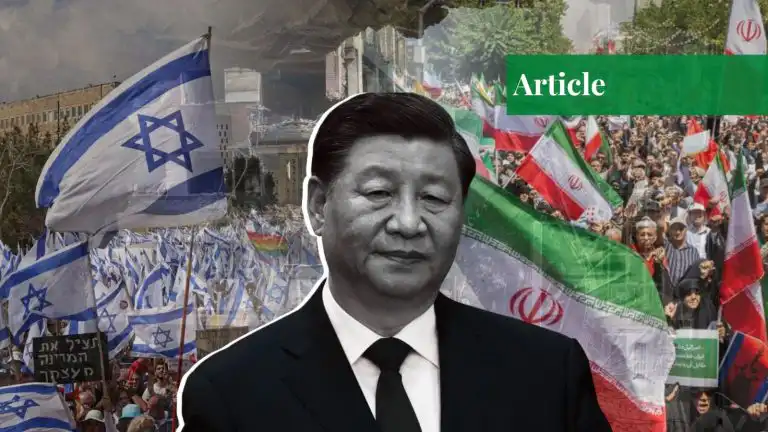
In the case of the conflict between Iran and Israel (2024-2026), however, the test was far greater. While the reconciliation between Saudi Arabia and Iran resulted from years of negotiations involving the Iraqis and Omanis, the conflict between Iran and Israel included confrontations through wars, nuclear issues, humanitarian issues, and the interests of different outside powers. Crisis management here required more than just mediation; it needed the ability to shape military behavior, coordinate an international response, and assure regional allies. It was thus the first real test of the ability of China’s rising diplomatic power to mediate in a crisis situation.
China already had some strategic interests in the region when entering this era. According to the latest trade statistics, China has turned out to be the top trading partner of the Arab world, with trade worth US$400 billion in 2024. At the same time, the Middle East continues to supply more than half of China’s imported crude oil. This has made regional stability vital to Beijing’s energy security and future economic development. The economic imperatives have prompted China to maintain positive relations with Iran, Saudi Arabia, the UAE, Egypt, Qatar, and Israel at the same time, providing Beijing with an unusually wide-ranging diplomatic portfolio in the region.
However, despite these emerging interests, economic influence does not automatically translate into diplomatic leadership. Efficient crisis management entails political credibility, experience with international institutions, strategic leverage, and often the capability to provide credible security guarantees. In the past, the United States has played all these roles through its military deployments, alliances, and wide regional network of partnerships. China has always placed its bets on non-interference, political diplomacy, and state sovereignty. Whether or not this alternative approach is adequate for managing complicated regional crises remains uncertain.
The present paper argues that the Iran-Israel conflict has highlighted both strengths and weaknesses of Chinese diplomacy in the Middle East. China demonstrated the ability to mediate between all key regional players, call for ceasefires, and engage in diplomatic negotiations using international organizations. At the same time, the conflict brought into light the structural limits of Chinese involvement. Beijing lacked the military deployment, networks of alliances, and coercive leverage, as well as mechanisms for managing the conflict. Thus, although China proved to be a more prominent diplomatic player in the region, there is reason to believe that it only complements the United States as the primary crisis mediator in the Middle East.
China’s Expanding Strategic Interests in the Middle East
The relations between China and the Middle East have changed drastically during the past two decades. While initially characterized by energy imports and business deals, the Chinese presence in the region now extends to include the building of infrastructure, digital networks, political conversations, defense collaboration, and diplomacy. Nowadays, the Middle East plays a more prominent role in the Chinese vision for international connectivity and power.
Energy security continues to be the foundation of China’s policy in the region. China has emerged as the biggest importer of oil in the world owing to industrialization and economic development, which would not have been possible without the Gulf countries. According to the International Energy Agency (IEA), along with several other policy research institutions, about half of China’s imported oil comes from the Middle East region, thus making uninterrupted access to it via the Persian Gulf and Strait of Hormuz critical, not just economically.
In addition to that, economic ties have improved China’s standing in the region even more. Starting from the year 2013 and the implementation of the Belt and Road Initiative, China has been spending billions of dollars on the development of ports, industrial complexes, renewable energy, logistics, telecommunication systems, and transport infrastructure across the Middle East. All of these steps increased economic interdependency and reinforced China’s reputation as a country interested in long-term development of the region instead of being a security guarantor.
The difference between China and the USA is that while the influence of the latter has always been determined by military and defense ties, the strategy of China is based on cooperation and flexible diplomacy. China deliberately developed good relations with countries having different geopolitical goals. The country maintains a comprehensive strategic partnership with Iran, a comprehensive strategic partnership with Saudi Arabia and the UAE, increasing cooperation with Egypt and Qatar, as well as diplomatic and business contacts with Israel. In this way, China can contact virtually any big player in the region without entering alliances.
Chinese diplomatic approach also stands in stark contrast to many other approaches used by Western states. Chinese diplomats always stress such notions as sovereignty, territorial integrity, non-intervention in internal affairs, and peaceful resolution of any dispute. All of these values became the main elements of Chinese regional diplomacy and are usually well-received by those countries that welcome investments without political strings attached. Consequently, many of the regional leaders started viewing China as a pragmatic and predictable actor whose actions are determined by economic interest only.
The growing influence made a perfect foundation for the first major diplomatic success of China in the region, the restoration of diplomatic relations between Saudi Arabia and Iran in 2023. This event not only changed the perception of Chinese diplomatic skills but also raised hopes that China could play a bigger part in resolving Middle Eastern conflicts in the future. However, these hopes had to be put to the test right after the outbreak of the conflict between Iran and Israel.
From Diplomatic Breakthrough to Strategic Test
China’s diplomatic breakthrough in the Middle East came with the restoration of diplomatic relations between Saudi Arabia and Iran in March 2023. While it is true that Beijing was not responsible for organizing prior diplomatic attempts in the region, the hosting of the final negotiations raised its profile and demonstrated its growing political clout among regional rivals. It allowed China to demonstrate its ability to contribute to the region’s stability via the power of diplomacy and not brute force, further bolstering China’s claim that development and dialogue offer better means of peace than coercion.
It became clear that Beijing’s ability to facilitate dialogue between Saudi Arabia and Iran was bound to lead to expectations of its involvement in other regional crises. Those expectations, however, were put to the test soon after as it turned out that the conflict between Iran and Israel, which occurred in 2024-2026, was very different from the diplomatic situation that existed in relation to the Saudi-Iran agreement. It meant that the conflict involved active military confrontations, proxy warfare, potential nuclear threats, humanitarian effects, and interests of both regional and global powers.
The response was in line with China’s foreign policy approach in general terms. From the very beginning of the crisis, China kept asking for restraint, a ceasefire, and the peaceful resolution of the disputes through negotiations. It was argued that more escalation could lead to destabilization of the region, hampering international trade and posing a threat to the energy market around the world. In contrast to calls for military solutions to the dispute, Beijing always stressed the need for negotiations, and this should be done according to the rules of the United Nations.
Foreign Minister of China, Mr. Wang Yi, became the main representative of China’s diplomatic reaction to the situation. At the consultations with regional and international leaders, Wang Yi kept insisting that all parties avoid any kind of escalation of the conflict and stressed that securing maritime channels, including the Strait of Hormuz, is necessary for the safety of the global economy. Prolonged instability in the region would cause negative effects not only in the Middle East but around the whole world.
In terms of multilateral diplomacy, China was able to leverage its diplomatic efforts through the United Nations. China’s diplomats were in favor of emergency talks regarding the declining state of security, reaffirmed their commitment to the rules of international law and the UN Charter, and urged more diplomacy between the sides. This can be seen as an extension of China’s general preference for multilateral diplomacy and diplomatic resolution to issues, as opposed to unilateral military measures. This differed from the U.S., which engaged in a combination of diplomatic and military deterrence measures.
There are also economic factors at play in Beijing’s decision-making process. Today, China is very tightly interwoven with the economies of the Middle East through trade, investments, and energy cooperation. The volume of bilateral trade between China and Arab countries surpassed $400 billion in 2024, thus making China the largest trading partner in the region and emphasizing the importance of peace in the region for Beijing. In addition, today, China’s reliance on the Middle East as its energy supplier is quite considerable. Even though China managed to diversify its suppliers in the last few years, the Gulf continues to supply a significant portion of China’s imports of crude oil.
The above-mentioned strategic interests have been responsible for China’s proactive role in de-escalation without engaging in military action against anyone. The Chinese government was in contact with the Iranian government, the Saudi Arabian government, the United Arab Emirates, Egypt, and other government players in the region throughout the time of the dispute, thus keeping open its diplomatic lines with most of the important actors. This balanced approach forms the core strength of Chinese foreign policy.
However, the clash also showed the weaknesses of China’s diplomatic strategy. Although China kept its communication channels open with all the players, its role in influencing the military decision-making of Iran or Israel was very limited. China did not give any security assurances, did not send its military assets into the region, and was not willing to use its economic or political clout to change the behavior of the key combatants.
This is a very important point to make since negotiating between parties that are already looking for de-escalation of tensions is a very different matter than managing a military crisis that is still ongoing and in which the participating sides still pursue their combat interests. In the case of the Saudi-Iran deal, China demonstrated its ability to help negotiate peace talks when conditions are favorable, whereas the Iran-Israel conflict revealed that effective crisis management often involves additional measures, such as military deterrent force and the ability to implement negotiated settlements.
China’s position differed from that of the US increasingly. Unlike the Americans, who used political diplomacy, security guarantees, military deployments, and deterrence in one package, China chose not to engage directly in anything except diplomatic talks and restrained demands. It kept China’s reputation as a politically neutral actor on the one hand, but limited its ability to influence events during the time of actual conflict on the other hand. Some commentators noticed that China’s position revealed its diplomatic risk-aversion and unwillingness to bear the political and security responsibilities of major powers’ crisis management.
Instead of proving that China is ready to replace the U.S., this confrontation between Iran and Israel has shown that the role of Beijing in the region has been changing. Indeed, China is getting more and more involved in the political affairs of the region through its diplomacy, economic cooperation, and engagement in the region. Nevertheless, it became clear that Beijing’s power lies in facilitating negotiations and supporting political engagement, not in guiding the process of crisis.
Can China Replace the United States?
China’s involvement in the Iran-Israel dispute is evidence of the increased weight it carries in the region; however, influence does not mean the same as mediation skills. China has built its position as an economic player, gained relationships with competing regional powers, and taken part in negotiations designed to ease tensions. All of these actions have contributed to an increased role for China in the region. Yet, taking over from America in being the primary crisis mediator in the Middle East involves a much wider range of capacities that China still lacks.
China’s key asset in this regard is its capability to establish good relations with countries that usually compete strategically. China maintains good economic and diplomatic relationships with Iran on the one hand and with Saudi Arabia, the United Arab Emirates, Qatar, Egypt, and Israel on the other. This allows Beijing to establish dialogue with all parties without becoming a formal member of a regional bloc. The United States is limited in this respect because of the commitments it made on security issues, which can affect the way its neutrality is perceived, especially in the cases of the conflicts with Israel and Iran.
The Chinese economic presence strengthens its foreign policy position in the region as well. As the largest trading partner for most Middle Eastern countries and an importer of energy from the Gulf States, Beijing has all the reasons to pursue regional stability. The BRI has allowed Chinese firms to invest in ports, industrial zones, alternative energy sources, telecommunications, railways, and logistical projects throughout the Middle East region. Such investments increased economic interdependence between China and the Middle East and made the country a reliable development partner, and not a military one.
Still, economic influence alone will be insufficient in the case of active conflict. Efficient crisis mediation in such cases will demand the ability to offer credible security guarantees, organize the de-escalation process in the military sphere, monitor the enforcement of the ceasefire agreement, and provide security assurances to its allies. In this area, the US continues to enjoy structural superiority as Washington has established military bases throughout the Gulf, shares information with Middle Eastern partners, cooperates in air and missile defence, and has vast experience in regional crisis management.
The concept of non-interventionism is another factor that influences China’s diplomatic behavior. Respecting the sovereignty of other countries has always been one of the most important principles of China’s foreign policy and has played an important part in shaping China’s international image. Such a policy makes China more attractive to many developing countries by distinguishing its diplomatic approach from the traditional interventionism of some Western countries. Nevertheless, the principle of respecting the sovereignty of other nations means that Beijing does not intend to put any political or military pressure on countries involved in conflicts. Therefore, China tends to support negotiation without taking any responsibility for making sure that all the agreements will be followed and securing post-conflict regions.
The case of the Iran-Israel conflict once again confirmed the limitations of such a policy. In the course of the crisis, Beijing constantly insisted on the peaceful resolution of the problem but refused to participate in military actions. China neither sent troops to prevent further escalation of the conflict nor offered any security guarantees to regional governments.
Regional perception is another key aspect. More and more, Middle Eastern states are practicing what many academics term “strategic diversification.” This means that instead of opting between Washington and Beijing, they seek to cultivate equally close ties with both. The U.S. continues to be the predominant supplier of security assistance and defense cooperation, whereas China is now the main economic partner of the region and provides investments and infrastructure projects. Such an approach demonstrates changes taking place within the regional order, when states try to exploit their economic advantages but at the same time maintain their previous security partnerships.
In other words, the issue is no longer whether China will replace the U.S. The more pertinent question would be whether the Middle East enters a period when different countries play different roles on the international scene. The analysis of the Iranian-Israeli dispute shows that this process has already started: China becomes more and more involved in the processes through economic, political, and diplomatic measures, while the U.S. continues its role as the guarantor of regional security.
Conclusion
The growing involvement of China in Middle Eastern affairs constitutes one of the biggest geopolitical events of the twenty-first century. Thanks to trade, investments, energy cooperation, and diplomatic efforts, China has become an influential political player beyond being purely economic. The restoration of diplomatic ties between Saudi Arabia and Iran in 2023 illustrated the possibility of constructive Chinese diplomacy in positive political circumstances.
Nonetheless, the situation with the Iran–Israel conflict (2024-2026) was a much more challenging task. The crisis demanded not only diplomatic effort but also the capacity to affect the military actions, coordinate international reactions, assure regional allies, and handle possible risks of regional escalation. In spite of the efforts to establish ceasefires and maintain communication with various actors while promoting political dialogue, China did not seem willing to take on the security role that is usually played by mediators in crises.
The clash thus brought out the strengths as well as weaknesses in China’s approach in the region. China’s wide diplomatic reach, economic clout, and neutrality offer significant benefits in fostering dialogue and easing political tensions. However, its weak military presence, non-interference policy, and lack of alliances still restrict its ability to influence the results of ongoing regional disputes.
There is a clear indication that China is not replacing the US as the key mediator of crises in the Middle East region. Instead, China has created its own unique diplomacy that complements the security leadership of the US. While China has increasingly emerged as an important broker of dialogue and an influential economic player, the United States maintains unmatched strength in the areas of military deterrence, alliance building, and crisis management.
In the future, the influence of China in the Middle East region can be expected to rise further due to its increasing economic engagements and diversification of its foreign policies by the states in the region. Whether China emerges as a full-fledged crisis manager or not in the future will be determined not only by its increasing economic strength, but also by its readiness to bear the political risks, military obligations, and other strategic responsibilities that come with being a global power. Until China undergoes such a transformation, China’s strength will be based not on the security-oriented approach of the United States in the region, but on its diplomatic, economic, and multilateral approaches.
If you want to submit your articles and/or research papers, please visit the Submissions page.
To stay updated with the latest jobs, CSS news, internships, scholarships, and current affairs articles, join our Community Forum!
The views and opinions expressed in this article/paper are the author’s own and do not necessarily reflect the editorial position of Paradigm Shift.

Tehreem Ahmed is an MPhil scholar in International Relations with research interests in China’s foreign policy, International Political Economy (IPE), and regional security dynamics. Her work focuses on China’s growing influence in global affairs and its impact on regional and international politics.