
South Asia, historically defined by its volatile intersections of politics, security, and identity, continues to occupy a precarious position within the global strategic order. The region’s two principal actors, India and Pakistan, remain ensnared in an enduring rivalry whose origins lie in the unresolved legacies of Partition and whose contemporary manifestations are embedded in doctrines of deterrence and power projection. Over the past decade, this antagonism has evolved from conventional territorial disputes into a technologically mediated contest in which missile systems, aerial capabilities, and external alliances have become the principal instruments of strategic signaling. The latest developments are India’s newly formalized missile procurement from the United Kingdom and Pakistan’s renewed engagement with the United States over AMRAAM sustainment, have reignited anxieties about a re-emerging arms competition in the subcontinent.
These parallel transactions are far from coincidental. They represent the latest iteration of a recurring pattern in which South Asia’s internal insecurities intersect with Western strategic opportunism. The India–UK agreement, valued at approximately £350 million and encompassing the acquisition of the Lightweight Multirole Missile (LMM) alongside naval propulsion collaboration, has been heralded as a milestone in bilateral defense cooperation. Simultaneously, reports of Pakistan’s discussions with Washington regarding AMRAAM upgrades, even if limited to sustainment, have been interpreted through a prism of regional competition, implying a reactive symmetry that has long defined Indo-Pakistani defense behavior. The convergence of these developments reflects not only the tactical logic of modernization but also the enduring structure of dependency that binds South Asian military modernization to Western patronage.
The New Exchange of Arms and Influence
In October 2025, the strategic landscape of South Asia was quietly but significantly reshaped by two seemingly disconnected announcements, one emerging from London and New Delhi, the other circulating through Washington and Islamabad. Taken individually, each transaction could be interpreted as a routine matter of defense procurement; however, they reveal a synchronized moment in which both South Asian rivals deepened their dependence on Western armament networks.
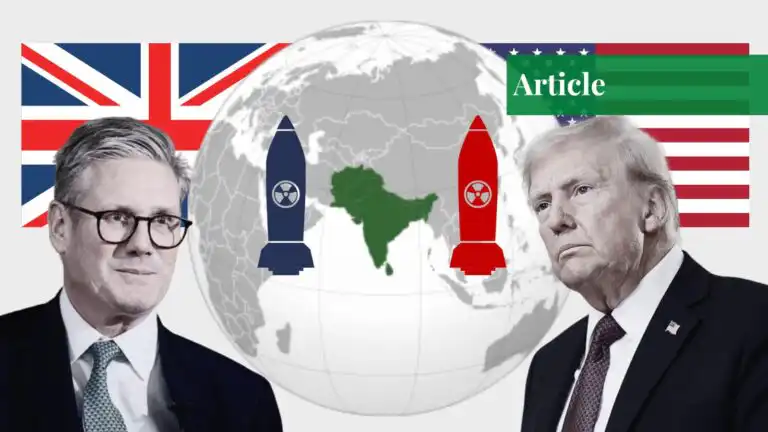
The first of these, publicly formalized during British Prime Minister Keir Starmer’s visit to India, entailed a £350 million missile acquisition agreement between New Delhi and London. The deal centers upon the Lightweight Multirole Missile (LMM) system, a precision-guided weapon developed by Thales U.K., intended to enhance the Indian Army’s short-range strike and air-defense capabilities. According to official briefings issued by the British Ministry of Defense, the agreement will sustain nearly 700 jobs across Northern Ireland’s defense-industrial corridor and advance the India–U.K. Defense Partnership Vision 2035, a strategic framework designed to institutionalize long-term technological collaboration. Supplementing the missile contract, the agreement also extends into the maritime domain through the co-development of electric propulsion technologies for India’s next-generation naval vessels, involving industrial participation by Rolls-Royce. British and Indian officials have jointly portrayed the arrangement as a mutually beneficial step towards greater self-reliance and industrial integration, a confluence of India’s “Atmanirbhar Bharat” initiative and the United Kingdom’s post-Brexit export diversification strategy. However, beyond the economic veneer lies a distinctly strategic undercurrent, London’s aspiration to reinsert itself into the Indo-Pacific’s security calculus, leveraging India’s geopolitical weight as an anchor for its “Global Britain” vision.
Concurrently, Pakistan found itself at the center of renewed media scrutiny when reports surfaced suggesting that Islamabad had entered negotiations with the United States for the upgradation and sustainment of Advanced Medium-Range Air-to-Air Missiles (AMRAAMs), employed by the Pakistan Air Force’s F-16 fleet. Although U.S. diplomatic representatives later clarified that the communication pertained to routine maintenance and spare-parts support rather than to the transfer of new offensive munitions, the timing of the notification proved consequential. Regional observers quickly juxtaposed the two developments, interpreting them as a synchronized rearmament sequence reflective of South Asia’s long-standing strategic rivalry. Thus, even in the absence of large-scale transfers, the symbolic simultaneity of these transactions has generated a potent narrative of a region entering a new phase of armament modernization, where perception itself functions as a weapon. Each announcement, official or speculative, becomes part of a broader choreography of reassurance and alarm, sustaining the delicate equilibrium of deterrence that defines the subcontinent’s fragile peace.
Strategic Efficiency or Strategic Captivity?
The efficiency of the recent missile and sustainment arrangements between the United Kingdom and India, and between the United States and Pakistan, extends beyond the arithmetic of cost, range, or payload capacity. Rather, these deals must be understood through a multidimensional lens that incorporates technological modernity, doctrinal fit, and strategic signaling. The Lightweight Multirole Missile (LMM) system acquired by India represents a generational leap in the optimization of short-range precision strike capability. Developed by Thales U.K., the LMM possesses a modular design adaptable for land, air, and maritime deployment, a feature that aligns seamlessly with India’s ongoing modernization of its tri-service operational architecture. Its capacity for rapid target acquisition against low-flying drones, helicopters, and fast-attack craft grants India a decisive tactical edge in layered defense scenarios, particularly in contested border and coastal theatres.
Beyond the immediate tactical dividends, the inclusion of electric propulsion collaboration for future Indian naval vessels underscores an emergent strategic objective, the gradual indigenization of advanced technologies within India’s domestic defense ecosystem. Such arrangements reduce dependency on Russian platforms, diversify supply chains, and embed Western technology standards into India’s industrial base, thereby enhancing its long-term defense sustainability and export potential.
Pakistan’s reported arrangement for AMRAAM sustainment and upgrades, though less spectacular in economic magnitude, holds equivalent strategic importance in operational continuity and deterrence assurance. The AMRAAM family of missiles remains the principal medium-range air-to-air weapon in the Pakistan Air Force’s (PAF) arsenal, forming a critical component of its F-16 fleet, the platform that symbolically and practically constitutes the backbone of Pakistan’s air deterrent posture. While Washington clarified that no new missiles were being transferred, even sustainment packages for sensors, guidance systems, or propulsion modules significantly influence readiness levels.
For Pakistan, maintaining AMRAAM operational efficacy ensures survivability against India’s expanding inventory of beyond-visual-range (BVR) weapons, including the Russian-origin R-77 and indigenous Astra missiles. The reliability and integration of AMRAAMs within the PAF’s command-and-control networks reinforce Pakistan’s interception confidence and crisis deterrence credibility. Thus, in efficiency terms, even maintenance agreements serve as critical enablers of strategic stability; they sustain technological parity, prolong fleet viability, and project continuity of alliance-based reassurance at a time when Pakistan’s broader foreign policy faces flux between the United States and China.
However, the efficiency of these deals cannot be divorced from their broader structural implications. India’s partnership with the United Kingdom, though technologically progressive, consolidates a dependency on Western design architectures and supply chains at a time when New Delhi seeks strategic autonomy under its Atmanirbhar Bharat doctrine. The economic and diplomatic symbolism of the contract is undeniably potent; it signals India’s capacity to attract and assimilate advanced Western systems, yet it also embeds long-term reliance on British and European subsystems whose export and servicing are subject to political contingencies. Likewise, Pakistan’s maintenance linkage with Washington perpetuates its historical dependency on U.S. defense logistics, a dependence that has repeatedly proven precarious during periods of political discord.
The paradox of efficiency, therefore, lies in its duality; what enhances immediate combat readiness may simultaneously erode strategic independence. Both nations find themselves in a cyclical pursuit of technological reassurance through foreign procurement, yet such reassurance remains contingent upon the external powers’ geopolitical calculus. In this sense, efficiency transcends the mechanical performance of weapons; it becomes a political instrument of alignment and influence. The LMM and AMRAAM narratives, when juxtaposed, thus illuminate a deeper truth that South Asia’s security architecture continues to operate not merely through indigenous capability or deterrent balance, but through the calibrated permissions and strategic discretion of its Western patrons.
Arms Diplomacy and the Theatre of Dependence
Both the United Kingdom and the United States, though pursuing distinct geopolitical objectives, exhibit a shared reliance on military technology as a tool of diplomacy and leverage. For London, the missile agreement with India is as much a commercial and industrial strategy as it is a geopolitical signal. In the aftermath of Brexit, the United Kingdom has sought to reconstitute its global presence under the rubric of a “Global Britain” narrative, wherein defense exports serve dual purposes: preserving industrial vitality at home and cultivating strategic partnerships abroad. The £350 million LMM agreement thus extends far beyond the transfer of hardware; it is an exercise in rebranding Britain as a credible security actor in the Indo-Pacific theatre, a region increasingly defined by maritime contestation, technological competition, and the shadow of Chinese expansionism. In this context, India functions as both market and multiplier; its absorption of Western technology enhances British relevance in Asia while simultaneously anchoring the U.K. within the collective Western posture of hedging against Beijing’s influence. The language of “partnership” and “co-development” that accompanied the deal serves to disguise a transactional realism, one that commodifies defense collaboration into a vector of strategic access.
United States, by contrast, continues to employ a more calibrated balancing act rooted in its long-standing but asymmetrical relationships with both India and Pakistan. While Washington has, in recent years, tilted perceptibly toward New Delhi, evident through frameworks such as the Quad, the Initiative on Critical and Emerging Technologies (iCET), and a series of advanced defense pacts, it remains reluctant to fully relinquish its traditional ties with Islamabad. Pakistan’s geography, its intelligence networks, and its residual influence in Afghanistan render it an indispensable albeit difficult partner.
The reports concerning AMRAAM sustainment reveal this balancing instinct in miniature, by providing limited technical support rather than offensive augmentation, Washington sustains influence without overtly antagonizing New Delhi. The rhetorical moderation of such transfers allows the United States to maintain a degree of leverage in both capitals, effectively transforming arms sustainment into an instrument of diplomatic signaling. Yet, this ambivalence is not without cost. It deepens mutual suspicion between India and Pakistan while ensuring that the United States remains a central referee, the indispensable mediator whose discretion can either stabilize or destabilize regional dynamics. In effect, Washington’s defense diplomacy reproduces dependence: it ensures that both rivals, despite their divergent alignments, continue to orbit within the gravitational pull of American influence.
Within this geopolitical choreography, the behavioral asymmetries of India and Pakistan further accentuate their structural vulnerabilities. Pakistan’s enduring reliance on U.S. defense infrastructure represents more than a legacy of past alliances; it is a manifestation of institutional inertia and constrained diversification. Despite repeated episodes of disillusionment, from sanctions under the Pressler Amendment in the 1990s to the suspension of coalition support funds post-2011, Islamabad continues to prioritize U.S.-origin systems, citing performance reliability and operational familiarity. However, this dependency imposes strategic liabilities, like spare parts, upgrades, and munitions flows remain susceptible to U.S. congressional oversight and political conditionalities. As a consequence, Pakistan’s air power is operationally potent yet diplomatically vulnerable. India, conversely, has internalized the logic of multi-alignment, an approach that synthesizes Western partnerships with Russian legacy systems and indigenous R&D programs. Its prompt engagement with the U.K. following the Pakistan–U.S. reports demonstrates a form of strategic reflexivity; India seeks to counter every perceived enhancement of Pakistan’s capability with a visible Western partnership of its own. This behavior is not purely reactive but performative, a deliberate signaling mechanism to affirm India’s status as the region’s preferred partner for advanced technology. The pattern thus becomes cyclical; Pakistan’s dependence on the U.S. perpetuates a reactive modernization; India’s responsiveness to Pakistan’s procurement sustains escalation.
Western states, meanwhile, capitalize on this rhythm, ensuring continued market relevance under the guise of maintaining balance. These intersecting motives and behaviors illustrate how arms diplomacy has supplanted traditional deterrence as the dominant mode of strategic interaction in South Asia. The U.K. and U.S. exploit arms sales not merely to project influence but to orchestrate dependency, while India and Pakistan, in their pursuit of security reassurance, entrench themselves within externally mediated cycles of acquisition. The result is a regional ecosystem in which the boundary between cooperation and manipulation blurs, and where the rhetoric of “partnership” conceals a deeper asymmetry of power.
Conclusion
By weaponizing access to technology as a currency of partnership, Western states have effectively transformed the subcontinent’s insecurities into a marketplace of influence, where deterrence is commodified and sovereignty is traded for maintenance contracts. The implications of this emerging pattern extend far beyond the operational level. The renewed prominence of external defense suppliers in South Asian military modernization suggests that the region’s strategic autonomy remains conditional upon Western discretion. For India, alignment with Britain and other European powers advances its technological base yet subtly constrains its freedom to pursue independent strategic trajectories, particularly when transatlantic interests diverge from Asian security realities.
For Pakistan, dependence on American systems reinforces a pattern of episodic empowerment followed by vulnerability, a cycle in which temporary reassurance through sustainment packages coexists with chronic exposure to diplomatic coercion. Consequently, both states remain trapped within an externally choreographed arms dynamic that perpetuates the security dilemma; each acquisition intended to enhance national defense inadvertently intensifies the other’s perception of threat. The result is a symbolic arms race, driven less by material necessity than by the compulsions of status, perception, and political signaling. This trajectory portends the institutionalization of a post-deterrence arms spiral, wherein modernization becomes an end in itself rather than a means of stability. Ultimately, the new missile race has not begun with a launch, but with a signature inked between patrons and clients across continents. Whether it culminates in deterrence or disaster will depend on whether regional actors can transcend the seductive logic of armament and rediscover the discipline of restraint.
If you want to submit your articles and/or research papers, please visit the Submissions page.
To stay updated with the latest jobs, CSS news, internships, scholarships, and current affairs articles, join our Community Forum!
The views and opinions expressed in this article/paper are the author’s own and do not necessarily reflect the editorial position of Paradigm Shift.