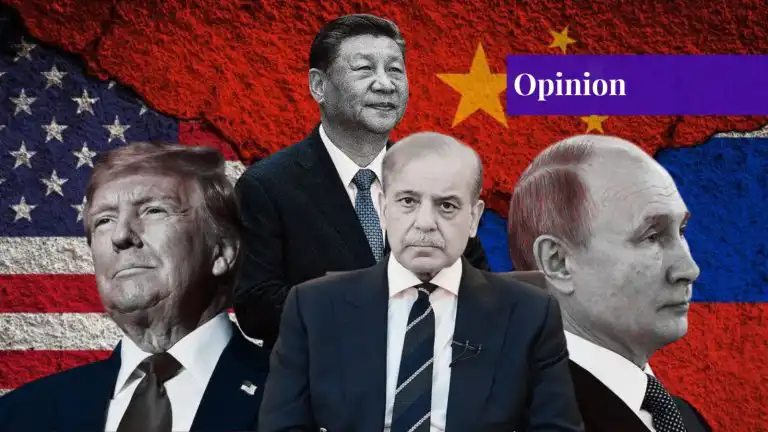

The twenty-first century’s third decade is clearly a pivot point in international politics. The bipolar international system that followed World War II and had thus far operated under Western dominance is breaking down. A new international system, this time multipolar with Asia at its center and China’s growing economic power upending American dominance, is rising in its place.
Caught between these rival groups of power-holders, Pakistan has regained its importance in world geopolitics. Nevertheless, Pakistan’s predicament may be far from merely political and military. Pakistan’s position is overshadowed by a series of legal commitments of compliance and international norms.
One of the most fundamental norms in international law is pacta sunt servanda, or “agreements must be kept.” Today, Pakistan is a party to very strong legal obligations on multiple fronts. The China-Pakistan Economic Corridor is a binding contractual and sovereignty-based obligation to Beijing, while on the other hand, there are also obligations to Washington and to Western-dominated groups like the IMF and World Bank.
When the rift between Washington and Beijing heightens, there goes Pakistan, reeling under not only political but also legal pressure. Sanctions, export controls, and technology restrictions by one bloc can disrupt obligations owed to another, giving way to the likelihood of contractual breaches, financial penalties, or international disputes.
Conversely, Pakistan has increasingly articulated a policy of strategic autonomy—cooperation with all major powers while alignment with none. This serves as a support mechanism for such an approach under international law, based on the law of neutrality, by which states are guaranteed freedom from international rivalry if they do not allow their territories or institutions to be used against any party.
However, neutrality cannot be the result of rhetoric either. The simultaneous status of Pakistan as a major non-NATO ally of the United States and a full member of the Shanghai Cooperation Organisation puts the country in a legally vulnerable position. Cooperation with one bloc has to be so carefully structured as not to violate obligations towards the other—a demanding legal balancing act indeed, and one that is inescapable without institutional precision.
The use of economic pressure has become another tool of coercion. Debt, sanctions, and regulatory regimes are increasingly used as weapons of “lawfare.” These days, for Pakistan, foreign financial laws, FATF, and arbitration laws are no longer technical or foreign laws but rather integral to its sovereignty.
For Pakistan to effectively resist the extraterritorial force, it must ensure that its own domestic reforms in areas such as anti-money laundering and counter-terrorism financing are more transparent, credible, and guaranteed against political interference. It is a welcome beginning that an International Mediation & Arbitration Center has been established in Islamabad.
The other critical front is maritime law. As competition heightens in the Indian Ocean, UNCLOS has become Pakistan’s most important legal shield. Gwadar Port now stands at the conjunction of the global stretch of competing maritime strategies. Any future attempts at coercive naval presence or disruption of sea lanes will demand not only naval preparedness but also a robust legal defense based on international maritime law.
However, a new domain of competition lies not in land nor in water. A “Digital Iron Curtain” is unfolding, potentially splitting worldwide data communications between East and West. Without a binding world cyber treaty, Pakistan needs an internationalized cybersecurity, data protection, and artificial intelligence regime that does not depend too heavily on one side of a particular bloc, being compatible, instead, with world regulations. Data sovereignty is no less vital than territorial sovereignty.
The message for Pakistan is clear: diplomatic efforts by themselves are no longer sufficient. In a world fragmented into a multiplicity of jurisdictions, one has to have legal rights. Pakistan has to fortify its legal framework for international law by developing a new crop of legal practitioners who are equipped to represent their country before the International Court of Justice or the WTO.
A bright future for Pakistan does not lie in taking sides. A bright future for it does lie in claiming dominance for international law. When Pakistani domestic legal systems conform to international standards, they can turn international uncertainty into an opportunity for strategic advancement.
If you want to submit your articles and/or research papers, please visit the Submissions page.
To stay updated with the latest jobs, CSS news, internships, scholarships, and current affairs articles, join our Community Forum!
The views and opinions expressed in this article/paper are the author’s own and do not necessarily reflect the editorial position of Paradigm Shift.

Muhammad Bakhsh Meskanzai is a distinguished High Court advocate, accomplished legal researcher, creative writer, and author of numerous articles, opinion editorials, essays, research papers, etc., from Quetta, Balochistan.