

Mahnoor Najeeb completed her Bachelor's in Public Policy from NUST. She has a keen interest in global politics and international conflicts.

Maryam Ibrahim has recently graduated from Lahore College for Women University with a bachelor's in international relations. Her sphere of interest includes the digitalization of international relations, specifically digital diplomacy.

He is pursuing a BS in International Relations programme from International Islamic University, Islamabad and has a keen interest in research works, policy analysis, defence and strategic studies and conflict resolution.
Introduction
The Pakistan Armed Forces are the seventh largest in the world with regard to active troops as of 2024-2025. The structure of the Pakistan Armed Forces comprises three formally uniformed services – the Army, Navy, and Air Force – that are supported by various constitutionally sanctioned paramilitary forces. The most significant aspect of Pakistan’s Armed Forces is the Strategic Plans Division Force, a department of the National Command Authority. The Division Force holds responsibilities to maintain and safeguard Pakistan’s tactical and strategic nuclear weapons assets.
The Pakistan Armed Forces are now led by the chief of defense forces (CDF), a post designated to the chief of army staff of Pakistan. The CDF now leads the team that consists of the chief of air staff, the chief of naval staff, the Rocket Force Command, the commandant of marines, the DG coast guards and the Strategic Plans Division, and the commanders of the service branches in the paramilitary command. The former post of Chairman of the Joint Chiefs of Staff Committee is now abolished by the introduction of the new rank of chief of defense forces (CDF) – a clear transition from a ceremonial to an authoritative role.
Operational Structures and Chain of Command
The chain of command is unquestionably one of the most resilient ideas in military organizations. The chain of command has established official authorities and accountability from the top leader to the front-line soldier since Roman times. Despite the size of the fighting formations, it made generating, giving, and obeying orders straightforward. A commissioned officer, for instance, has a higher rank than an enlisted soldier. There is a rank order inside those particular areas as well.
The chain of command is the name given to this system in the armed forces. Orders are being cascaded down the military units along a chain of command, which is a line of power and obligation. Orders are communicated down the chain of command from senior military officials to junior military personnel before they are implemented. Similarly, requests advance up the chain of command until they are addressed by the person with the power to decide on a certain kind of request.
The degree of authority possessed by a person depends on where he stands in the hierarchy. Respect for authority and this hierarchical structure is one of the military’s guiding principles. Respect should be shown to those in positions of authority since they have earned that status. To question or criticize authority in the military is frowned upon.
Military soldiers expect people in positions of authority to assume control and act decisively, especially when conflict is at hand, and such decisions can mean the difference between life and death. Personnel also tend to accept modifications to goals or standards if the leader is forthright and accepts responsibility for the adjustment.
Military Forces
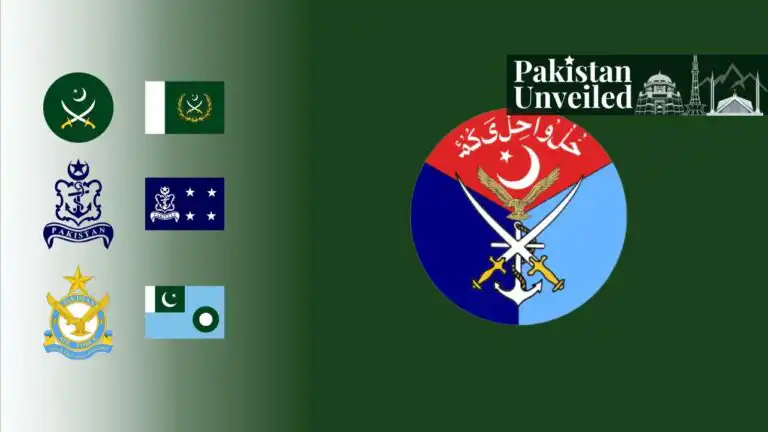
Structure of the Pakistan Army
The structure of Pakistan’s Army is divided into two categories: operational and administrative. The operational branch has 11 corps with different Areas of Responsibility (AOR). Administratively, the Army has different regiments.
Operational Network
| Corps (Commanded by a lieutenant general) |
| Division (Commanded by a major general) |
| Brigade (Commanded by a brigadier) |
| Battalion (Commanded by a lieutenant colonel) |
| Company (Commanded by a major or captain) |
| Platoon (Commanded by a lieutenant or a junior commissioned officer – subedar or naib-subedar) |
| Section (Commanded by a havaldar) |
- Corps
A corps is typically led by a lieutenant general and has two or more divisions, as well as a corps composite aviation squadron. The Pakistani Army now has 11 Corps. The newest one, the Army Strategic Force Command (ASFC), which is in charge of holding the country’s strategic and nuclear assets, is number eleven. It was formerly a division but was promoted to the rank of corps. As of 2025, the Pakistan Armed Forces have established the Army Rocket Force Command (ARFC), which is in charge of controlling and operating conventional rockets and missiles, including cruise, ballistic, and future hypersonic missiles. The ARFC is now promoted to corps rank as the 12th corps.
- Division
Pakistan has a total of 25 divisions. Every division has a major general in charge and typically has three brigades. For autonomous operations, each brigade is equipped with infantry, artillery, engineers, communications, and logistics (supply and servicing) support. Every division, except for those that operate in hilly terrain, has a minimum of one armored unit; some divisions may even have more, depending on their role. The infantry division is the largest of all ground force combat formations. Usually, a division of this kind would contain three infantry brigades. The Pakistani Army has 19 infantry divisions, 2 mechanized divisions, 2 armored divisions, and 2 artillery divisions.
- Brigade
Depending on its purpose, a brigade may consist of three or more battalions from various types of forces and is commanded by a brigadier. An autonomous brigade would primarily consist of an artillery unit, an infantry unit, an armor unit, and logistical support for its operations. Such a brigade has no divisional affiliation and is directly under the command of a corps.
- Battalion
Each battalion, which has 600–900 troops, is commanded by a lieutenant colonel. This varies depending on how well the unit is performing. A battalion is made up of either four companies (in the case of infantry regiments, generally known as Alpha, Bravo, Charlie, and Delta) or three batteries (in the case of artillery and air defense regiments, generally known as Papa, Quebec, Romeo, and Headquarters Battery), each under the command of a major and made up of separate subunits known as sections (which are further divisible into platoons and squads).
- Company
About 120–150 troops make up a company, which is led by a Major or Captain.
- Platoon
A Lieutenant or a junior commissioned officer with the rank of subedar or naib-subedar, depending on the availability of commissioned officers, leads a platoon, which is between a company and a section. It has between 30 and 36 troops overall.
- Section
The smallest military unit has a size of between 9 and 13 people. It is under the command of a junior commissioned officer.
Administrative Structure
| Infantry | Armour | Engineers |
|---|---|---|
| Punjab Regiment | 1st Cavalry | 1 Engineers |
| Sindh Regiment | 2nd Lancers | 2 Engineers |
| Baloch Regiment | President Bodyguard Group (PBG) | 3 Engineers |
| Azad Kashmir Regiment | 4th Cavalry | 4 Engineers |
| Mujahid Regiment | 5th Horse | 9 Engineers |
| Frontier Force Regiment (FF) | 6th and 7th Lancers | 18 Engineers |
| Northern Light Infantry (NLI) | 8th Cavalry | 19 Engineers |
| 9th Horse | 24 Engineers | |
| Guides Cavalry (Frontier Force) | 26 Engineers (Lahore Cantt) | |
| 11th Cavalry (Frontier Force) | 313 Assault Engineers (under 1 armoured division) | |
| 12th Cavalry (Frontier Force) | 313 Assault Engineers (under 1 armoured division) | |
| 13th Lancers (Spearheads) | 314 Assault Engineers (under 6 armoured division) | |
| 14th Lancers | 25 Mechanised Engineers (under 25 mechanized division) | |
| 15th Lancers (Baloch Horse) | ||
| 16th Horse (Al Mugheerat) | ||
| 17th Lancers | ||
| 18th Horse | ||
| 19th Lancers | ||
| 20th Lancers (Haider) | ||
| 21st Horse | ||
| 22nd Cavalry | ||
| 23rd Cavalry (Frontier Force) | ||
| 24th Cavalry (Frontier Force) | ||
| 25th Cavalry (Frontier Force) (Man of Steel) | ||
| 26th Cavalry (Mustangs) | ||
| 27th Cavalry | ||
| 28th Cavalry | ||
| 29th Cavalry | ||
| 30th Cavalry | ||
| 31st Cavalry | ||
| 32nd Cavalry | ||
| 33rd Cavalry | ||
| 34th Lancers | ||
| 35th Cavalry | ||
| 36th Cavalry | ||
| 37th Cavalry | ||
| 38th Cavalry (Desert Hawks) | ||
| 39th Cavalry | ||
| 40th Horse (Scinde) | ||
| 41st Horse (Frontier Force) | ||
| 42nd Lancers (Punjab Lancers) | ||
| 51st Lancers (Silver Eagles) | ||
| 52nd Cavalry | ||
| 53rd Cavalry | ||
| 54th Cavalry | ||
| 55th Cavalry | ||
| 56th Cavalry | ||
| 57th Cavalry | ||
| 58th Cavalry |
Ranks
The ranks in the Pakistan Army are divided into 3 categories: commissioned officers, junior commissioned officers, and non-commissioned officers. Sepoy (Sepahi) is the lowest rank in the Army. After this starts the chain of non-commissioned officers. The lowest rank in this category is lance naik, who is promoted from a soldier. After this, the rank is upgraded to that of naik, and the highest rank in this category is that of havaldar.
There are three naiks under one havaldar, and under each naik, there are 10 soldiers.
| Lance Naik |
| Naik |
| Havaldar |
Then, the next category is that of junior commissioned officers. The lowest rank in this category is naib subedar. The naib subedar is promoted to subedar and later subedar major, which is the highest rank in this category. After this, two ranks are considered honorary, including honorary lieutenant and honorary captain.
| Naib Subedar |
| Subedar |
| Subedar Major |
| Honorary Lieutenant |
| Honorary Captain |
The last category is commissioned officers, which has the greatest number of ranks, starting from second lieutenant, the lowest rank. The rank of second lieutenant is equal to the midshipman in Pakistan’s Navy and the pilot officer in Pakistan’s Air Force.
Next comes the rank of lieutenant, followed by captain. The rank of captain is equal to flight lieutenant in Pakistan’s Air Force and lieutenant in Pakistan’s Navy. The captain is later promoted to the rank of major, followed by a lieutenant colonel who leads a complete battalion and is equal to the rank of wing commander in the Pakistan Air Force and commander in Pakistan’s Navy.
After this, a lieutenant colonel is promoted to colonel, which is equivalent to group captain in the Pakistan Air Force and captain in the Pakistan Navy. A lieutenant colonel may become a one-star general, a brigadier, who is responsible for one complete brigade that includes three units. A level above Brigadier is the rank of Major General, or a two-star general, who is responsible for a division, with one division consisting of three brigades.
A three-star general, the lieutenant general, controls the complete army corps, with one corps having two to five divisions. The highest rank in this category would be that of a four-star general. Currently, General Syed Asim Munir is serving as the lieutenant general of the Pakistan Armed Forces. As of 2025, revoking the rank of chairman of the Joint Chiefs of Staff Committee, the Pakistan Armed Forces have introduced the rank of chief of defense forces of Pakistan, which is considered above a four-star general, commanding the tri-services of Pakistan simultaneously.
The next one is the rank of field marshal. In the history of Pakistan, there has only been one field marshal, General Ayub Khan. A general is honored with this rank if he has won a war by leading armies of one or two countries. As of 2025, the chief of defense forces of Pakistan, General Asim Munir, due to his extraordinary leadership in the Operation Bunyan um Marsoos against India, has been elevated to the rank of field marshal.
| Second Lieutenant |
| Lieutenant |
| Captain |
| Major |
| Lieutenant Colonel |
| Colonel |
| Brigadier |
| Major General |
| Lieutenant General |
| General (four star – COAS) |
| Chief of Defence Forces (Above a four-star general – Apex tri-service post) |
| Field Marshal (Five-star rank) |
Prominent Personalities
The history of Pakistan’s military is filled with brave and courageous warriors who sacrificed their lives for their country. Among the prominent ones, we see the name of Major Tufail M. Shaheed, who lost his life in a military operation with India in 1958. He holds the honor of receiving the highest military award, Nishan-e-Haider.
Next in line is Raja Aziz Bhatti Shaheed, who lost his life during the second war with India. He also had the honor of receiving Nishan-e-Haider. Army personnel have always fought with utmost zeal and patriotism and lost their lives while on duty. Like many other military officials, Major M. Akram Shaheed and Major Shabbir Sharif Shaheed are among those brave warriors who lost their lives during the war of 1971.
Even in the political realm, army chiefs have played their role. The chain started with Major General Iskander Mirza, who served as the governor general of Pakistan from 1955 to 1956 and later as the president from 1956 to 1958. He was succeeded by Field Marshal Ayub Khan, who stayed as president from 1958 to 1971. Later, General Zia-ul-Haq took over as the president of Pakistan from 1978 to 1988, and then from 2001 to 2008, Pakistan experienced the tenure of General Pervez Musharraf.
Naval Forces
The Pakistan Navy is the naval branch of Pakistan’s Armed Forces that is responsible for maritime security by implementing national policies through military, diplomatic, and humanitarian activities.
Structure of the Pakistan Navy
Like the military structure, the structure of the Navy is divided into two components: administrative and operational.
Administrative Network
Operational Commands in the Pakistan Navy
| Branch | Specialization and Qualification Badges |
|---|---|
| Naval Operations | Surface warfare, underwater warfare, electronic warfare, communication, navigation, NBCD |
| Logistics | Logistics Badge |
| Judge Advocate General Corps | JAG Badge |
| Weapons Engineering Branch | WEB Branch |
| Aviation | Naval Aviator Badge |
| Medical | Medical Badge |
| Naval Intelligence | Navy Intelligence Badge |
| Navy SEALs | SSGN Badge |
| Special Branch | IT Badge |
| Naval Supplies | Supply Badge |
| Mechanical | Ship Mechanical Engineering Badge |
| Education | Education Badge |
| Marine Engineering Badge | |
| Music | Music Badge |
| Naval Police | Naval Police Badge |
| Marine Corps | Marine Badge |
| Maritime Security Agency | MSA Badge |
| Chaplain Service |
Ranks
The chain of non-commissioned officers starts with the Leading Seamen and ends with the Petty Officer.
| Leading Seamen |
| Petty Officer |
The category of junior commissioned officers starts with the Chief Petty Officer. After this, the officer is promoted to the position of Fleet Chief Petty Officer, and the highest rank in this category is that of Master Chief Petty Officer.
| Chief Petty Officer |
| Fleet Chief Petty Officer |
| Master Chief Petty Officer |
The ranks of commissioned officers in Pakistan’s Navy start with midshipman, the lowest rank in the Navy. Pakistan Navy cadets undergo 18 months of training and are called midshipmen. After the completion of the first phase of training, they start another 6 months of training at sea, after which they are elevated to the rank of sub lieutenant.
The next rank in line is lieutenant, who is responsible for leading the crew, followed by lieutenant commander, who is responsible for the craft and serves as the management director of the SEAL Teams. Then comes the commander, who ensures control over submarines and warships. Commanders can either serve on naval bases or opt to work with the Defense Ministry.
The captain is the next rank in the Pakistan Navy. Captains examine bigger vessels and elevated places in shore-based installations. They are also responsible for the well-being of the equipment and the craft. A commodore is a one-star officer who monitors a flotilla of ships and plays an important role on the shore. They also support rear admirals in their duties as needed.
The rear admiral ensures the safety of the boats and maintains the squadron during warfare. Another prominent position is that of a three-star officer, a vice admiral, who controls the boat and the fleet. The last and highest rank in Pakistan’s Navy is that of admiral, who has direct control over all the ships.
| Midshipman |
| Sub Lieutenant |
| Lieutenant |
| Lieutenant Commander |
| Commander |
| Captain |
| Commodore |
| Rear Admiral |
| Vice Admiral |
| Admiral |
Prominent Personalities
Admiral Naveed Ashraf has been serving as the chief of the naval staff since 7th October 2023. He was serving as chief of staff at Maritime Central Command before taking over as CNS. He took the office as head of the training and personnel branch of the Pakistan Naval Force. He has, moreover, already served as commandant of the Naval Academy, VP of the National Defense University, maritime secretary, and appointee chief of the maritime staff at the Maritime Central Command for the organization department. There is a modest bunch of other officers as well in Pakistan’s naval force who have played significant parts amid times of war and savagery.
Air Forces
Pakistan’s Air Force is regarded as the “powerful defense element of the country’s defense.” According to the International Institute of Strategic Studies, the Pakistan Air Force includes 70,000 active-duty personnel and at least 594 operational aircraft.
Structure of the Pakistan Air Force
| Headquarters | Commands | Weapons Production Establishments |
|---|---|---|
| Air Headquarters (AHQ), Islamabad | Northern Air Command (NAC), Peshawar | Pakistan Aeronautical Complex (PAC), Kamra |
| Central Air Command (CAC), Lahore | Air Weapons Complex (AWC), Kamra | |
| Southern Air Command (SAC), Karachi | ||
| Air Defense Command (ADC), Rawalpindi | ||
| Air Force Strategic Command (AFSC), Islamabad |
| Flying Bases | Non–Flying Bases |
|---|---|
| PAF Base Mushaf (Sargodha) | PAF Base Korangi Creek (Karachi) |
| PAF Base Bholari (Bholari) | PAF Base Malir (Karachi) |
| PAF Base Masroor (Karachi) | PAF Base Lower Topa (Murree) |
| PAF Base Rafiqui (Shorkot) | PAF Base Kallar Kahar (Kallar Kahar) |
| PAF Base Peshawar (Peshawar) | PAF Base Kohat (Kohat) |
| PAF Base Murid (Chakwal) | PAF Base Lahore (Lahore) |
| PAF Base Samungli (Quetta) | PAF Base Sakesar (Sakesar) |
| PAF Base M.M. Alam (Mianwali) | PAF Base Kalabagh (Nathia Gali) |
| PAF Base Minhas (Kamra) | |
| PAF Base Nur Khan (Rawalpindi) | |
| PAF Base Faisal (Karachi) | |
| PAF Base Risalpur (Pakistan Air Force Academy) (Risalpur) | |
| PAF Base Shahbaz (Jacobabad) |
Ranks
The ranks in Pakistan’s Air Force are again divided into three categories: commissioned officers, junior commissioned officers, and non-commissioned officers. If we look into non-commissioned officers, then the lowest rank is that of an aircraftman. Higher up the ladder is the leading aircraftman, which is equivalent to Grade 8. Next comes the senior aircraftman, followed by the junior technician and later the corporal technician. A corporal technician can be promoted to the rank of senior technician.
| Aircraftman |
| Leading Aircraftman |
| Senior Aircraftman |
| Junior Technician |
| Corporal Technician |
| Senior Technician |
In the chain of junior commissioned officers, the rank starts with the assistant warrant officer, who later becomes the warrant officer and is finally followed by the chief warrant officer.
| Assistant Warrant Officer |
| Warrant Officer |
| Chief Warrant Officer |
The last and the highest category is that of commissioned officers. The first rank is a pilot officer, which is achieved after professional and military training at Pakistan Air Force Academy, Risalpur. After promotion, a pilot officer becomes a flying officer. Next, he becomes a flight lieutenant, followed by a squadron leader, and then the higher rank of wing commander.
The wing commander is then elevated to group captain. After serving as a group captain, the officer is promoted to a one-star officer called air commodore and then possibly to the rank of air vice-marshal, a two-star officer. After this comes the rank of air marshal and then air chief marshal. The last and the highest rank in Pakistan’s Air Force is the marshal of the Air Force.
| Pilot Officer |
| Flying Officer |
| Flight Lieutenant |
| Squadron Leader |
| Wing Commander |
| Group Captain |
| Commodore |
| Air Vice Marshal |
| Air Marshal |
| Air Chief Marshal |
Prominent Personalities
The history of Pakistan’s Air Force is also marked by the actions of gallant officers. In 1959, on the eve of Eid-ul-Fitr, an Indian Air Force English Electric Canberra was shot down in Rawat by Flight Lieutenant M. N. Butt and Flight Lieutenant M. Yunis.
Apart from this, many officers have represented Pakistan’s Air Force internationally. One such distinguished personality is that of Flight Lieutenant Muhammad Waseem Khan, who won the Clarkson Aerobatic Trophy in the UK for the “All Purpose Instructors’ Course” in 1948. The next year, Flight Lieutenant Fawad Shahid Hussain scored the first position in the “Pilot Attack Instructors’ Course” at Central Gunnery School at Leconfield and later set a Commonwealth record in air-to-air shooting.
Currently, Zaheer Ahmed Babar Sidhu, the air chief marshal, is the highest-ranking officer in the Pakistan Air Force. He has been awarded various awards; the most prestigious among them are Nishan-e-Imtiaz (Military), Hilal-e-Imtiaz (Military), Sitara-e-Imtiaz (Military), Tamgha-e-Imtiaz (Military), and the Turkish Legion of Merit.
Institutional and Structural Changes
Rocket Force Command
The government of Pakistan declared the creation of the Army Rocket Force Command as an independent command to manage and operate conventional rockets and missiles, including cruise, ballistic, and future hypersonic missiles, after the successful accomplishment of Operation Bunyan um Marsoos against India in May 2025. The force will also be well-equipped with the latest technology and be able to assault the enemy in all directions under the supervision of GHQ. It now has the Fatah-1 and Fatah-2 rockets. The creation of the Army Rocket Force Command brings together the traditional rocket units of various structures and expert detachments into one operating command, which is similar to the Army Strategic Forces Command. A three-star general is supposed to lead the ARFC, and it is upgraded to the 13th Corps.
Field Marshal
Field Marshal is the highest rank in the Pakistan Army – a five-star general. This rank is provided to the chief of army staff who stands out exceptionally against the rival forces. Consequently, the federal government of Pakistan announced that Pakistan COAS Asim Munir would become the second Pakistani field marshal after General Ayub Khan in May 2025, when the Pakistan Armed Forces decisively defeated India. The rank has no additional constitutional power and is only a symbolic national honor, with only exceptional services being taken into account.
Chief of Defense Forces (CDF)
By November 2025, under the 27th amendment of the Constitution of Pakistan that annulled the previous rank of Chairman of the Joint Committee of Staff Committee, the then President of Pakistan, acting on the recommendation of the prime minister, announced the creation of the CDF office with CDF General Asim Munir as its head. The office is established to bring the operational powers of the Pakistan Army, Pakistan Navy, Pakistan Air Force, and National Strategic Command to one constitutional post. The new structure offers the option of the federal government approving the powers of the COAS to be exercised by the vice chief of army staff or the deputy chief of army staff by issuing written orders with the advice of the CDF.
If you want to submit your articles and/or research papers, please visit the Submissions page.
To stay updated with the latest jobs, CSS news, internships, scholarships, and current affairs articles, join our Community Forum!
The views and opinions expressed in this article/paper are the author’s own and do not necessarily reflect the editorial position of Paradigm Shift.