

Introduction
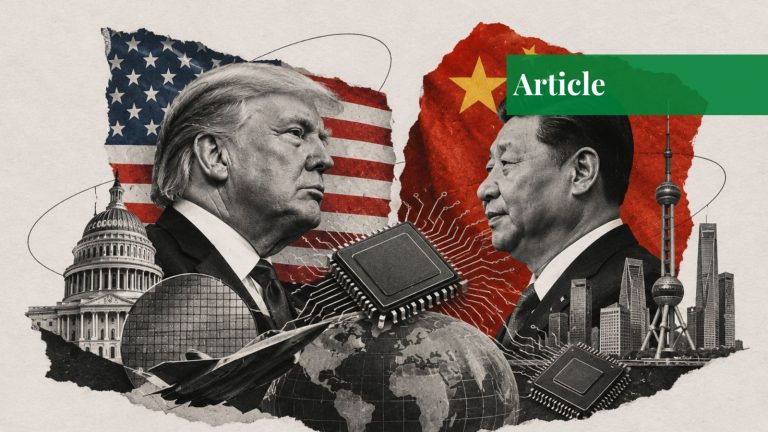
The twenty-first century has ushered in a new era of geopolitical competition, with the United States and China locked in a rivalry that extends beyond traditional military and ideological domains. This competition, often described as the “New Cold War,” is waged via technology, trade, and economic influence. The frontiers of this competition are semiconductor manufacturing, artificial intelligence (AI), 5G networks, and global supply chains, and they have transformed global alliances and institutions. The implications are far-reaching, not only to the two superpowers but also to the developing world, multinationals, and the international political setup.
Semiconductors: The Core of Technological Rivalry
Modern technology cannot function without semiconductors, as they are the heart of smartphones and defense systems. The United States, via the CHIPS and Science Act of 2022, has attempted to limit reliance on the Chinese supply chain, investing billions in its semiconductor research and development. Export restrictions introduced by Washington obstruct entry of state-of-the-art chip-making devices, especially from companies such as ASML in the Netherlands.
China, in response, has accelerated its push for self-reliance, investing billions in semiconductor research and development. Yet, despite progress, China remains dependent on foreign technology for cutting-edge chips. The outcome is a discontinuous supply chain around the world, with industries all over the globe experiencing increased expenses and insecurity. The case of semiconductor competition proves that competition in technology has immediate effects on economic destabilization and ripple effects throughout industries worldwide.
Artificial Intelligence and Quantum Computing
The next wave of technological control is artificial intelligence and the sphere of quantum computing. The competition over frontier AI models is led by the United States, backed by Silicon Valley giants and research institutions, whereas the competition in China revolves around shaping the future of governance, economic leadership, and national security due to the huge data volumes and the initiatives that are led by the state.
China announced its Action Plan for Global Artificial Intelligence (AI) Governance on July 26, 2025, a few days after the White House released America’s AI Action Plan. Building on President Xi Jinping’s October 2023 Global AI Governance Initiative, this Action Plan reflects China’s ambition to shape global AI governance amid intensifying technological competition, emphasizing infrastructure development, sectoral application, data quality and security, an open and inclusive ecosystem, sustainability, and international cooperation to bridge the digital divide.
The race for AI and quantum supremacy is not merely about innovation but about shaping the future of governance, economic leadership, and national security. The AI and quantum race underscores how technological rivalry is inseparable from strategic competition.
5G and Digital Infrastructure
The ownership of the 5G networks is a symbolic representation of technological power struggles. China has indeed expanded its 5G footprint globally through Huawei, which commands the largest share of 5G core network revenue at over 42% worldwide, powering more than 420 networks. Huawei targets developing nations with cost-effective 5G solutions, securing contracts in regions like Africa, Latin America, and Southeast Asia, where affordability trumps Western competitors’ pricing.
Based on the threat to national security, the United States has prohibited Huawei equipment and encouraged partners to use other options. This gap has given rise to a bipolar digital world, and some countries are with the US and others with China. The implication is not just restricted to technology, as it forms geopolitical alliances and economic reliance. The 5G competition is an example of how technological rivalry penetrates geopolitics because countries are forced to align with one side in the polarized digital world.
Cybersecurity and Digital Espionage
The global competition between the US and China extends beyond semiconductors, AI, and 5G to include cybersecurity and digital espionage. Hacking has emerged as a new battlefield, and both countries have accused each other of attacking critical infrastructure, stealing intellectual property, and controlling the flow of information. Cyber tools enriched with AI have elevated the level of sophistication, and attacks have also become more difficult to detect. The securitization of data, ranging from social media platforms to electric vehicles, has deepened mistrust and accelerated the tech decoupling between Washington and Beijing. This digital confrontation highlights how control over cyberspace is now inseparable from national security and economic resilience.
Impact on Developing Countries
Developing nations are caught in the crossfire of US–China rivalry. Third-world countries are in the middle of the US and China competition. Semiconductors and 5G equipment export restrictions restrict access to cheaper technology. Countries tend to prefer Chinese products because of their cost benefits, which leaves them dependent. The rivalry forces nations to align with one power, complicating foreign policy and economic planning.
To illustrate, African countries involved in Belt and Road Cases participated in the partnership with China, which provides chances to accumulate debt, and other countries cannot decide between the US security partnerships and the Chinese economic advantages. To developing countries, the US-China rivalry is not based on ideology but rather on survival in the fragmented world economy.
International Organizations and the Limits of Mediation
International organizations like the United Nations (UN), the World Trade Organization (WTO), and the International Telecommunication Union (ITU) have not been able to curb the growing technological rivalry between the two countries, the United States and China, even though these bodies are mandated to promote cooperation and stability. WTO has failed to significantly resolve the dispute surrounding the restriction issues related to the exportation of semiconductors and trade barriers, as the two powers tend to evade the multilateral system by exercising unilateral or bilateral measures.
Equally, the ITU, which must establish international standards in telecommunications, has experienced energy polarization, with the nations either siding with the US-supported or China-supported 5G technologies. The initiatives of the UN to encourage the discussion of AI governance and cybersecurity are not an easy task, and both Washington and Beijing are eager to promote their systems of governance instead of compromising on the common rules. This failure reflects a broader institutional paralysis, where global organizations lack enforcement power against major powers and struggle to adapt to the speed of technological change. As a result, the rivalry continues unchecked, fragmenting the global digital order and undermining the spirit of multilateralism.
Future Outcome: Innovation and Fragmentation
The future of the US-China rivalry lies in innovation and global fragmentation. The US is trying to stay on top through alliances and innovation strategies, as China seeks to enlarge its influence by providing low-cost technological substitutes and infrastructure development. The digital world can be further split, and AI, 5G, and semiconductor standards would be different. This disintegration can cause decreased collaboration and innovation at a global scale, and it brings about more economic ineffectiveness. Competition will probably result in a polarized international system, with innovation doing well and collaboration being weak.
Conclusion
The technological and economic race between the US and China is not an ideal Cold War, but rather it is a contest of innovation, supply chains, and world influence. The weapons of this war are semiconductors, AI, 5G, and trade wars, and their effects are experienced globally. Developing countries, international organizations, and business conglomerates need to address this competition cautiously since its results will shape the future of globalization and technological advancement. Ultimately, the US-China technological rivalry is not just about dominance; it is about shaping the future architecture of globalization, where innovation thrives, but collaboration remains fragile.
If you want to submit your articles and/or research papers, please visit the Submissions page.
To stay updated with the latest jobs, CSS news, internships, scholarships, and current affairs articles, join our Community Forum!
Find our FREE quizzes and MCQs here!
The views and opinions expressed in this article/paper are the author’s own and do not necessarily reflect the editorial position of Paradigm Shift.

Manahil Tariq Manj is a student of defence and strategic studies at Quaid-i-Azam University, Islamabad. She has previously interned at the Ministry of Defence (MOD) and is currently interning at the Ministry of Foreign Affairs, Islamabad. Her research interests include conventional and hybrid warfare, strategic deterrence, military diplomacy, regional conflict dynamics, and evolving doctrines of modern warfare.