
What Is the Badr Defense Agreement, and Why Does It Matter?
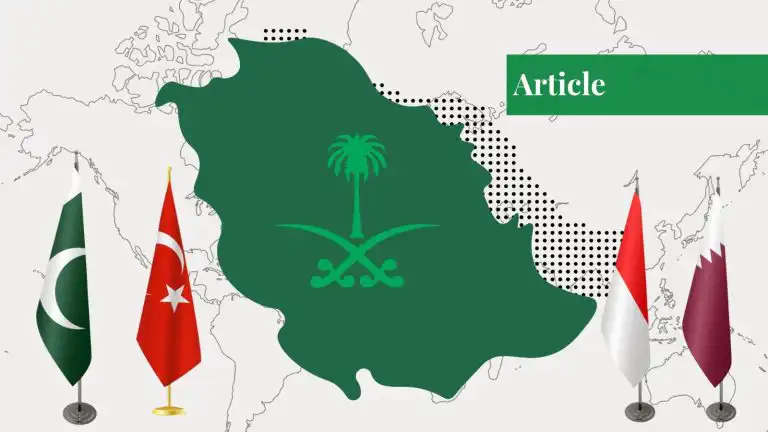
On 21st October, 2026, four Muslim nations from four different regions signed a novel Memorandum of Understanding (MoU) in Doha, Qatar, which came to be known as the ‘Badr Defense Pact.’ The four signatories include Pakistan from South Asia, Turkey from Eurasia, Qatar from West Asia, and Indonesia from Southeast Asia.
Burcu Ozcelik, a senior research fellow at the Royal United Services Institute, explained the very purpose of this new defense arrangement as “the rationale is to streamline these distinct defense export and joint production agreements under a more structured and resilient networked hub, rather than reinvent the wheel with each new defense agreement.”
With the United States pursuing the policy of Conservative Internationalism under the Trump administration, Washington is retreating back from its traditional role of global policeman, focusing ultimately on the Western Hemisphere. And it’s the ultimate rule in international affairs that whenever a power retreats from a region, others try to fill that gap. This Badr agreement is its best manifestation of where regional countries (the Muslim world) are trying to take the lead to create a post-Iran war regional security architecture.
What Does the Name “Badr” Symbolize?
Badr is an Arabic word that means ‘full moon.’ But its usage is often linked to a major battle. It happened in 624 CE near Medina. Back then, Mecca was not under Muslim rule. It was controlled by the Quraysh tribe. This tribe clashed with Prophet Muhammad (P.B.U.H) and his followers in the desert. The Quraysh had some 1000 men. On the other side were 313 Muslims. Despite the odds, Prophet Muhammad (P.B.U.H) won that battle. It was one of the earliest military successes of Islam. This battle has been mentioned by name in the Holy Quran as
وَلَقَدۡ نَصَرَكُمُ ٱللَّهُ بِبَدۡرٖ وَأَنتُمۡ أَذِلَّةٞۖ فَٱتَّقُواْ ٱللَّهَ لَعَلَّكُمۡ تَشۡكُرُونَ
“And already had Allah given you victory at [the battle of] Badr when you were [vastly] outnumbered. So be mindful of Allah; perhaps you will be grateful.” (3:123)
That victory was followed by several others, and in 630, the Quraysh surrendered Mecca to Prophet Muhammad (P.B.U.H). Even today, the battle is remembered fondly. Pakistan has named its warship Badr. There are towns in Egypt and Libya also called Badr. So, this naming of the pact is a tribute to the historical battle of Badr.
What Diplomatic and Strategic Developments Paved the Way for the Badr Agreement?
- Hub and Spokes Model
On 7 August 2026, three prominent Muslim countries, including Pakistan, Turkey, and Saudi Arabia, signed a mutual defense treaty known as the “Mecca Defense Pact.” This defense treaty works on the basic principle of ‘one for all,’ where an attack on one will be considered an attack on the other. It was then forecasted that more Muslim countries could join this treaty, and still the pact’s membership remains open for states like Egypt, etc.
However, there are many Muslim countries that are referred to as the swing states, which means that they are not direct enemies of Israel or Iran. They often act as intermediaries. These states include Qatar, Bahrain, and Oman, and Muslim countries of other regions, including Indonesia and Malaysia, which are far distant from the Middle East. Their interests could be jeopardized, or they could face overstretching if they join the Mecca Pact, which obliges them to a greater responsibility of mutual defense.
Thus, the Badr agreement is introduced for such swing states that can join the Muslims’ collective security arrangement. It’s like the Mecca Pact acting as a tree whose branches include mini-lateral groupings like the Badr Pact. Lt Gen (Rtd) Tariq Khan – a retired army officer who has served as the head of Pakistan’s Central Command – commented on the inclusion of swing states:
“A larger membership does not automatically create a stronger alliance. Different countries will have different interests and restrictions. Pakistan should therefore favour project-based cooperation, with defined responsibilities and measurable benefits. Otherwise, Badr could become another ambitious arrangement without clear ownership or results.” (Interview by Hammad Gillani, October 2026)
- Revival of Strategic Autonomy
The second major reason behind the signing of the Badr Pact is the revival of Muslim nations’ spirit of strategic autonomy. The ongoing war with Iran has made it clear to the Gulf nations that despite the fact that the US was their sole security guarantor, it has failed to protect the Gulf economies from Iranian attacks. And now, the Muslim countries are diversifying their defense partnerships, focusing on indigenous defense production and procurement.
Speaking about the effectiveness of the Badr MoU, Mir Adnan Aziz, a columnist whose writing explores the forces that shape power, belief, and society, explicitly mentioned:
“Badr is a framework, not yet proof of technology transfer. Genuine self-reliance requires binding production agreements, access to technology, local manufacturing, and export rights. Türkiye’s defense exports highlight the gap Pakistan must bridge. Until concrete projects and transparent membership criteria emerge, Badr merely remains a promising MoU, not evidence that Pakistan is becoming a technology producer rather than a buyer.” (Interview by Hammad Gillani, October 2026)
- Post-American Regional Order
Third, such defense arrangements are a strategic signal to Israel and its allies in the region. On 27 May 2020, Jonathan Spyer, a research fellow at the Middle East Forum and the Jerusalem Institute for Strategy and Security, published an article in The Jerusalem Post, titled “Turkey, Pakistan, Malaysia, and Qatar form a troubling new alliance.” This shows that Israelis have been preparing for such alliance formations by the Muslim countries for so long.
On one side, there is an Israeli model for the region that contends that no country other than Israel should have hegemony in the region. On the other side, Muslim countries are striving for a collective security arrangement where hegemonic powers could be deterred efficiently. Thus, the Badr Pact could be considered a defense grouping in response to that Israeli model of hegemony.
- Alternative to QUAD
Last but not least, several Indian analysts are also comparing this Badr Pact with the QUAD group, which includes India, the US, Japan, and Australia. India tried its best to project its power and influence in the Indian Ocean region through such groupings. As of 2026-2026, QUAD has become irrelevant. Instead, Pakistan is now forming such minilateral coalitions, enhancing its sphere of influence. Thus, the ever-increasing minilateralism by India in the region compelled Pakistan to respond in a similar yet powerful way.
What Can Each Member Country Bring to the Table?
- Turkey could bring defense technology, drones, missiles, electronics, and systems integration.
- Pakistan could bring defense manufacturing, skilled manpower, and an established military-industrial base.
- Qatar brings with it the financial resources plus defense procurement capacity.
- Indonesia brings a large market base, manufacturing potential, and a growing defense industry.
What Are the Agreement’s Principal Objectives?
The agreement seeks to bring the four countries’ defense industries closer together through:
- Joint defense production
- Research and Development (R&D)
- Technology cooperation and transfer
- Technical military training
- Industrial capacity building
- Integration of defense supply chains
- Development of systems suited to modern warfare
How Does the Badr Agreement Differ from the Makkah Defence Pact?
The most prominent difference between the Mecca Pact and the Badr Pact is the principle of collective security. As per Article 2 of the Mecca Defense Treaty, “an externally originating armed attack against any of the Parties shall be considered an attack against all the Parties.” However, the Badr Pact does not include any such defense obligation.
In simple terms, the Mecca Pact can be considered the hub of the wheel, while other defense arrangements like the Badr Pact are the spokes. Another major difference between the two pacts is that the Mecca Pact is limited to only South Asia and West Asia, while the Badr Pact involves other regions of the world, including Southeast Asia.
Does the Badr Agreement Signal the Emergence of a Muslim NATO?
When the term ‘NATO’ is used, the only thing that comes to mind is Article V, which states that an attack against one will be considered an attack against all. The Badr Pact does not include any such clause. Thus, it can be said that the Badr Pact has nothing to do with Muslim NATO. One can say that if not for the Badr Pact, then its predecessor, the Mecca Pact, would have the collective security principle. But here the point to be noted is that NATO, which was established in 1949, was formed against one common enemy—the USSR.
In the case of the Muslim world, every Muslim country has different interests and threat perceptions. Mir Adnan Aziz further elaborated on it as:
“The key questions are whether the pact requires military intervention, who determines its scope & whether Pakistan can limit its role to defensive protection. MOFA has explicitly stated that Pak forces will defend Saudi territory but will not cross into Yemen to attack the Houthis. That is the stated limit, although defending Saudi Arabia could still expose Pakistani forces to Houthi retaliation. The crucial safeguard is engaging Tehran diplomatically (as it is being done), ensuring collective defense does not become participation in offensive operations inside Yemen.” (Interview by Hammad Gillani, October 2026)
Thus, in the long term, if Muslim countries come on a common platform with a common threat, then definitely these already signed treaties could provide an impetus to the formation of a Muslim NATO.
How Does the Badr Agreement Fit into Washington’s Changing Middle East Strategy?
It seems very odd that Muslim countries are coming together and Washington is supporting these defense agreements. In the case of the Mecca Pact, to which Israel is cautious to a large extent, President Donald Trump welcomed it and said, “Very happy to see that Saudi Arabia, Türkiye, and Pakistan have recently, and finally, signed the Makkah Joint Defense Agreement. It shows how the Middle East is coming together and how countries will finally be able to defend themselves in a more meaningful way.”
Now here the question arises: are the Mecca Pact and now the Badr Pact American-sponsored? Not significantly. America supporting something does not mean it’s backing it. The revival of strategic autonomy is not limited to only the Middle East. It’s now being observed in nearly every region of the world. In East Asia, Japan, South Korea, Taiwan, and the Philippines are all diversifying their defense partnerships beyond the US. Likewise, Europe is also meeting the same fate.
Since 2008, we have been listening to China rise. The multipolar world order is in the pipeline. That’s the only reason the Trump administration is supporting both the Israeli and the Gulf model of regional security architecture, because the US is now not in a condition of burden-lifting or burden-sharing. It’s now burden shifting.
Can the Badr Agreement Become a Cornerstone of Peace, Security and Strategic Resilience?
Before addressing this question, another question must be answered. Who provided impetus to this changing Middle Eastern security architecture? Definitely, it’s Iran. Despite American and Israeli pressure, Iranians have withstood it and shown their resilience and firm attitude. Just as in South Asia, Pakistan destroyed the decades-long Indian conventional prowess; Iranians have done it against the Israelis and Americans. And it’s the rule in international relations; the one who wins or withstands will be emboldened in the region.
Lt Gen (Rtd) Tariq Khan commented on the recent engagement of Mecca alliance partners with Iran and said:
The reported engagement of a Makkah Alliance delegation with Iran, led by Field Marshal Asim Munir, adds an important diplomatic dimension. Pakistan, Saudi Arabia and Turkey maintain close ties with the United States, but their engagement with Iran shows that partnerships need not eliminate diplomatic channels with opposing states. Pakistan should use its relationship with Riyadh to encourage restraint while maintaining communication with Tehran. Preventing war is preferable to entering one. The Tehran engagement may therefore reflect an effort to preserve strategic space, not abandon the Saudi relationship.” (Interview by Hammad Gillani, October 2026)
Now, whether the Badr agreement could become a cornerstone of peace, security, and strategic resilience depends on how much Iran is taken on board by other Muslim countries. As Pakistan’s DG ISPR Ahmed Shareef has already noted, these defense pacts are not meant against any Muslim country. Therefore, Iran should either be included or taken on board in all the regional security frameworks. This is the only way peace could prevail in the region.
If you want to submit your articles and/or research papers, please visit the Submissions page.
To stay updated with the latest jobs, CSS news, internships, scholarships, and current affairs articles, join our Community Forum!
Find our FREE quizzes and MCQs here!
The views and opinions expressed in this article/paper are the author’s own and do not necessarily reflect the editorial position of Paradigm Shift.

Syed Hammad Ali is pursuing a BS in International Relations programme from the International Islamic University, Islamabad, and has a keen interest in research works, policy analysis, defence and strategic studies, and conflict resolution.