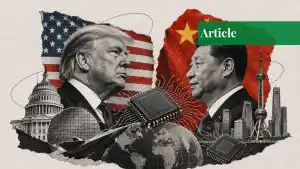

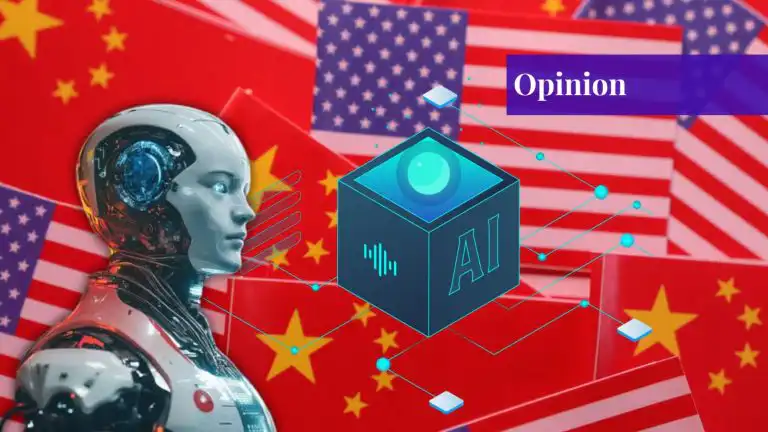
On 28 October, President Donald Trump said the United States is leading China in artificial intelligence and wants to stay there, adding that whoever wins AI wins. The remark followed Xi Jinping’s September state visit to the White House, where the two sides agreed to extend their trade truce until January but reached no agreement on safeguards for AI. Trump and Xi are due to meet again in Beijing next month.
The tariff war has paused. The technology race has not.
A Truce With a Gap
Some summaries say the AI talks “broke down.” The reporting is more modest: no deal was reached on safeguards, and nobody has said talks ended. That distinction matters, because a gap can still be filled at the Beijing meeting. But the sequence tells you what each side values. Both capitals were willing to prolong a trade arrangement that costs them little to maintain. Neither would accept limits on the technology each thinks decides the next decade.
Two Tours, One Region
The competition has moved into countries that sit between the two powers. Chinese Premier Li Qiang visited Uzbekistan on 17–18 October, and Secretary of State Marco Rubio arrived in Samarkand on 18 October with a delegation of American business leaders for talks with the five Central Asian presidents in the C5+1 format. Washington announced about $12 billion in deals, and Rubio told American firms to compete there against Russia and China. The Irish Times reported that Li had been promising cooperation on everything from critical minerals to artificial intelligence.
The visits were a day apart, not simultaneous, but the effect was the same. Central Asian governments were offered rival packages in the same sectors in the same week. Washington’s priority is critical minerals used in electronics and batteries, which it wants to source away from China.
The Argument for Spying
A harder argument is being made in Washington. David Cohen, a former CIA deputy director, wrote in Foreign Affairs under the title “The Case for Economic Espionage” that the United States should lift its prohibition on collecting intelligence to help American companies. His premise, as reported by the South China Morning Post, is that the US lead in key technologies is being contested or erased by China. The piece appeared earlier in October, not this week.
It has company in the news. The Washington Post reported that the Pentagon is working on a deep-cover program overseen by Tom Rakusan, a retired CIA veteran who is now an adviser to the Deputy Defense Secretary. The Defense Department rejected the report. CIA Deputy Director Michael Ellis said in a September speech that the agency is expanding espionage against Chinese firms in AI, biotechnology and advanced semiconductors.
Beijing’s answer was predictable. The Global Times said that state intelligence agencies cross the basic line of fair competition when they steal corporate secrets. The diplomat made a sharper point: Washington spent three decades lecturing the world on intellectual property and now appears ready to abandon the norm. Cohen’s side has a reply. He argues, in his NPR interview, that by abstaining, the United States has tilted the playing field against itself. Both positions deserve a hearing. But a norm that the largest economy drops will not stay confined to Chinese targets.
What This Means for Pakistan
Pakistan sits on both sides of the divide. China supplied 81 percent of its major arms imports in 2020–24, according to SIPRI. Its financing runs through Washington-influenced institutions: on 8 October it reached a staff-level agreement with the IMF on a review of its $7 billion program, worth about $1.2 billion, subject to board approval. Reserves reached $26.8 billion on 2 October.
Islamabad does not need to choose a side in AI because it is not yet a serious competitor in it. It does need a rule for itself before pressure arrives: which technology partnerships it will sign, which data it will host, and which supply chains it will refuse to enter on exclusive terms. Central Asia shows what happens to governments that wait. They receive offers from both capitals and set the terms of neither.
Pakistan also has a seat to use. It took the chair of the Shanghai Cooperation Organisation for 2026–27 on 1 September and will host the next summit in Islamabad in 2027. A chair can put connectivity and technology-sharing rules on the agenda before the great powers write them for everyone else.
If you want to submit your articles and/or research papers, please visit the Submissions page.
To stay updated with the latest jobs, CSS news, internships, scholarships, and current affairs articles, join our Community Forum!
Find our FREE quizzes and MCQs here!
The views and opinions expressed in this article/paper are the author’s own and do not necessarily reflect the editorial position of Paradigm Shift.

Azhar Ud Din is a student of international relations at Government College University, Lahore.