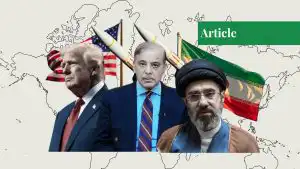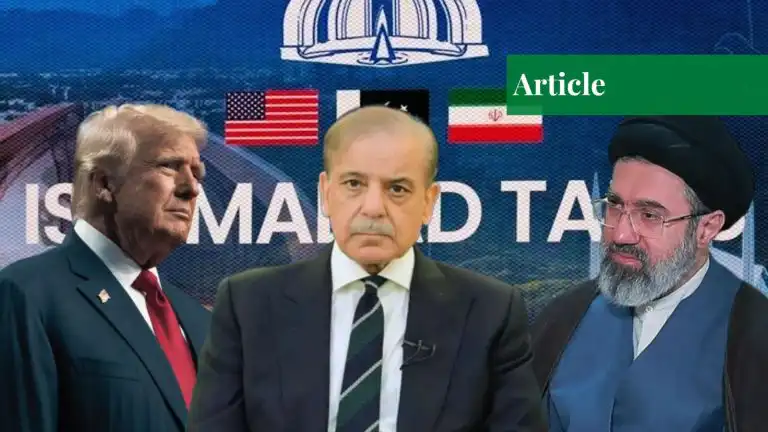
There is a special sadness for peacemakers when their peace is destroyed in real time, and this week Pakistan is experiencing that. Just a month ago, Prime Minister Shehbaz Sharif was holding up a signed memorandum of understanding between Washington and Tehran in Geneva, declaring it to be the best peace the region had seen in a generation. This week, Iran declared that document null and void, that it was in an existential conflict with the United States, and that it had buried its own supreme leader following the assassination that began it all. The paper that Pakistan spent a hundred sleepless nights quietly caught fire somewhere between June 17 and July 15.
It’s worth stopping to consider how improbable this story is. On February 28, when American and Israeli jets struck Iran and killed Ayatollah Khamenei, sparking the 2026 Iran war, no one would have thought that the country that held the room would be Pakistan. By April, however, Islamabad was hosting the highest-level talks between the US and Iran since 1979, and by June Munir had been in Tehran three times in a row and Sharif had been in Riyadh, Doha and Ankara. More talked about than talked at, Pakistan was the room in which two hostile capitals were willing to sit.
That success gave Pakistan something tangible: respect in the capitals of the Gulf countries that have grown tired of it, and a place at tables they had only heard about. Islamabad’s line has remained firmly neutral against strikes on Iran, against strikes on Gulf states, to return to the MoU, to dialogue as the only option.
However, neutrality is not control, and that’s the uncomfortable truth this week revealed. The issue that led to the ceasefire’s break was not Pakistan’s to solve, and the one who controls passage through the Strait of Hormuz is the one who controls the world. It is at the crossroads of American naval doctrine and Iranian sovereignty claims, and nothing can be done to bridge such a fundamental disagreement. The two men who had maintained the talks for months were left to make statements of concern from the sidelines when Trump reimposed a naval blockade and threatened tariffs on ships in the strait, while Iran fired on commercial vessels and declared the waterway closed.
Why not sooner, when the ceasefire was as fragile? Hundreds of thousands of people turned out in Tehran and Najaf on the streets to mark Khamenei’s funeral, which coincided with the resumption of fighting, reinforcing the anti-capitulation sentiment. There was always going to be the first serious dispute, and Hormuz was always going to be that dispute, as it was always going to be a partly structured MoU with no enforcement mechanism. Islamabad’s mediation was not a settlement; it was a postponement, and a postponement was never going to be enough.
The tension no one in Islamabad dares to express: Pakistan’s newest source of relevance is entirely reliant on the need of two other governments. If Washington chooses pressure over talks, or Tehran chooses negotiation itself as the trap, Pakistan’s role as a mediator is not lost; it’s never really in its hands.
There’s a domestic reflection of that fragility. Neutrality is a form of statesmanship from Geneva, but unlike Karachi, where ten people died after an attempted storming of the US consulate after Khamenei’s killing, or Gilgit-Baltistan, where a curfew was imposed for three days after, it is not seen as such in the capital. The Shia population, which makes up about 20% of Pakistan, has been watching the state remain neutral between Washington and Tehran, and accusing it in the streets of being on the side that pulled the trigger. Mediation is not free; Islamabad is spending domestic political capital to gain foreign policy capital, and that does not always balance.
None of this renders Pakistan’s credibility useless when the MoU is cancelled. There is a genuine counter-argument: Saudi Arabia’s foreign minister had already commended Pakistan’s mediation on its merits, irrespective of the outcome, and months of shuttle diplomacy do not disappear because one document did. Oman has established just this kind of credibility over decades of behind-the-scenes negotiations between Washington and Tehran, and it has survived the failure of previous talks. It’s just that Pakistan is developing the same reputation, but it’s just a matter of time. Oman’s role is decades old, and has nothing to do with the personalities of any one government, while Pakistan’s is four months old and has everything to do with two men and one unresolved war. That can turn into a permanent thing, but taking that for granted would be the riskier error.
That’s why the smart thing to do is to hedge both readings. It’s a bonus if Pakistan’s mediator reputation develops into something like Oman’s, but it’s not a windfall that can be spent in a hurry. However, it can’t be the entire approach until it has been proven. The same credibility must be extended to other places and other levels of economic engagement with the Gulf, beyond crisis diplomacy, to a more assertive presence in the Shanghai Cooperation Organisation and quiet insurance policies with Riyadh and Beijing that are not reliant on Washington and Tehran’s presence.
The MoU may be revived; it happens that way, until it doesn’t. But the lesson Pakistan has already learnt is that influence gained from other people’s wars is real, but it is rented, not owned. Its next chapter in diplomacy should be about creating the kind of regional relevance that no ceasefire can remove.
If you want to submit your articles and/or research papers, please visit the Submissions page.
To stay updated with the latest jobs, CSS news, internships, scholarships, and current affairs articles, join our Community Forum!
The views and opinions expressed in this article/paper are the author’s own and do not necessarily reflect the editorial position of Paradigm Shift.

Barira Mumtaz is a policy researcher specializing in international relations, regional security, and strategic studies, with a particular focus on Central Asian geopolitics and economic connectivity frameworks at IRS Islamabad. She is also pursuing an MS in Strategic Studies at NUST's Centre for International Peace & Stability (CIPS), Islamabad, and holds an MA in Political Science from the University of Sargodha.