
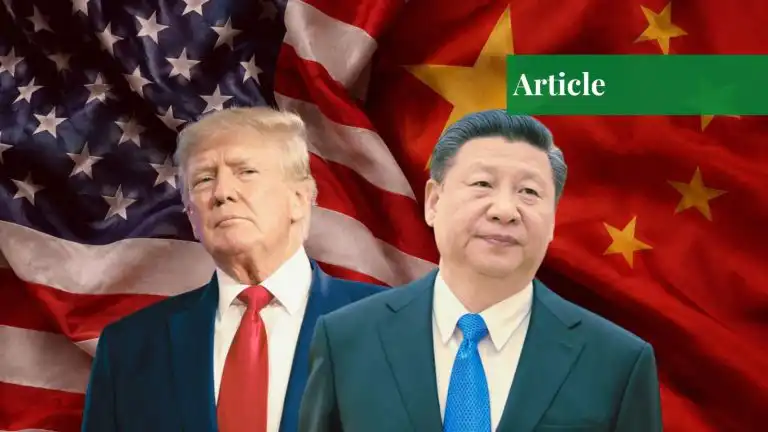
As an old axiom goes: small countries do not dance with enemies. Pakistan, however, is one up the ante: it cannot afford to lose either of the two preeminent powers in the world as friends. Islamabad has been in the news for strengthening economic cooperation with Beijing, getting close to Washington, and mediating between Tehran and the US during the last few months. As diplomatic theatre, it’s quite a show. But don’t get it wrong — this is also one of the most dangerous games any country can play in the 21st century.
A Common Friend, But Trusted By Neither?
The China-Pakistan relationship runs deep, is structured, and is decades old. The China-Pakistan Economic Corridor (CPEC) — the flagship project of Beijing’s Belt and Road Initiative — has directed tens of billions of dollars in Pakistani infrastructure. China is the largest supplier of arms to Pakistan, which, after all these years, remains aligned with Pakistan when it comes to it, and in many respects is also the biggest lifeline from an economic perspective. For Islamabad, Beijing is no less than a strategic lifesaver. The relationship with the US is older, more tempestuous, and one of convenience at best, as it lacks an ideological affinity. America needs Pakistan for its power play in the region, for cooperation on counterterrorism, and increasingly in balancing against Chinese advances into South Asia. Pakistan, in turn, requires US benevolence for International Monetary Fund bailouts, Western investment, and geopolitical legitimacy.
While Pakistan is openly mediating between Iran and Washington, it can also both signal that Islamabad will intercede something the US or China cannot do as well anywhere in the world right now: an ad hoc back channel with a potential outreach to multiple sides of different conflicting parties. This is a valuable asset. However, in the world of international politics, we found out that we have also liabilities to assets.
The Structural Issue: Two Masters, One Minor
Pakistan’s greatest threat is not economic or military — it is, by its nature, a loss of credibility. The US-China rivalry is not the cold competition over spheres of power. It is a category of competition that covers technology, trade, military capabilities, and the future architecture of international order. Both powers increasingly insist on loyalty, not neutrality. The Americans have obviously grown uncomfortable with CPEC and Pakistan’s military cooperation with China. American officials have also been wary of developing surveillance technology in Pakistan through Chinese ties, as well as what they view as Beijing’s encroachments into Islamabad’s decision-making. Every new CPEC treaty that Pakistan enters into, every joint military drill it carries out with China sends a new message to Washington, which only confirms its worst suspicions.
On the other hand, Beijing has a quietly worried eye on Pakistan’s growing appeal to Washington. China has invested unprecedented political and financial capital in Pakistan. If Seoul were to pivot too far toward the US camp, say via defense pacts, intelligence agreements, or joining US-led initiatives in the Indo-Pacific region, Beijing would consider this a breach of trust. China seems to have a long memory for the strategic blunders of partners.
Warning from History: Non-Alignment
History provides cautionary lessons. Cold War countries that attempted this sort of balancing act between the US and Soviet blocs often found themselves crushed by pressure from both sides. We know from the experience of Yugoslavia under Tito how skillfully it can be done — but remember, Tito was a genius and eventually his path proved divisive too. Swinging between superpowers, Pakistan is used to nominally serving as a frontline state for Washington — at the time of the Soviet-Afghan War — only to enjoy waning American interest once the Cold War ended.
It is not that known to be balance it impossible. This is because balancing needs tremendous diplomatic restraint, institutional cohesion and — above all — a compelling national interest that both powers will acknowledge and honour. The fundamental problem for Pakistan is that it has frequently been reactive rather than strategic — addressing crises, rather than anticipating them. To truly earn the mantle of the indispensable mediator in the US-China-Iran matrix, Islamabad needs a doctrine rather than a reflex.
The True Threat: Dependence Without Autonomy
By far the worst danger is not that Pakistan will be required to make a choice between Washington and Beijing but rather that it becomes economically and strategically dependent on both so as to give up any freedom at all in its choices. Investment repayments to China, IMF programmes in tow with their US nudging, military assistance conditionalities — all of them silently delimitize Pakistani sovereignty even as Islamabad plays the part of a sovereign actor. Only a truly sovereign state can afford to be the one saying no — to Beijing on an exploitative clause in CPEC, to Washington on a destabilising military operation. At the moment, Pakistan has less manoeuvrability to opt out of either power than its rhetoric would indicate.
The Path Forward
Pakistan’s aspirations are not unreasonable. Small and medium powers have played a more significant part as honest brokers before. Switzerland, Qatar and Oman — the atypical small powers providing services that larger, more entangled powers cannot. If Pakistan is genuinely able to be an honest broker between adversaries, that is a real and potentially stabilising role in a broken world. The criteria for success, however, are stringent: a relatively stable internal order, a unified military and civilian establishment on foreign policy issues, sufficient economic output to reduce reliance, and the fortitude to withstand short-term temptations. Pakistan is still not doing well on most of these dimensions. Pakistan’s balancing act between Washington and Beijing is not an insurmountable one. However, it’s just enormous and very high, but the wind is nice. Politicians in Islamabad should be mindful, for there is no second time climbing again the nations that fell from such heights.
If you want to submit your articles and/or research papers, please visit the Submissions page.
To stay updated with the latest jobs, CSS news, internships, scholarships, and current affairs articles, join our Community Forum!
Find our FREE quizzes and MCQs here!
The views and opinions expressed in this article/paper are the author’s own and do not necessarily reflect the editorial position of Paradigm Shift.

Saikat Halder is an undergraduate student in the department of International
Relations at Jahangirnagar University, Dhaka, Bangladesh. He has interest in security issues,
migration and environmental diplomacy.