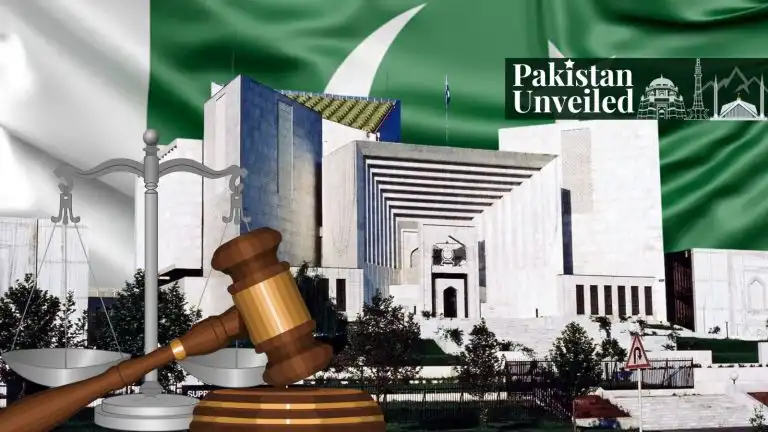
Knowing how justice works in Pakistan requires understanding the institution that delivers it.
The judiciary system of Pakistan is the national system of courts responsible for maintaining law & order in the Islamic Republic. It is one of the three pillars of the Pakistani state alongside the legislature and the executive & under the Constitution of 1973, it carries the specific obligation to preserve, protect & defend the constitution itself. That constitutional mandate gives the judiciary not just a functional role but also a guardianship role, one that has made it increasingly significant in Pakistan’s political & legal landscape over recent decades.
The Foundation: Common Law & Constitutional Framework
Pakistan uses a common law system, which was introduced in the colonial era, influenced by local medieval judicial systems based on religious & cultural practices. The Constitution of Pakistan lays down the fundamentals & workings of the Pakistani judiciary.
The 1973 Constitution is still the primary legal document governing how courts are structured, how judges are appointed & what jurisdiction each court carries. Significant amendments have updated this framework, most recently the 26th Constitutional Amendment in 2024 & the 27th Constitutional Amendment in 2025, each of which made important changes to how judges are nominated & appointed at senior levels.
Two Classes of Courts: The Basic Structure
Pakistan has two classes of courts
- The superior (or higher) judiciary
- The subordinate (or lower) judiciary
The superior judiciary is composed of the Supreme Court of Pakistan, the Federal Shariat Court, the Federal Constitutional Court & five High Courts, with the Supreme Court at the apex. There is a High Court for each of the four provinces as well as the federal capital.
This two-tier structure creates a clear hierarchy. Cases start at the lowest appropriate level & work their way upward through appeal. Each tier has defined jurisdiction and defined authority over the tier below it.
The Supreme Court: Pakistan’s Apex Institution
The Supreme Court of Pakistan was established on the 2nd of March, 1956, under the Constitution of 1956. It is the Apex Court—the last appellate court—in Pakistan’s judiciary system and the final arbiter of legal and constitutional disputes.
The court consists of a chief justice and sixteen other judges. There is also a provision for the appointment of acting judges as well as ad hoc judges in the court. It has a permanent seat in Islamabad as well as branch registries in Lahore, Peshawar, Quetta, and Karachi.
The Supreme Court exercises original, appellate, & advisory jurisdiction. It can hear matters directly in particular constitutional situations, hear appeals from high courts, and advise the government on legal questions when asked. Its suo motu power, the ability to take up matters on its personal initiative, particularly in human rights cases, has made it one of the more actively interventionist apex courts in the region.
The Supreme Court is located in Islamabad and has appellate authority over decisions of the High Court as well as exclusive jurisdiction over disputes between or among the federal and provincial governments.
The Federal Shariat Court: Islamic Law Oversight
The Federal Shariat Court of Pakistan is a constitutional Islamic religious court, established in 1980 to scrutinize all Pakistani laws and determine if they conform to Islamic values as laid down in the Quran and the Sunnah. If a law is found to be repugnant, the court notifies the relevant government, specifying the reasons for its decision.
The court also has appellate jurisdiction over penalties arising out of Islamic law, although these decisions can be reviewed by the Shariat Appellate Bench of the Supreme Court. The decisions of the court are binding on the high courts as well as the subordinate judiciary.
Of the 8 judges, 3 are required to be Islamic scholars—Ulama—who are well versed in Islamic law. The judges hold office for a period of 3 years, which may eventually be extended by the president.
The High Courts: Provincial Pillars of Justice
There is one High Court in each province and one in the federal capital, Islamabad, including the Lahore High Court for Punjab, the Sindh High Court in Karachi for Sindh, the Peshawar High Court for KPK, the Balochistan High Court in Quetta, and the Islamabad High Court for the Capital Territory.
The High Court is the principal court of the province, which exercises original jurisdiction—issuing writs for enforcement of fundamental rights—and appellate jurisdiction against orders and judgments of subordinate courts and special courts. The subordinate courts function under the administrative control of the High Court.
High Court judges must be at least 45 years of age and are appointed through the Judicial Commission of Pakistan—a body that includes senior judges and legal representatives from the relevant province.
The Subordinate Judiciary: Where Most Justice Is Delivered
The subordinate judiciary consists of civil and criminal district courts and numerous specialized courts covering banking, insurance, customs and excise, smuggling, drugs, terrorism, taxation, the environment, consumer protection, and corruption.
The lower judiciary, which consists of the District Courts, Session Courts, and Courts of Magistrates, has the most significant role in the criminal justice system of Pakistan.
District courts are the first point of contact for most Pakistanis seeking legal remedy. They handle the overwhelming majority of civil and criminal litigation in the country. Session courts also function as trial courts for serious offenses, while magistrates’ courts in cities and towns handle the bulk of less serious criminal matters at first instance.
According to one estimate, around 90 percent of litigation in Pakistan is conducted at the level of subordinate courts and the rest at the level of high courts and the Supreme Court.
Special Courts and Tribunals
Beyond the main court hierarchy, Pakistan maintains a significant network of specialized courts designed to handle specific categories of disputes more efficiently than general courts can manage.
These include anti-terrorism courts; special tribunals and boards, including environmental tribunals and banking courts; family courts; and juvenile courts.
Family courts handle matrimonial disputes, custody, maintenance, and inheritance matters. Juvenile courts deal with criminal matters involving minors within a separate framework designed for their specific situation. Anti-terrorism courts handle cases related to terrorism offenses with a distinct procedural framework.
Judicial Accountability: The Supreme Judicial Council
The Supreme Judicial Council is a unique institution, which comprises the senior-most judges in the judicial hierarchy and is entrusted with the onerous responsibility of deciding complaints that are referred to it. The Supreme Judicial Council is comprised of the Chief Justice of Pakistan, as Chairman, with two most senior judges of the Supreme Court and two most senior chief justices of high courts as members.
When a complaint is received against a senior judge—either from the President or through suo moto action—the Council investigates and presents its findings to the President. This mechanism exists to ensure that judicial accountability is handled within the judiciary itself rather than being subject to executive or political interference.
The Law and Justice Commission
The Law and Justice Commission of Pakistan is a federal government institution established to promote legal reform and ensure the effective administration of justice. It is chaired by the Chief Justice of Pakistan and includes as members the Chief Justices of the High Courts, the Chief Justice of the Federal Shariat Court, the Attorney General for Pakistan, the Secretary of the Ministry of Law and Justice, and the Chairperson of the National Commission on the Status of Women.
This body works on systemic reform—identifying gaps in the legal framework, recommending legislative changes, and monitoring the implementation of judicial policy across the country.
The Challenges Facing Pakistan’s Judiciary in 2026
The judiciary works under a heavy workload. Against the bulging population and surge in litigation, the strength of judges has not increased in equal proportion. There are around 4,200 judges—the combined strength of judges of superior courts, subordinate courts, special courts, and administrative tribunals—for a population of 180 million in Pakistan. This means that there is one judge for 42,857 persons, which is far below international standards.
As of 2017, Pakistan’s judiciary is suffering from a backlog of two million cases, with lawsuits taking an average of nearly ten years to resolve. According to some estimates, 90 percent of civil cases involve land disputes, owing to Pakistan’s lack of a proper land register.
These challenges—case backlog, judge shortages, delays in resolution, & access to justice at the grassroots level—are the most significant structural problems the judiciary faces entering 2026. Digitization initiatives & alternative dispute resolution frameworks are being piloted to address these issues, but meaningful systemic change requires sustained commitment in all levels of government and the judiciary itself.
Separate Systems: Gilgit-Baltistan and Azad Kashmir
The autonomous and disputed territories of Gilgit-Baltistan and Azad Kashmir have separate judicial systems from the main Pakistani system.
These territories maintain their own court hierarchies operating independently from the five high court federal and provincial structures. Tribal areas historically also maintained the Jirga system—a traditional dispute resolution mechanism — though the integration of FATA into Khyber Pakhtunkhwa has brought these areas progressively under the mainstream judicial framework.
Why Judicial Independence Matters
The independence of Pakistan’s judiciary from executive and political interference is not simply a constitutional ideal—it’s the practical foundation on which the entire system’s credibility rests. Citizens who cannot trust that courts will decide on legal merit rather than political convenience stop using formal mechanisms for dispute resolution. That erosion of trust is far more damaging to social order than any individual judicial decision.
The independence of the Pakistani judiciary has changed over time. Whereas the judiciary used to defer to the Pakistani military, which is a dominant actor in Pakistan’s politics, the judiciary has increasingly competed with and confronted the military.
This evolving relationship in the judiciary & other power centers in Pakistan’s political landscape is one of the most significant ongoing developments in the country’s constitutional history.
FAQs
The Supreme Court of Pakistan, based in Islamabad, is the apex court and the final authority on all legal u005cu0026amp; constitutional matters. Its decisions are binding on all courts below it in the entire country.
It reviews Pakistani laws to determine if they conform to Islamic principles as laid down in the Quran u005cu0026amp; Sunnah. It can declare a law repugnant to Islam and notify the relevant government to amend it accordingly.
By means of the Judicial Commission of Pakistan, which includes the Chief Justice, senior judges u005cu0026amp; other legal representatives. The Commission recommends appointments, which are then processed by a parliamentary committee before final presidential appointment.
If you want to submit your articles and/or research papers, please visit the Submissions page.
To stay updated with the latest jobs, CSS news, internships, scholarships, and current affairs articles, join our Community Forum!
The views and opinions expressed in this article/paper are the author’s own and do not necessarily reflect the editorial position of Paradigm Shift.

Paradigm Shift is an official staff account.