
Introduction
On 28th February, 2026, the United States and Israel launched Operation Epic Fury against Iran. It has become the most consequential conflict in the Middle East since the Gulf Wars. On the first day of conflict, the US and Iran conducted frequent strikes, killing Iran’s supreme leader, Ayatollah Ali Khamenei, and 40 other leaders of Iran’s forces and parliament. Iran retaliated by targeting US bases across the Gulf and even Diego Garcia in the Indian Ocean, which is a joint US-UK base in the Indian Ocean.
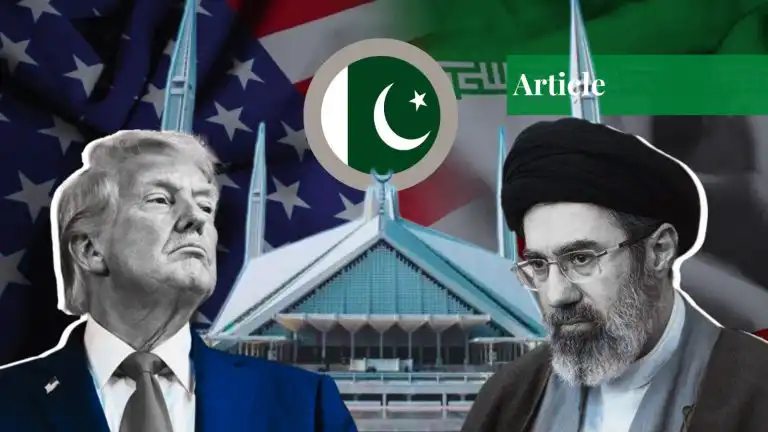
In early March, Iran blocked the Strait of Hormuz, the world’s busiest oil shipping lane, resulting in an economic backlash worldwide. In this regional escalation, Pakistan found itself in a very strategic position, having ties with both Washington and Tehran. Pakistan announced on 24th March 2026 that it would host peace talks and serve as a mediator in the US-Iran conflict. Both countries promoted the peace talks but also issued harsh statements, warning each other. US President Donald Trump said that “negotiations are in progress, but if a ceasefire is not reached, then American forces could ‘obliterate’ Iran’s energy infrastructures, including oil wells and Kharg Island.” Iran also responded sharply that “any US ground interventions would face severe retaliation.”
President Trump is drawing on a twin-track war approach: a rapid exit from a conflict, which is damaging its own party’s prospects through negotiations, and mulling an escalation by threatening Iran through deploying its boots on the ground and damaging Iran’s civilian and military infrastructure. Negotiations are on their way, but Iran has denied accepting any peace plan, as Iran’s foreign minister, Abbas Araghchi, said that “there is a need to be a permanent end to the war.” According to him, the US tries to negotiate every time, but during the negotiations, it again escalates the conflict, leaving the negotiation in the middle.
In Gaza, President Trump proposed a 20-point peace plan that subordinated Gaza to the United States. He proposed a similar plan for Iran. In the 15-point peace plan, there are some points that can violate Iran’s sovereignty. The 15-point peace plan says Iran will dismantle its nuclear program and restrictions on ballistic missile production. These points have raised security concerns for Iran, as Israel can attack Iran at any time, and if Iran doesn’t have missiles or any defensive measures, then Iran will probably become a graveyard like Gaza has become.
In this tripartite conflict, Pakistan is emerging as a peace-promoting state. On 29th-30th March, 2026, Pakistan hosted peace talks with Egypt, Türkiye, and Saudi Arabia. These states are very important to negotiate with in this regional escalation. Egypt has the Suez Canal, Türkiye is part of NATO, and Saudi Arabia has US bases, along with a defense agreement signed with the only Muslim nuclear state, Pakistan. This conflict has showcased the emergence of middle powers in the Indo-Pacific.
Pakistan’s Historical Role as Mediator
Historically, Pakistan served as a mediator during the Cold War, which forced US President Richard Nixon to visit China in 1972. It was secret diplomacy as Pakistan maintained strict secrecy in transferring messages from the US to China and vice versa. This mediation highlighted Pakistan’s role as a neutral bridge between the US and China. Similar to this situation today, the US and Iran are standing on the edge of nuclear conflict, and Pakistan is playing its role as a back-channel mediator.
At a recent Capitol Hill Symposium, experts noted that Pakistan’s mediation provides peace for the short term, but it does not guarantee long-term settlements. For example, during the 1971 India-Pakistan tensions, Pakistan relied on shuttle diplomacy with the United States to promote peace in the region. But its long-term consequences were worse, like the secession of Bangladesh.
Pakistan also played the role of mediator during the Soviet-Afghan War, which resulted in the withdrawal of the Soviets from Afghanistan in 1989, but it didn’t bring lasting peace to Afghanistan. The 1972 US-China cooperation is a rare example of Pakistan’s backchannel diplomacy, where lasting peace was achieved. Due to those cooperations, today, the US and China do not engage in direct warfare; they engage in indirect war. These patterns show how Pakistan always opens its doors for peace promotion and to glorify itself worldwide, but lasting peace remains uncertain. Pakistan serves as a communication bridge but not as an enforcer of settlements.
Pakistan’s Role in De-escalating the US-Iran Conflict
On 29th-30th March 2026, Pakistan hosted peace talks among the three most important countries of the region: Saudi Arabia, Türkiye, and Egypt. This meeting marked a shift from Western to regional mediations. These peace talks were conducted to de-escalate the US-Iran conflict. Four of the most important countries gathering together have revived debates around the “Muslim NATO” concept. Egypt has the strongest military among African states; Türkiye is part of NATO; Saudi Arabia is a big economy; and Pakistan has nuclear missiles. Collectively, these states can serve as the “Islamic QUAD,” which can dominate the world’s islands. According to Reuters, these efforts are not merely symbolic; all four states are exchanging messages and aligning strategies to settle the Middle Eastern crisis.
The talks have not provided any fruitful results yet. Pakistan’s foreign minister, Ishaq Dar, has said that the US and Iran are communicating through messages via Pakistan. In this scenario, for Pakistan, the Munir-Trump relationship will be beneficial for bringing a permanent peace in the Middle East. Any mediation or talks will not succeed until both parties agree on a consensus. But the conditions for a ceasefire proposed by the United States are incredibly harsh for Iran’s security and sovereignty.
To be victorious, Iran has played its first card by blocking the Strait of Hormuz. Recently, President Trump has said, “The countries that can’t get jet fuel because of the Strait of Hormuz, I have a suggestion for you: number 1, buy from the US; and number 2, build up some courage, go to the Strait, and just TAKE IT.”
President Trump paused for 10 days till 6th April, 2026, symbolizing that the United States is cooperating with Pakistan in peace talks, but in reality, he was waiting for his paratroopers to arrive in the Middle East. It is visible from the US attack on Isfahan with 2,000-pound bunker buster bombs. Till now, 3,500 US paratroopers have arrived in the Middle East. This conflict is escalating day by day, resulting in many casualties. For peace in the region, both states could agree on a “mini deal” in which there is permission for Iran to carry on its nuclear program with limited inspections and, on humanitarian grounds, exchange prisoners. This deal will stabilize tensions without resolving their strategic rivalry. This deal represents crisis management rather than reconciliation.
Pakistan’s Strategic Self-promotion as a Peaceful State
Pakistan’s strategic step as a mediator in the US-Iran conflict functions not only as mere mediation but also has built Pakistan’s image as a peace-promoting state worldwide. Recently, the Global Terrorism Index declared Pakistan number 1 among the most affected countries from terrorism. It happened due to recent attacks conducted by the Islamic State of Khorasan Province (ISKP) and the ongoing cross-border conflict between Pakistan and Afghanistan. In this critical situation, Pakistan took advantage of the opportunity and positioned itself as a mediator in the US-Iran conflict.
The foreign ministers of Egypt, Türkiye, and Saudi Arabia arrived in Pakistan to attend high-level negotiations. It is an honor for Pakistan to conduct such a meeting, wherein, in the past, the United States mediated between Pakistan-India and Pakistan-Afghanistan conflicts. Now, Pakistan is mediating to resolve the conflict with the great power, the United States.
For further efforts, Pakistan’s foreign minister, Ishaq Dar, visited China on 31st March, 2026, to review the situation of the Gulf and the Middle East. A joint five-point initiative has been proposed by both states, which says that negotiations and respect for international law are the only solutions for a permanent peace in the region. But we can see the pattern of crisis, negotiations, temporary peace, and again conflict, so negotiations are proven vague in the Middle Eastern crisis.
Future Trajectories
Negotiations are just a delay in conflicts in international affairs. Not a single conflict has been resolved through negotiations, be it Pakistan-Afghanistan, Pakistan-India, the Iraq War, or the Israel-Palestine conflict. The Iran conflict will stop after the US achieves its ultimate goal of occupying the oil, which it did in the Iraq War. Similarly, as in Iraq, there are still conflicts; it is free from war, but there is instability in Iraq. Iran will suffer from minor conflicts and destabilization.
The US-Iran peace talks in Pakistan can provide short-term peace, but they will not achieve any long-term objectives for peace and prosperity. If this happens, then oil markets will remain volatile as Iran has blocked the Strait of Hormuz. Iran has said that “the Strait of Hormuz is open for all except for the vessels linked to Iran’s enemies.” This blockade can cause a loss of $2.2 trillion of global GDP in 3-6 months. If, in any case, the United States occupies the oil resources of Iran, then it will take a heavy toll on Iran; history will repeat itself as a farce.
In history, one can see that after World War I, the Allied powers (Great Britain, the US, and France) imposed a reparations fee of $33 billion, which Germany paid over 90 years; the final payment was made on 3rd October 2010. It caused hyperinflation in Germany in 1923 and devastated its economy. If the United States wins this conflict, then Iran may also suffer from these conflicts.
Conclusion
Pakistan’s engagement in US-Iran peace talks positioned Islamabad as a laboratory of multipolar diplomacy. By bringing together countries like Saudi Arabia, Türkiye, and Egypt, Pakistan shows how Muslim countries with some influence are trying to work diplomatically. They are dealing with the geopolitical shifts and trying to bring peace to their region. A lesser-known fact about this conflict is that many terrorist organizations from the Middle East have been activated to conduct attacks in different areas, even in the West.
This will further destabilize the situation, as a terror attack on one state or its allies will be blamed on the other state, and the blame game will start. This factor will further escalate the situation. Taking note, primarily the conflict was between Iran and Israel, but strategically, the US interfered in the conflict to gain the opportunity of occupying Iran’s oil. Recently, the US Secretary of War Pete Hegseth has said that “the next few days in Iran will be decisive.” We can anticipate that something big is coming from the United States.
If you want to submit your articles and/or research papers, please visit the Submissions page.
To stay updated with the latest jobs, CSS news, internships, scholarships, and current affairs articles, join our Community Forum!
The views and opinions expressed in this article/paper are the author’s own and do not necessarily reflect the editorial position of Paradigm Shift.

Syeda Farani Fatima is an undergraduate student of International Relations at the International Islamic University of Islamabad, with a strong interest in anti-corruption, counter-terrorism and geopolitics. Strongly committed to fighting corruption, terrorism, and supporting national reform through research and public service.