
There is a beautiful saying the esteemed author, Helen Keller, that “The highest outcome of education is tolerance.” This quote reflects the significance of education in shaping human behaviour for the collective goodness of society. Education plays a pivotal role in enlightening an individual’s intellectual consciousness. It assists in empowering disadvantaged societies to highlight their socio-economic grievances.
Article 25 (a) of the 1973 Constitution of Pakistan enshrines equality and justice in acquiring basic education. However, the education system of Pakistan paints a bleak picture, reflecting an outdated system with many dilemmas. The deep-seated problems can be alleviated by inculcating modern technology and innovation in the education landscape.
The AI revolution has been proliferating in the entire domain of modern education, making it more efficient, effective, and innovative. The introduction of AI in Pakistan’s education system holds great potential for transforming it as per the demands of the contemporary world. The transformation of Pakistan’s fragile economy into a knowledge-oriented economy requires a concerted struggle. Though our policymakers have acknowledged multiple strides to inculcate an AI-powered education system, there are several barriers on the road to adopting AI-based learning techniques all at once.
 You will find more infographics at Statista
Anatomizing the Deep-Rooted Structural Problems in the Education System of Pakistan
The education system of Pakistan has remained a stepchild since its inception. The myopic view of the narrow political elites has never welcomed a reliable and efficient education system in the country. Political polarization, increased waves of extremism, and a lack of political will have restricted the flower of education from blooming on the soil of Pakistan. Such issues have prevented the power holders from focusing on the enduring dilemmas in the education sector. The education system of the country is suffering from significant challenges, which are listed as follows;
- Budget Constraint as the Prime Cause of Educational Backwardness in Pakistan
The mere budget allocation of 1.77% of GDP for the fiscal year 2024-2025 seems insufficient to overcome the persistent challenges in the way of the education system. The limited budget distribution can not cater to the need for quality and innovative education.
Effective and robust policies are needed to expand investment in the education sector to improve the quality of education for the enrolled students and to embrace the enrollment of 26.2 million out-of-school children.
- Ineffective Policy Implementation and the Absence of Political Commitment
Policy formulation regarding education subjects has been visible over the years. However, policy implementation has been flawed throughout owing to multiple factors. Political polarization, bureaucratic bottlenecks, and the absence of political will have prevented policy enforcement.
- Educational Stratification in Pakistan
Educational stratification has been a constant dilemma in the education system of Pakistan since its independence in 1947. An Al Jazeera report aptly stated that “ In Pakistan, private school education is for the upper elites, public school education is for the middle class, and madrassa education system is for the lower class”.
This educational layering has failed to create an innovative learning ecosystem in the country. Such categorization prevents the education system from growing as per international standards, making the country vulnerable in its socio-economic outlook.
- Patriarchal Norms and Socio-cultural Stereotypes in Disadvantaged Societies
The marginalized communities have restricted educational growth due to the absence of modern infrastructure, qualified faculty, and basic provisions. Gender discrimination in disadvantaged communities has restricted girls to the four walls of the house.
For instance, in some areas of Balochistan and KPK, gender stratification is prevalent. These communities prevent girls from acquiring basic education due to societal taboos, limited resources, and safety issues. As per the World Bank report, girls contribute to a greater ratio of out-of-school children in Pakistan.
- Poor Infrastructure and Outdated Pedagogy
Infrastructural innovation in the education system has become a distant dream for Pakistan. The public sector educational institutions reflect a darker picture in this regard. Public schools, especially in rural areas, lack suitable classrooms, laboratories, basic sanitation, washrooms, and libraries. The absence of these basic facilities restricts students from acquiring quality education in a conducive environment.
Moreover, the outdated courses based on rote learning fail to embrace creative learning and problem-solving expertise. The outmoded course content lacks contemporary relevance to compete with the changing dynamics of modern education.
Significance of AI for the Education System of Pakistan
Artificial intelligence is considered a revolutionary force to transform the education system of Pakistan. These opportunities offer numerous ways to overcome the prevalent problems plaguing the education system. Integration of AI in the educational domain extends an effective and efficient learning environment.
- Students’ Performance Evaluation through AI-driven Platforms
AI algorithms are effective and reliable in addressing performance and learning techniques. Individualized learning ensures an inclusive academic landscape where every student learns according to their understanding, bridging learning gaps across the rural and urban education divide. For instance, great superpowers like the United States, China, Russia, and Canada have been investing in AI to lead the world. These countries have transformed their education systems through generative AI.
The Chinese Government has recently made AI education compulsory from the sixth standard for every student to acknowledge critical thinking and an innovative mindset. As per The Guardian report, out of ten AI universities, six are in China, while the rest are in the US. It reflects the significance of AI in modern academics. AI gets more relevant in the context of Pakistan due to the multitude of structural problems in its education system. It offers great avenues to embrace quality reforms to raise a better generation with intellectual consciousness.
- Competitive Virtual Tutoring Approach of AI Over Traditional Human Tutors
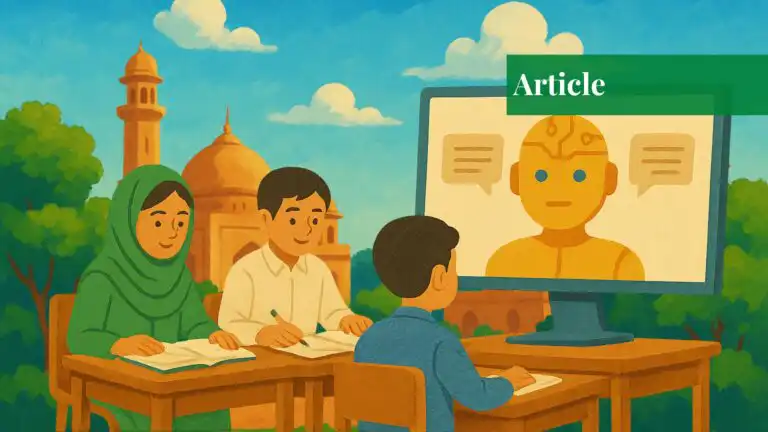
AI-powered virtual teachers ensure reliable assistance while addressing students’ queries instantly. E-tutors are significant for a country like Pakistan, where there is a lack of qualified faculty and trained teachers.
In this cost-effective and student-friendly learning approach, virtual tutors are a great replacement for human mentors in assisting students across the world, regardless of any discriminatory behavior. Virtual interactions are more productive for every student because they are tailored to the needs and comfort of every individual student. The need of the hour for a developing country like Pakistan is to garner benefits from the AI revolution to transform its traditional education system into a modern and innovative educational landscape.
- Narrowing Urban and Rural Digital Differences
Digitalization has this all-encompassing quality to engage millions of people through digital platforms. AI-driven online learning bridges the gap between cities and the countryside. The virtual platforms are cost-effective and accessible to every learner in marginalized communities with restricted resources. This ensures quality and equitable education across the country. The AI-oriented online applications are beneficial to engage diversity in the learning landscape, promoting inclusivity.
The AI innovative tools, such as writing, reading, speech-to-text, and text-to-speech functions, act as blessings for disabled students. Translation and writing features in AI chatbots overcome linguistic obstacles. In this way, AI can be a transformative agent in the academic outlook of Pakistan.
- Curriculum Advancement through AI to Adopt an Effective Learning Approach
AI tools offer immense opportunities for academia to overcome its reliance on traditional rote learning methods. Such virtual applications provide modern educational courses for students to upgrade their existing knowledge and skills to compete with the contemporary knowledge requirements. Integration of AI in the academic domain of Pakistan holds the opportunity to transform its debt-based economy to a knowledge-driven economy.
- Effective Evaluation and Feedback Systems
Another significant feature of AI is the swift and timely feedback and evaluation mechanisms. The AI algorithms offer unbiased and error-free evaluations, providing large-scale accuracy and reliability. Students can review their write-ups through AI tools and can make corrections instantly. There is access to attempt quizzes, practice exercises, and master all sorts of learning beyond space and time. AI-driven tools give comprehensive explanations, proposing aspects of improvement. Such tools remain relevant to address the queries of every single student.
Obstacles on the Road to Welcoming AI into the Educational Landscape of Pakistan
The introduction and proliferation of Artificial Intelligence requires knowledge and equality of opportunity to get the maximum benefit out of it. However, there are immense barriers to embracing AI entirely.
- Poor Technological Literacy/Skills
Unfortunately, the majority of students and professionals lack basic digital knowledge and advanced skills to correctly utilize AI in academia. The absence of the will to embrace modern and innovative learning is not entertained in the outdated pedagogy. To inculcate the benefits of AI in the education system for the enhancement of innovative skills, professionals and teachers should be equipped with regress training to reap the opportunities through evolving AI platforms while AI-driven courses should be made part of the academic syllabus to diversify their skill sets to compete for the world in the present age of technology.
- Uneven Technology Access
Research shows that only 25% population of Pakistan has access to internet connectivity. Moreover, as per the Pakistan Bureau of Statistics, Pakistan has a mere literacy rate of 62.8% by 2025, where the literacy rate of males is 72.5% and that of females is 51.1%. It shows that the female literacy rate falls to 35% from 65% in urban areas. Furthermore, in Pakistan, around 21% of females have internet access in contrast to 42%. The given statistics reveal a darker picture of internet access, manifesting gender-based discrimination in the digital landscape.
- Inadequate Digital Infrastructure and Preparedness
In Pakistan, the infrastructural dilemma is prevalent when it comes to adopting AI tools in schools and other academic institutions. The majority of schools in rural areas have no access to internet connectivity due to restricted resources. Even in schools having digital access, the available digital infrastructure is outmoded and inefficient for the required needs of AI execution.
- Deficit in AI Expertise and Workforce Development
Pakistan encounters a lack of skilled specialists for AI establishment, execution, and upkeep. Immense investment and budget allocation are prerequisites to training teachers and embracing AI initiatives at the local level. Basic AI knowledge is absent. The need of the hour is to foster an environment of research and modern innovation in the educational landscape. The government and other relevant institutions must ensure awareness programs among the masses to proliferate AI education. Basic AI education is necessary to adopt emerging AI tools.
What has Pakistan Done to Embrace AI in its Education System?
- Presidential Initiative for AI and Computing (PIAIC), 2018
- Sino-Pak Centres for AI (SPCAI), 2024
- Approval for the First AI University in Punjab, Lahore, 2025
- Nawaz Sharif Internet City
- PHEC Initiative: Three-Day Faculty Development Program to Embrace Generative AI in the Higher Education System
- Scholarships and support initiatives to pursue AI studies
- Artificial Intelligence Education Foundation (AIEF), 2025
- Generative AI Training for Educators (AIdotEdu) via STEM education
- National AI Policy Implementation
- Installation of E-Rozgar centers, Technological Parks, SMART Classrooms, STEAM Labs, ICT Schools and Colleges, and E-Taleem Portal
In a nutshell, AI holds a huge potential to transform the outlook of the outdated education system of Pakistan. It offers the opportunity to diversify the learning environment through innovative and effective practices. The AI tools promote critical thinking, competitive learning, and inclusive innovation. Such virtual applications acknowledge digitalization, welcoming equality and accessibility.
If you want to submit your articles and/or research papers, please visit the Submissions page.
To stay updated with the latest jobs, CSS news, internships, scholarships, and current affairs articles, join our Community Forum!
The views and opinions expressed in this article/paper are the author’s own and do not necessarily reflect the editorial position of Paradigm Shift.

The author is a microbiologist and an avid writer, offering insight into national and global affairs.