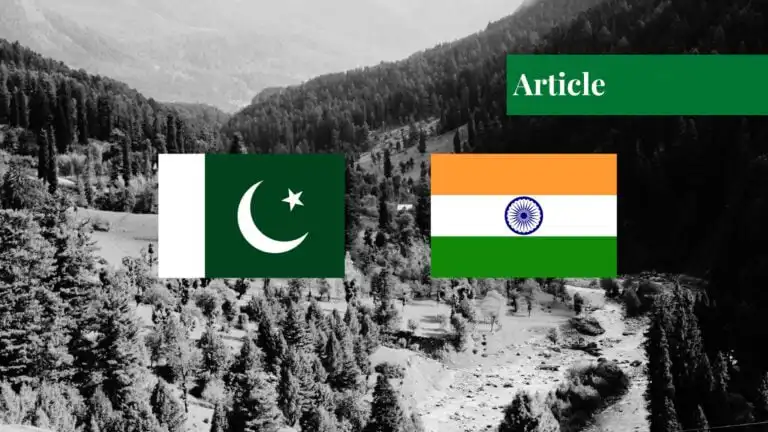
The frenzy of the attack in Pahalgam, Kashmir, has yet again brought Pakistan into the international limelight. Such might be the repercussions, which were always in the realm of objective conjecturing, and therefore, it is turning out to be more of Pakistan’s complicit indifference and India’s 9/11 yet again. The game of brinkmanship is on again, and this time around, it has more serious underpinnings, with Indian lawmakers blowing hot on Islamabad’s apparent plot and culpability.
Unlike Mumbai 2011, where the US citizens were the victims of a terrorist attack and where its policy was more evenhanded, this time around, we witness a strong condemnation by President Trump, labelling the attack as deeply disturbing and affirming that the “US stands strong with India against terrorism.” In our bid, therefore, not to create war hype, we need to construct a more objective and pragmatic stand rather than the usual rhetoric, which at least appears to have been the case.
Strategic Appraisal
Certain conclusions could be discerned from the prevailing external and internal environment in the contextual framework of socio-political and security dimensions. These are:
External Environment
- The United States, the United Kingdom, and the European Union have all condemned the terrorist attack and have refrained from any Pakistani complicity, but are demanding accountability and transparency.
- The French, Germans, and Russians’ response to the terrorist attack had been remorseful, regrettable, and reprehensible yet circumspect, suggesting India and Pakistan pursue a more cautious and deliberate approach based on restraint and cooperation.
- China’s condemnation of the incident reflects its understanding of Pakistan’s security concerns. The reaffirmation of their “iron-clad friendship” may be heartwarming for Pakistan. However, at the same time, China is calling for an impartial investigation into the incident and urging both Pakistan and India to exercise restraint and resolve their differences to maintain regional peace.
- The reaction from the Muslim bloc underscored a collective denunciation of terrorism and a commitment to peace and solidarity with the victims of the Pahalgam attack in Kashmir. However, it stopped short of any proverbial support and solidarity for Pakistan’s position, given their social and economic interests with India. Therefore, this may straitjacket their diplomatic influence.
Out of the ashes of Pahalgam, India again emerges as the darling of the international community, garnering international sympathy and solidarity.
Pahalgam again reminds the world of the need to incarcerate terrorism, a threat to regional and international peace and security.
Pakistan will find it hard to salvage its international image and earn understanding and respect, given its internal disquiet, weak political dispensation, and a chequered history of abetment of terrorism.
Regional Environment
The Indian hegemonic mindset characterizes the regional environment:
- Taking a leaf out of “Kautiliya Artthashastra,” which dictates the pursuit of a “sixfold inter-state policy,” illustrating that when a neighboring Prince (state) is in difficulty, he should be attacked, when he is without support or has weak support, he should be exterminated. Pakistan, being judged as either in difficulty or without support, is hence worthy of being attacked if not exterminated.
- India’s attempt to show Pakistan as a state sponsor of terrorism and part of the problem is in full swing to forestall the international community’s intention of having a sympathetic view of Pakistan’s position, if any.
Internal Environment
- Against India’s intractable attitude and overly bellicose statements, which are loaded with an exhaustive noncompliant accusatory wish list and demand for retributive actions, our dispensation has been seen as rather pliant, reactive and reflective of culpability.
- Pahalgam may be used as an opportunity to gel the fractured nation; however, given the government’s recalcitrance and political compulsions, it could not induce the traditional unity, nationalist fervor, and much-needed across-the-board political congregation in the face of burgeoning security crises.
- However, there has been some regression due to increasing conflict and a gap between the state and society due to the establishment’s increasingly lopsided political patronisation.
- While we witnessed deafening silence from the ruling party’s leadership sic PML(N), the incumbent government’s proverbial lip service did little to induce the requisite conviction and resolution to drum up the desired public support and solidarity.
- Pakistan is, hence, in a paradoxical situation wherein we ought to exhibit determined resolve in the face of India’s potential threat and also make the international community believe it not only has cut the umbilical ties with the terrorists but is relentlessly persecuting them at a great personal and financial cost almost single-handedly like no other nation in the world.
- More importantly, we ought to use this event as a godsend to effect the much-needed correction course by forging the obligatory political consensus without exception.
Emerging Trends
Some of the strands of the emerging trends are:
- Construct an environment of the so-called “constructive chaos” in the region, framing Pakistan as a state abetting terror and showcasing a more irrational, reactive, and diplomatically constrained Pakistan.
- Project Pakistan as a weak state beset with internal political squabbles, besieged by an autocratic mindset, overshadowed by military/ISI.
- Discredit Pakistan as an irresponsible nuclear state, necessitating intrusive international safeguards and oversight.
- “Balkanisation of Pakistan” on ethnic lines, with a client status to the regional hegemon India, so as not to pose any threat to international peace and security. The diminutive and emasculated Pakistan is expected to be a good, responsible international citizen.
- To bear incremental pressure on Pakistan to comply with international diktats, with recognition of Israel being the touchstone.
- Indian efforts to implicate Pakistan through a dossier or a white paper as an alibi are well-plotted and framed as “Complete, Verifiable, Irrefutable and Actionable (CVIA)” to elicit international pressure and authorization of military action.
The situation presents challenges and opportunities that the government must contend with and seize. The biggest challenge is maintaining peaceful, tranquil regional and internal order and stability.
The following are some of the possible strands:
- Remaining relevant to the international community and rehabilitating the international image.
- Exhibiting non-involvement in the Pahalgam incident as a dastardly terrorist attack without caveats.
- Show determined resolve to face aggression/adventurism while not creating war hype.
- Curtailing the propensity of the “Blame Game” and striving for a status quo ante bellum.
- Tackling the growing menace of indigenous extremism/terrorism.
Some of the opportunities coming our way that need to be capitalized on are:
- Transforming our relentless efforts in GWOT into an enviable example as part of a responsible member of the international community adherent to international norms/regulations.
- Internationalization of the intractable Kashmir dispute since the Pahalgam carnage, being a corollary and allegedly attributed to a little-known militant group, “The Resistant Front,” which Delhi claims is an affiliate of Lashkar-e-Taiba (LeT) – a Kashmir-based freedom organization.
- Leverage our strategic indispensability in the fight against terrorism for:
- Resolution of the Kashmir dispute
- Solution of water conflicts
- Economic/financial assistance
- Seeking acknowledgement and support from the international community in purging the society from the menace of extremism and talabanization.
- Forging national solidarity and eliciting consensus to ward off the impending security crises.
Threat Perception
Be that as it may, Indian war rhetoric and sabre rattling, more because of domestic reasons and objectives, are putting pressure on the weak democratic dispensation in Islamabad.
Indians’ initial overreaction and their readiness to undertake retributive actions are reflective of their bellicosity and testing of Pakistan’s resolve/preparedness. Additionally, Indian internal political factors need to be weighed in, as well as the Indian intelligentsia, think tanks, and veterans, who have raised their hands for a calibrated military action.
The salient of PM Narendra Modi’s strategy that appears to be unfolding along three prongs can be rounded up as strategic messaging, measured retaliation, and international alignment, wherein it pursues:
- Isolate Pakistan globally while consolidating India’s status as a responsible and assertive power.
- Precedence of controlling the narrative over a resort to the kinetic option, and hence the insistence on galvanizing international support and legitimacy for a retributive measured military action.
- Avoiding escalation traps by keeping global stakeholders informed to avoid triggering a full-scale war.
Conclusively, therefore, Indians will try and accrue maximum advantages from Pahalgam carnage, with the minimal objective of incriminating Pakistan to extract maximum concessions and, at max, possibly (though remotely) resort to selective use of force.
Threat Scenarios
Some of the possible scenarios that could actualize under certain applicability environments are:
Scenario I – Diplomatic Isolation
- Applicability Environment: Upscale the incessant diplomatic initiative framing Pakistan as an unwilling and recalcitrant state supporting and abetting terrorists.
- Manifestation: Using coercive diplomacy and media maneuvers induces substantial international pressure to force Pakistan to yield to demands of ceasing cross-border terrorism and dismantling terrorist infrastructure from its territory.
Scenario II – A Precision Retaliation
- Applicability Environment: Given the Indian policy of zero tolerance towards terrorism, legitimacy for applicability already exists, but only after the global narrative aligns with the Indian position and if Pakistan’s retributive action does not appear substantive enough.
- Manifestation: Carry out limited kinetic strike (surgical/aerial) and hot pursuit (sting) operations, especially along LOC, premised on Cold Start imperatives of mobilizing and hitting.
Scenario III – Internal Pressure on Civil-Military Cohesion
- Applicability Environment: Pakistan’s political government, largely seen as malleable and subservient to the military, is largely marginalized in controlling the terrorism menace.
- Manifestation: Suspecting Pakistan’s military/ISI for either abetting terror outfits or its incapability to deal with militant organizations, garner international support to discredit the “miltablishment,” invoke political and economic sanctions, and lobbying for Pakistan’s relisting in the FATF grey list.
Scenario IV – Neutralization of Nuclear Deterrent
- Applicability Environment: With a nuclear deterrent viewed as enabling proxy terror under the cover of a nuclear shield, Pakistan may be castigated as a rouge and an irresponsible state unworthy of handling nuclear assets.
- Manifestation: Pakistan may be under greater global scrutiny and possibly neutralize its strategic capability peacefully through international intrusive mechanisms (UN/IAEA inspectors).
- Rider Clause: Seeking UN, US, and international support.
Response
Strategy: The strategy ought to be like “a step back….side step…..and step forward combination,” i.e., while appearing overly pacifist (consciously not creating war hype), resolutely and zealously guard national sovereignty/integrity, and present Indians with the Hobson’s choice of sharing credible information for extending possible support/cooperation for a meaningful détente and a precursor for a rapprochement through mediation by the US/international community.
Options available are:
- Option 1: A policy of proactive engagement with the international community that of reconciliation with India, condemning the terror incident unequivocally to avert international isolation and prevent escalation ladder while ushering in internal harmony, order, and solidarity.
- Option 2: A policy of cooperation with the international community, constructive engagement with India, and achieving national reconciliation to create an environment conducive to resolving the impasse.
- Option 3: Rely on intrinsic strength, refrain from seeking international reliance, and assert an aggressive policy for resolving the present hiatus in the relationship with India. Strive rather for socio-political reconciliation, capitalizing on the latent national moral strength and industrious potential to rally out of the crisis.
Adopted Option:
Option 1, owing to the following accrued dividends:
- A more balanced and comprehensive approach.
- There are bright prospects of realization, as the Indian’s present state of hysteria, haughtiness, and intransigence precludes a possibility of rather constructive dialectic.
- Induces more international involvement.
Conclusion
Pakistan also faces the Hobson’s choice that complicit indifference is not without consequences. It corrodes international trust, isolates Pakistan diplomatically, and fuels instability in the region. More dangerously, it diminishes the threshold for escalation. When terror is met with deflection instead of contrition, retaliation becomes not just a risk but an inevitability.
If you want to submit your articles and/or research papers, please visit the Submissions page.
To stay updated with the latest jobs, CSS news, internships, scholarships, and current affairs articles, join our Community Forum!
The views and opinions expressed in this article/paper are the author’s own and do not necessarily reflect the editorial position of Paradigm Shift.

Brigadier Syed Mushtaq Ahmed (Retd) has extensive experience in areas of national security, intelligence and strategic issues. He has worked as a senior research analyst in a strategic organisation and has a niche for writing research articles and analytical assessments, specializing in counterintelligence, counter-terrorism and nuclear security.