The Final Bailout
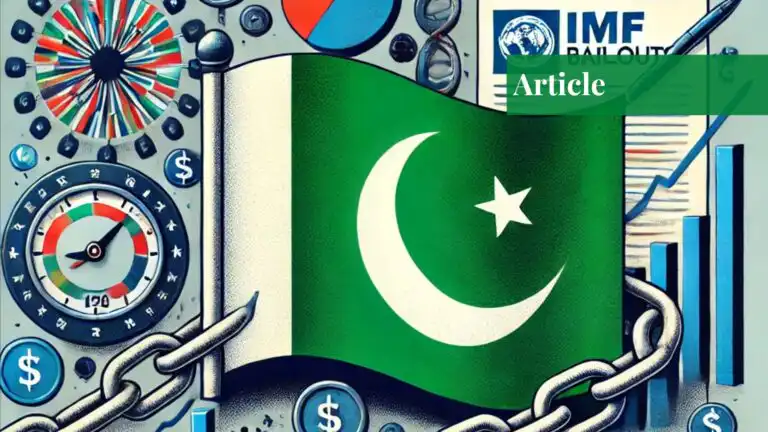
Once entangled in the grip of an immense capitalist system, it is realistic to assume that escape will not be easy. As national reserves dwindle while countries struggle to manage overwhelming debt, often resorting to repeated bailouts, the news of Pakistan’s most recent IMF bailout of 7 billion dollars has likely raised serious concerns among fiscally prudent citizens. While it may seem naïve, some argue that this could be Pakistan’s final bailout unless substantial reforms are undertaken.
The crux of structural economic change remains congruent for most developing economies. Privatization of corrupt and inefficient state-owned enterprises, increasing taxation and curbing the informal sector, reigning in government spending, etc.—all are logical macroeconomic steps that lead the way to economic efficiency, productivity, and liberalization. But many utopian dreams have been sold on theory alone; reality often distorts the outcomes. A recent example of bureaucratic inefficiency is the broadening of the tax base, which may boost government revenues but at the expense of burdening Pakistani businesses with excessive costs, high electricity tariffs, and uneven fiscal pressure on the middle class. So, the solution lies not in policies but in enhancing the apparatus that facilitates their deployment.
Pakistani governance often finds solace in exorbitant populist schemes. Long-term economic growth is waived for myopic political gains. Building on this, structural change must factor in public discontent with these radical shifts in economic policies. Under the premiership of Nawaz Sharif, the public applauded the notion of one hundred rupees being equal to one dollar, yet it wasn’t through robust economic growth and was instead due to the governance artificially pegging the rupee at that valuation. Short-term economic and political gain at the cost of nearly depleting every ounce of the foreign reserve. This tendency must be hampered at any cost; the governance can’t afford transfer payments and must focus on investments that provide tangible returns.
Consider India as a regional rival and the world’s fifth-largest economy. India’s significant borrowing from institutions like the World Bank, stemming from the 1991 economic crisis marked by a massive deficit and dwindling foreign reserves, was followed by a period of economic liberalization, deregulation, and heavy investment in infrastructure and the IT sector. These reforms enabled India to stabilize its economy and reduce its dependency on external creditors. Pakistan has a similar young and active demographic that will be a perfect market for any international conglomerate. But two things stand in their way: political stability and ease of doing business.
Political Stability as a Foundation for Investment
Residents of Islamabad will testify to the political volatility of the nation. The endless roadblocks and the violent political uproar ensure foreign direct investment remains wary. Blockades are a particularly pernicious tactic that incurs exponential foreign business costs in logistics. Additionally, political stability pillars the idea of predictability for the business owner; if the government policy regarding corporate tax remains consistent, the fiscal year can be planned accordingly.
Notoriously, no prime minister has ever finished their term in Pakistan; this rampant and unpredictable upheaval makes business planning difficult and impractical. Furthermore, the Pakistani government platforms political vengeance that often meddles the economy with active sabotage in order to muddle the approval of the following government. Reminisce on the artificial pegging of the rupee; when it finally unraveled in Imran Khan’s regime, he was blamed for the harsh inflationary pressure instead of his predecessor.
The Ease of Doing Business
Moving from politics we go to the ease of doing business. According to the recent World Bank’s Business Ready Report 2024, Pakistan scores highest in business entry, financial services, and utility services. Domestic and foreign firms do not encounter many business entry restrictions; the economy implemented good practices in terms of the types of movable assets, debts, and obligations that can be secured and the provision of regulations for monitoring tariffs and service quality for the internet.
Unfortunately, Pakistan also scored the lowest in dispute resolution, international trade, and market competition. The economy underperforms in the transparency of courts, lags in the implementation of trusted trader programs, and lacks digitalization of intellectual property services. Other general grievances with the business environment include bribes required to stay in business, cumbersome red tape, endless licensees, and novel operational taxes.
Leveraging Pakistan’s Comparative Advantage
Economics teaches comparative advantage, a concept that every nation should specialize in what they can make better compared to every other nation. Besides the football industry in Sialkot, Pakistani exports aren’t a valuable commodity for the international market. The developed world is entrenched in the service sector or advanced manufacturing, the middle-income countries in low-skill manufacturing, and the low-income countries in agriculture.
Pakistan has no inedible mark in any of these sectors. Feudal lords and a dearth of investment in the agriculture sector have led to immense inefficiencies with a significant technological lag. Textile, a major manufactured good, can’t compete with India or Bangladesh in its production volume or quality. The service industry is practically 60% of the GDP share but suffers from a lack of government investment, and industries such as tourism suffer from Pakistan’s negative international image alongside general security issues.
Conclusion
Release from the beast of indebtedness requires a route, illustrated by realistic and achievable goals. Simply, making it business-friendly through generous concessions to international companies will propel foreign investment. Pakistan has a large, young, and growing middle class, the perfect market that every conglomerate would be happy to serve. Incubation centers and similar concessions to domestic businesses would invigorate the entrepreneurial spirit in Pakistan, like how Indian unicorns repackage Western business ideas, Pakistani entrepreneurs with government backing could do the same.
A dedicated and logical investment plan should be outlined, specifying which sectors to exploit and improve—whether doubling down on CPEC-related developments, extracting newly discovered oil and gas reserves, developing the IT sector, or enhancing security for the tourism industry, among others. The possibilities are endless, but they require adherence to structural reforms alongside a religious observance of long-term economic growth that transcends political cycles and petty rivalries.
If you want to submit your articles and/or research papers, please check the Submissions page.
The views and opinions expressed in this article/paper are the author’s own and do not necessarily reflect the editorial position of Paradigm Shift.

The author is studying Economics at the National University of Science and Technology (NUST) with a keen interest in financial affairs, international relations, and geo-politics.