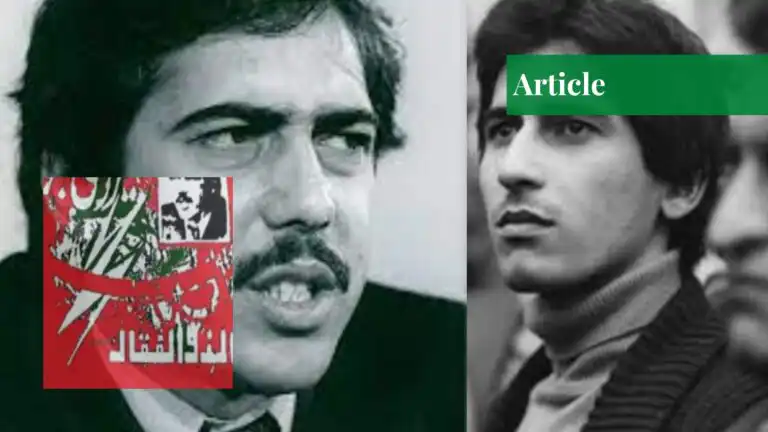

An uncertain future has always marked Pakistan’s political setup. A complex interplay of socio-political factors and regional influences (the looming Cold War and the Soviet invasion of Afghanistan in 1979) created a suitable climate of desperation for militant factions. In this regard, Al-Zulfikar, a left-wing terrorist organization, was launched by the political heirs of the PPP dynasty, i.e., Murtaza Bhutto and Shahnawaz Bhutto. The group immediately labeled themselves as socialist revolutionaries leading an armed struggle against the injustices brought against their beloved leader, Zulfiqar Ali Bhutto.
The group survived paltry attacks, but the highlight came as an infamous hijacking, which turned the tables for them. This can be explained by the statement below;
“Al-Zulfikar, by the way, was the title of a pamphlet written in August 1980, before my arrest, by Shaukat Ali. This pamphlet was an attack on General Zia and was to be distributed in Pakistan. In other words, Al-Zulfikar had no existence before the hijack: it was named on the spot by Murtaza from a pamphlet. Thus, it was not Al-Zulfikar who hijacked the aircraft but the hijack that created Al-Zulfikar. The baby had preceded the mother.” – Raja Anwar’s account in ‘The Terrorist Prince”
Henceforth, this article explains the formation of Al-Zulfikar through the dramatic episode of the 1981 hijacking.
The Socio-Political Environment
The period preceding Al-Zulfikar’s formation was marked by significant upheaval and turmoil. As a martial law administrator, General Zia-ul-Haq played a noteworthy role as he successfully deposed Zulfiqar Ali Bhutto’s democratically elected government based on economic fallout, corruption, and the East Pakistan conundrum. The uncertain fate of Zulfiqar Ali Bhutto culminated in a diplomatic struggle in London (International organizations and political figures) by Murtaza and Shahnawaz to stop their father from getting executed by the military regime. But, alas, Zia-ul-Haq sanctioned it with no remorse. Soon after, Bhutto was sent to the gallows and was executed in a one-sided, controversial trial. Under imperial supervision, Zia legitimized his rule based on his aggressive attitude. Raja Anwar can effectively explain this in his book: “To consolidate his power, General Zia pulled out the magic casket of Islam from his bag of tricks and declared that his sole objective was the ‘implementation’ of Islam in Pakistan.”
The state of anarchy that followed was for the history books, as a widespread crackdown was witnessed against the PPP. Brutal suppression and dissent were the catalysts that galvanized a charged atmosphere, leading to armed resistance from PPP supporters in the form of Al-Zulfikar.
The Making of Al-Zulfikar
The Al-Zulfikar group was the brainchild of two sensationalist youngsters, Murtaza Bhutto and Shahnawaz Bhutto, the sons of the former Prime Minister of Pakistan, Zulfiqar Ali Bhutto. Murtaza, the operational manager, was of the view that ending Zia’s tyrannical despotism was the only way to avenge his late father’s death. Soon, he started his revolutionary struggle by assembling a network ripe with passionate activists.
Logistical and sympathetic support was bagged by Muslim Leaders such as Colonel Qaddafi (Libya), Hafizul Asad (Syria), and Yasser Arafat (Palestinian Liberation Organization). Therefore, after accumulating funds and a hefty cache of arms, the foundations were set in Kabul, Afghanistan, in 1979 under a pro-Soviet government.
The first among the recruits were fiery zealots extracted from the PPP’s student wing, i.e., the People’s Students Federation (PSF), and members of small left-wing groups such as the Communist Mazdoor Kissan Party.
The Kabul cell became functional when rudimentary training was carried out for a few hours a day, and the rest was spent watching Indian movies at Kabul cinemas. With no minimal training and strategic thought, the first trial batch was either killed or arrested by Zia’s government for executing half-baked plans. Such included bomb attacks (the Karachi High Court), assassination attempts (bombing of Pope John Paul’s rally in Karachi and Zia-ul-Haq), and infrastructure sabotage (the destruction of a DC-10 at Karachi airport). Nevertheless, the second group was reduced to the staunchest of hardliners, such as 25-year-old Salamullah Tipu, who was responsible for the hijacking.
Granted that Al-Zulfikar regarded itself as a socialist and far-left guerrilla outfit. Their armed struggle was branched out from Afghanistan via clandestine cells located both in Pakistan and the neighboring states.
The Hijack of PIA PK- 326
The militant insurgency group finally gained prominence when it carried out one of the most impressive hijackings in aviation history. The hijacking took place on 2 March 1981 when a Pakistan International Airlines flight, PK-326, was en route from Karachi to Peshawar. The hijackers, namely Tipu Salamullah, Nasir Jamal, and Arshad Khan, were Al-Zulfikar and PSF members who diverted the plane to Kabul, Afghanistan, and then to Damascus, Syria. The context behind the hijacking was to release some 92 of their political prisoners who were languishing in the Pakistani jail.
The hijacking was initially not in stores for Murtaza, who had sent a message to their frontline man Tipu to postpone it till further orders. Tipu was unfortunately desperate to carry on with the plan, as he was chased for an alleged murder of a Jamaat-i-Islami activist at the Karachi University. Therefore, Murtaza Bhutto embraced the plan and congratulated the hijackers for their valor and bravery. There, he communicated a list of political prisoners who needed freed from jail. Moreover, the hijackers set a deadline of 5 March 1981 for meeting their demands, or else a hostage would be executed every 24 hours.
In addition, the women and children were released on humanitarian grounds.
Briefing the hostage list with his comrades, Murtaza noticed 5 Americans and a Pakistani military officer aboard by the name of Major Tariq Rahim (First Secretary of the Pakistan Embassy in Tehran), son of General Rahim. Murtaza was triumphant by this discovery as he confused the major, being the son of Zia’s close confidant, General Rahimuddin. On the contrary, he was the former ADC of Zulfiqar Ali Bhutto, who kept him in high regard. Despite repeated assurances by Tariq Rahim in the form of letters, he was labeled as a traitor who had colluded with the military regime to convict the PPP leader. Therefore, he was isolated from 3 March onward and was killed brutally on 6 March, his body thrown out of the fuselage onto the tarmac.
Meanwhile, Zia-ul-Haq tried to keep calm and resisted the threat with all his might. Even after Tariq’s death, General Zia did not relent, and so the plane was directed toward Damascus on 8 March 1981. The deadline was looming on the horizon, but Zia-ul-Haq remained upright. Reviewing the situation, General Kohli, the head of Syrian Intelligence, advised Murtaza that the noose should be tightened around Zia’s neck by threatening the Americans. The plan worked, as on 15 March, Zia’s government agreed to release 54 political prisoners to secure the safety of the passengers. Subsequently, the hostages were given a choice to join the struggle or remain free.
Henceforth, Tipu and Murtaza’s one-man show emboldened the organization’s reckless activities, which were later the root cause of their movement’s demise.
The Fate of Al-Zulfikar Post Hijacking
The successful hijacking by a premature organization was considered a big achievement by Murtaza Bhutto, whose position in his terms was elevated to a daring revolutionary. Since the hijacking occurred in Cold War hotspots, it gained further recognition through local and worldwide media. Funds and recruitment from neighboring cells were bolstered, the ultimate green light for their next assignments. Meanwhile, two serious assassination attempts in 1982 and 1983 were made on Zia’s life, but the plans came to naught.
The organization’s political genius Tipu and KHAD (Afghan Intelligence) were used to eradicate ‘supposed’ threats, i.e., Zia’s agents who might’ve infiltrated the ranks. Murtaza’s irrational fear and paranoia created cracks in the organization’s armor, which disintegrated due to a potential conflict of interest between the members. He ultimately turned on his own henchman Tipu, who, adding to his heedless tactics, was killed in a firing skirmish in 1984.
The remaining operatives lived miserable lives as they were constantly on the run in Libya, Syria, or Afghanistan, while the ones in Pakistan were either killed or tortured brutally. Amongst the 200 members, most were killed by unknown assailants, leaving a few behind to tell the gruesome tale.
As for the fates of the masterminds, Murtaza Bhutto was killed in a suspicious police encounter in Karachi in 1996, while Shahnawaz Bhutto was poisoned to death in Cannes, France, in 1985. Adding on, the remaining hijackers, Nasir Jamal and Arshad Khan, also lived a tough life as they could not manage a pardon for their actions. After freeing themselves of charges, they have been reported settling in Libya, with their current whereabouts unknown.
Conclusion
Al-Zulfikar’s birth was as much of a coincidence as its downfall was. Its bloody saga was structured on radicalization and adventurism, which was further cemented by the hijacking. In this way, two birds were killed with one stone; Murtaza Bhutto found a golden opportunity to oil his organization’s rusty wheels while on the other hand humiliating Zia for his father’s death. Subsequently, implementing a quixotic scheme such as that of hijacking was not too difficult; the young, idealistic minds were warped enough to present their heads willingly. Al-Zulfikar, therefore, used political stuntmen like Tipu to continue their ethnic, sectarian, and nationalistic politics.
The revolutionary struggle they claimed was based on delusion as the organization was headed by hotheaded individuals whose arrogance was built around raging tendencies. Without any organizational awareness, Al-Zulfikar worked on a whim, and sooner than later, it dissolved as if it did not exist in the first place. Therefore, this historical incident is an eye-opener, revealing that revolutions are built upon positive social and political change rather than rage-fueled politics and unending bloodlust.
If you want to submit your articles and/or research papers, please visit the Submissions page.
To stay updated with the latest jobs, CSS news, internships, scholarships, and current affairs articles, join our Community Forum!
The views and opinions expressed in this article/paper are the author’s own and do not necessarily reflect the editorial position of Paradigm Shift.

Paradigm Shift is an official staff account.